


Of the twenty-seven nakshatras used in Vedic astrology, Abhijit stands in a special place. It is counted as the 28th nakshatra, placed between Uttara Ashadha and Shravana, within a narrow arc of Capricorn. Its name means “the victorious” or “the one who cannot be defeated.”
From Vedic ritual texts to the Itihasas and Puranas, Abhijit appears as a sign of victory, divine favor, and sacred authority. Its importance does not rest only on its unusual position in the nakshatra scheme. Tradition also gives it a direct link with Krishna, which places it in a very high spiritual rank.
In this article
The Vedic foundation
The oldest clear scriptural source for Abhijit appears in the Nakshatra Sukta, preserved in the Taittiriya Brahmana and Taittiriya Samhita. There, Abhijit is invoked as the nakshatra connected with Brahma’s victory and with the gaining of prosperity, light, and success in battle.
Sanskrit:
यस्मिन् ब्रह्माभ्यजयत्सर्वमेतत् । अमुञ्च लोकमिदमूच सर्वम् ॥
तन्नो नक्षत्रमभिजिद्विजित्य । श्रियं दधात्वहृणीयमानम् ।
उभौ लोकौ ब्रह्मणा सञ्जितेमौ । तन्नो नक्षत्रमभिजिद्विचष्टाम् ।
तस्मिन्वयं पृतनास्सञ्जयेम । तन्नो देवासो अनुजाननतु कामम् ॥
Transliteration:
yasmin brahmābhyajayatsarvametat | amuñca lokamidamūca sarvam
tanno nakṣatramabhijidvijitya | śriyaṁ dadhātvahṛṇīyamānam
ubhau lokau brahmaṇā sañjitemau | tanno nakṣatramabhijidvicaṣṭām
tasminvayaṁ pṛtanāssañjayema | tanno devāso anujānantu kāmam
Translation:
“In it Brahma won all of this, that world and this whole world. May that nakshatra, Abhijit, the victorious, give us prosperity without anger. Both these worlds are won by Brahma. May that nakshatra Abhijit look upon this for us. In it may we win our battles. May the gods grant us our wish.”
This early Vedic setting gives Abhijit its core meaning. It is the star of conquest, blessing, and sanctioned success.
Krishna and Abhijit
Bhagavad Gita 10.35 names Brihat-sama among hymns, Gayatri among metres, Margashirsha among months, and spring among seasons, though it does not mention Abhijit. The explicit identification appears in Srimad Bhagavatam 11.16.27, where Krishna tells Uddhava, “Among months I am Margasirsa, and among lunar houses I am the auspicious Abhijit.”
This verse appears in Canto 11, Chapter 16, within Krishna’s discourse to Uddhava. The larger Uddhava Gita section is commonly treated as Canto 11, Chapters 7 through 29. That placement gives Abhijit a special standing in Vaishnava tradition, since Krishna names it among his own manifestations.
Astronomical position
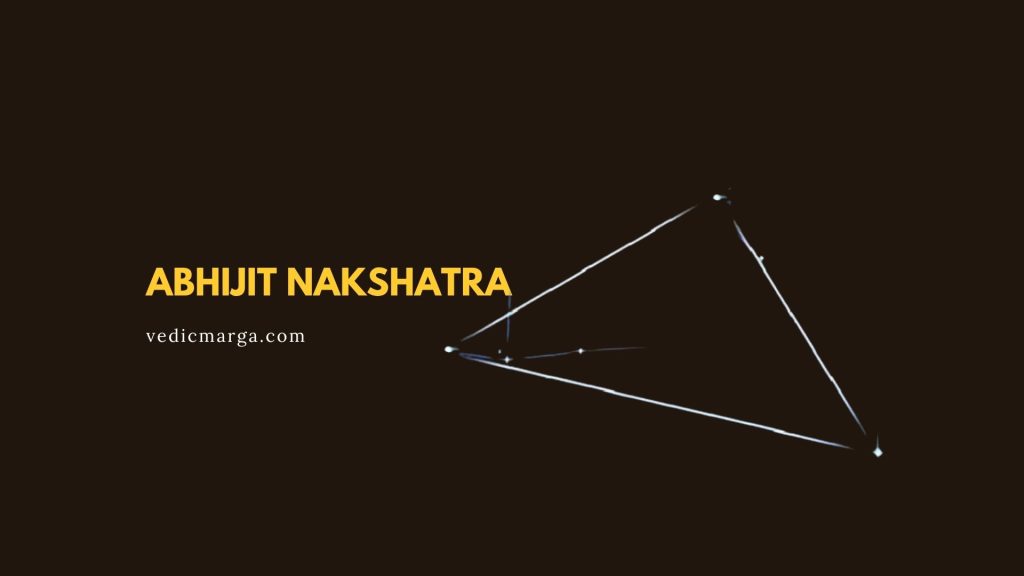
Modern identification links Abhijit with Vega, the bright star of Lyra. In the Vedic zodiacal framework, it is placed from 6°40′ to 10°53′20″ Capricorn, spanning the end of Uttara Ashadha and the beginning of Shravana.
Its small span explains why it does not function like the main twenty-seven nakshatras in ordinary chart work. Even so, tradition never treats it as insignificant. Its role remains distinct, compact, and powerful.
Traditional attributes
In mythic accounts, the twenty-seven standard nakshatras are linked with the daughters of Daksha, while Abhijit is remembered separately. Later astrology describes its nature as active, assertive, and directed toward achievement.
In practice, Abhijit is not usually used in the same way as the regular twenty-seven nakshatras for dasha or routine compatibility work. Its presence is more selective. It appears where tradition wants to mark victory, distinction, or divine sanction.
Abhijit Muhurta
The most practical use of Abhijit in astrology is Abhijit Muhurta, the daily period centered on local solar noon. It is commonly described as lasting about forty-eight minutes and is widely treated as an auspicious time for important undertakings.
Because of that status, astrologers often treat it as a dependable choice when stronger muhurta options are not available. The idea follows the older meaning of the nakshatra itself. What begins under Abhijit is believed to carry the force of success.
To check the Abhijit Muhurta for today or any chosen date, you can use the Cosmic Clock, which shows Abhijit Muhurta along with Hora, Rahu Kaal, Yamaganda, and Gulika based on location.
Closing
Abhijit occupies a rare place in Vedic thought. It is small in span, outside the ordinary count, and still too important to ignore. Vedic texts remember it as a star of victory, later tradition preserves it as a sign of divine favor, and practical astrology keeps its influence alive through Abhijit Muhurta.


