


Nirriti is the Vedic deity of Mula Nakshatra, which spans 0° to 13°20' Sagittarius and is ruled by Ketu. In the Veda she is the goddess of decay and dissolution, the power that breaks things down. Vedic hymns ask her to go far away, and later texts make Nirriti the guardian of the south-west.
Nirriti is one of the few nakshatra deities whom the Veda honours so that she will leave. Her verse for Mula names her and asks her to turn away. This verse shows the Vedic way of meeting loss and endings with respect.
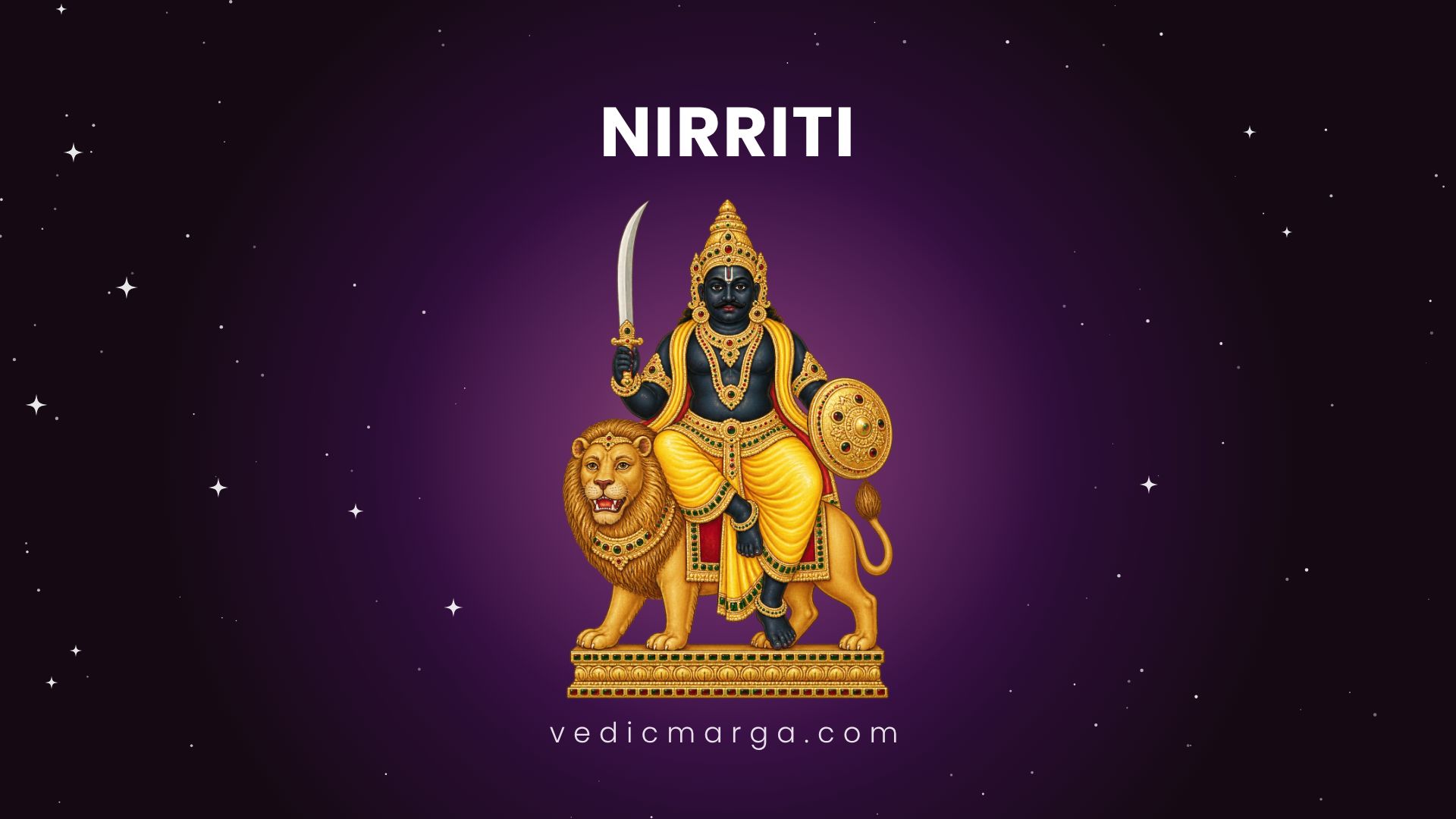
| Nirriti | Key facts |
|---|---|
| Meaning of the name | Decay, dissolution, the absence of order |
| Nakshatra | Mula (0° to 13°20' Sagittarius) |
| Nakshatra ruler | Ketu |
| Form in the Veda | A goddess |
| Form in later texts | A male guardian of the south-west, and a Rudra in the Mahabharata |
| Direction | South-west, called Nairritya after her |
| Vedic verse | Rig Veda 10.59.1-4, "let Nirriti depart far away" |
In this article
What Does the Name Nirriti Mean?
The name Nirriti is usually explained as nir, "away" or "without," joined with rita, the right order of the world. Read together, the name means the state that lies outside that order. It is usually translated as decay, dissolution or destruction.
Nirriti is the force that lets things fall apart. In the Veda this covers old age, loss, illness and death. Griffith's translation of Rig Veda 10.165 renders her name simply as "Destruction."
Nirriti in the Rig Veda
The Rig Veda names Nirriti in many verses, and almost always asks for protection from her. She has no hymn of praise of her own. The clearest example is Rig Veda 10.59.
Its first 4 verses ask for long life, wealth, victory and a kind old age. Each verse ends with the same line:
परातरं सु निरृतिर्जिहीताम्
parātaraṃ su nirṛtir jihītām
Let Nirriti depart to distant places. (Rig Veda 10.59.1-4)
Rig Veda 10.165 shows how people read her signs. A dove has landed near the household fire, and the hymn calls it the messenger sent by Nirriti. The family sings verses of atonement and asks that the dove bring no harm to people or animals.
| Text | Reference | What it says |
|---|---|---|
| Rig Veda | 10.59.1-4 | Asks Nirriti to depart far away, in a refrain |
| Rig Veda | 10.165.1 | Calls a dove at the fire the messenger of Nirriti |
| Atharva Veda | 6.63.1-2 | Asks Nirriti to loosen the iron fetters she has bound |
| Shatapatha Brahmana | 5.2.3.2-4 | Gives her a portion in the south, at a natural cleft in the earth |
| Mahabharata | Adi Parva 1.60 | Names Nirriti among the 11 Rudras, the sons of Sthanu |
| Bhagavata Purana | 4.8.2 | Calls Nirriti childless, taking in Dambha and Maya, the children of Adharma |
How Did the Vedic Ritual Treat Nirriti?
The Vedic ritual gave Nirriti her own share and then sent her away. The Shatapatha Brahmana (5.2.3.2-4) describes this during the royal consecration. The priest takes fire from the southern altar, walks south, and finds a natural hollow or cleft in the ground.
He offers the loose grain there with the words of Vajasaneyi Samhita 9.35: "This, O Nirriti, is thy portion: accept it graciously, hail!" The Brahmana explains that Nirriti is the earth in its aspect of decay. Once she is given her portion, she does not seize the person being consecrated.
The Atharva Veda speaks of her fetters. In hymn 6.63, the priest addresses the goddess Nirriti and asks her to loosen the iron collar and fetters she has fastened. The aim is long life for the person being freed.
The pattern is the same in every text. Nirriti is named, given her due with respect and asked to leave. Nothing in the ritual tries to fight her.
Is Nirriti a Goddess or a God?
In the Veda, Nirriti is a goddess. The Atharva Veda calls her "Nirriti the Goddess," and the ritual texts treat her as female.
Later texts often present Nirriti as male. The Mahabharata (Adi Parva 1.60) names Nirriti among the 11 Rudras, the sons of Sthanu, next to Ajaikapad and Ahirbudhnya. As a guardian of the directions, Nirriti is also usually shown as male.
The Puranas add family stories. The Bhagavata Purana (4.8.2) says Nirriti had no children and took in Dambha (pride) and Maya (deceit), the children of Adharma. Some later traditions link Nirriti with Alakshmi or Jyeshtha, the goddess of misfortune.
Nirriti, Guardian of the South-West
In the Puranas and the temple texts, Nirriti is one of the 8 guardians of the directions, the dikpalas. Nirriti guards the south-west. The Sanskrit name for this corner, Nairritya, comes from Nirriti, and Vastu uses the same name.
| Direction | Guardian |
|---|---|
| East | Indra |
| South-east | Agni |
| South | Yama |
| South-west | Nirriti |
| West | Varuna |
| North-west | Vayu |
| North | Kubera |
| North-east | Ishana |
T. A. Gopinatha Rao's study of Hindu iconography records how the Agamas show Nirriti. The figure is dark, large in body and dressed in yellow, riding a man or a lion.
Nirriti and Mula Nakshatra
Mula means "root." Its symbol is a bunch of tied roots, and its ruler is Ketu. With Nirriti as its deity, Mula is the nakshatra of going down to the root and pulling up what no longer belongs.
People with the Moon in Mula often question everything until they reach the base of it. Many go through periods when careers, homes or beliefs fall away. These endings clear the ground for a truth they can stand on. You can find your own birth nakshatra with the nakshatra calculator.
Nirriti's lesson for Mula is the one the Veda teaches. Loss is given its due, honestly and calmly, and then let go. Met this way, the Mula nature becomes a strong gift for research, healing and spiritual practice.
Families sometimes worry about a child born in Mula and arrange a Mula Shanti puja. Such rites follow the same Vedic approach of honouring the deity and asking for protection. The rest of the chart decides far more than the birth nakshatra alone.
Nirriti Mantra
The most authentic mantra for Nirriti is the Mula verse of the Nakshatra Suktam in the Taittiriya Brahmana (3.1). It names Nirriti and asks her to turn away:
मूलं प्रजां वीरवतीं विदेय ।
पराच्येतु निरृतिः पराचा ।
गोभिर्नक्षत्रं पशुभिः समक्तम् ।
अहर्भूयाद्यजमानाय मह्यम् ।
अहर्नो अद्य सुविते दधातु ।
मूलं नक्षत्रमिति यद्वदन्ति ।
पराचीं वाचा निरृतिं नुदामि ।
शिवं प्रजायै शिवमस्तु मह्यम् ॥Mulam prajam viravatim videya |
parachyetu Nirritih paracha |
gobhirnakshatram pashubhih samaktam |
aharbhuyadyajamanaya mahyam |
aharno adya suvite dadhatu |
Mulam nakshatramiti yadvadanti |
parachim vacha Nirritim nudami |
shivam prajayai shivamastu mahyam ||
Meaning: Through Mula may I gain children with brave sons. May Nirriti turn away and go far. May the nakshatra be rich with cattle and animals. May the day be good for me, the one who offers.
May this day place us in well-being. They call it the nakshatra Mula. With my words I push Nirriti away. May it be good for my children, and good for me.
Some lists give Prajapati as the deity of Mula. The verses for all 27 nakshatras are on our page of nakshatra mantras. Learn the accents from a teacher or a recording before you recite it.
Name Mantra
The salutation used for Nirriti in the worship of the 8 guardians is:
ॐ निरृतये नमः
Om Nirritaye Namaḥ
It means "Om, salutation to Nirriti." We could not find a separate name mantra for Nirriti as the deity of Mula in a classical text.
How to Worship Nirriti
The Vedic way with Nirriti is to give her portion with respect and ask her to depart. Reciting the Mula verse on the days the Moon passes through Mula follows this pattern. This happens about once every 27 days.
The refrain of Rig Veda 10.59, "let Nirriti depart to distant places," can be recited in the same spirit. Recite it calmly, as a request, with no fear in the mind.
All of this works on the mind. Each month, choose one thing that has run its course, such as an old habit or a grudge, and let it go. This is the practice closest to Nirriti, since it meets decay before it builds up.
For a reading of your own Moon nakshatra and running dasha, you can book a Vedic astrology consultation.
Frequently Asked Questions
Who is the deity of Mula Nakshatra?
Nirriti, the Vedic goddess of decay and dissolution, is the deity of Mula. The Nakshatra Suktam verse for Mula names her and asks her to depart.
Is Nirriti a goddess?
Yes, in the Veda Nirriti is a goddess. Later texts often show Nirriti as male, as a Rudra in the Mahabharata and as the guardian of the south-west.
Which direction does Nirriti rule?
Nirriti rules the south-west. The Sanskrit name for this direction, Nairritya, comes from Nirriti.
Is Nirriti the same as Kali or Alakshmi?
Some later traditions link Nirriti with Alakshmi or Jyeshtha, and some astrologers connect Mula with Kali. The Vedic texts present Nirriti as a deity in her own right.
What is the mantra of Nirriti?
The Vedic mantra is the Mula verse of the Nakshatra Suktam, which asks Nirriti to turn away. The name salutation used in the worship of the 8 guardians is Om Nirritaye Namah.
Is Mula Nakshatra bad because of Nirriti?
No. Nirriti gives Mula its power to reach the root and remove what does not belong. The full chart and the running dasha decide how this works for a person.
Summary
Nirriti is the deity of Mula Nakshatra and the Vedic power of decay and dissolution. The Rig Veda asks her to depart far away, and the Shatapatha Brahmana gives her a portion in the south before sending her off. In the Veda she is a goddess, and later texts make Nirriti a Rudra and the guardian of the south-west.
For Mula, Nirriti teaches the work of letting go at the root. Recite the Mula verse on the Mula star day, and release one thing each month that has run its course.


