


In Vedic astrology, every rashi has a lord. When two planets occupy each other's rashis, they form Parivartana Yoga, commonly called Exchange Yoga. Phaladeepika of Mantreswara classifies the results of this exchange in Chapter 6 under three names: Maha Yoga, Khala Yoga, and Dainya Yoga.
This article explains the logic of the exchange and the full set of possible combinations. It then covers the specific exchanges that classical texts single out for wealth.
In this article
What Parivartana Yoga Means
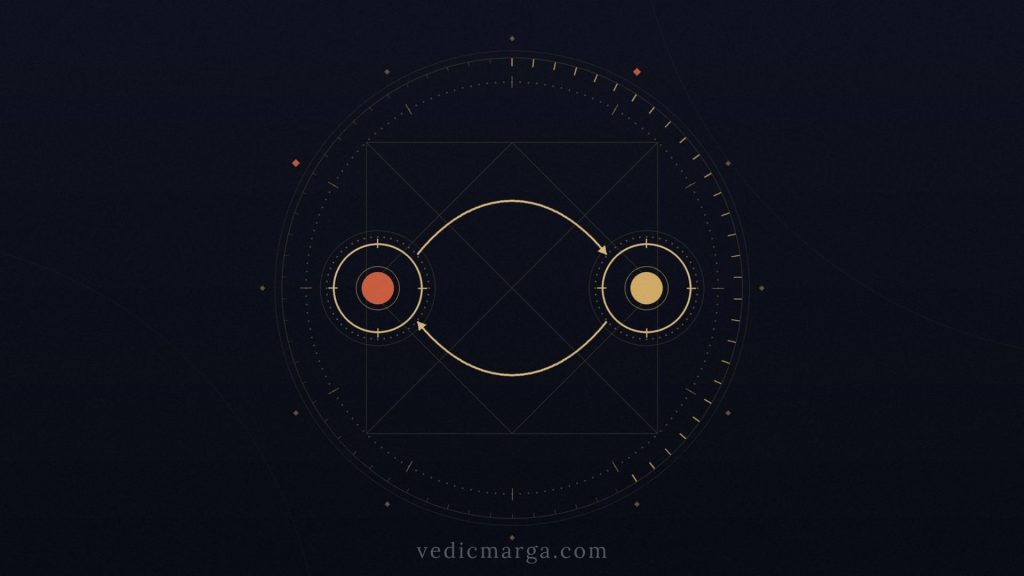
Suppose Mars occupies Cancer, the rashi of the Moon. Suppose the Moon occupies Aries, the rashi of Mars. Each planet now sits in the home of the other. This mutual placement creates a permanent two-way link between them.
Each planet treats the other's house as its own responsibility. The matters of both houses begin to support each other. This support continues for the whole life of the chart.
The exchange also softens the problem of placement in an unfriendly rashi. Mars and the Moon may carry natural friction in other contexts. Once the exchange forms, each planet protects the rashi it occupies, because its own rashi rests in the care of the other planet. The two house lords work like partners who hold the keys to each other's homes.
The Limits of the Yoga
Honest analysis requires one caution here. The exchange improves cooperation between the two planets. It does not erase every weakness. A debilitated, combust, or heavily afflicted planet still carries that condition into the exchange.
The yoga raises the working capacity of both planets. The astrologer must still weigh dignity, combustion, aspects, and house strength before predicting the size of the result.
A Parivartana between two well-placed planets gives full results. A Parivartana involving a damaged planet gives partial results. The damaged side of the exchange shows where effort and remedy are needed.
The Sixty-Six Possible Exchanges
A birth chart has twelve houses. An exchange always joins the lords of two different houses. Selecting two houses from twelve gives sixty-six possible pairs.
This figure of sixty-six is a logical derivation from the twelve-house framework. The classical contribution of Phaladeepika lies in sorting these pairs into three groups according to the houses involved.
Twenty-eight pairs form Maha Yoga. These arise when the lords of the eight favorable houses exchange among themselves. The favorable houses are the 1st, 2nd, 4th, 5th, 7th, 9th, 10th, and 11th.
Eight pairs form Khala Yoga, where the 3rd lord exchanges with one of those eight favorable lords. Thirty pairs form Dainya Yoga, where the lord of the 6th, 8th, or 12th house takes part. Together, 28 + 8 + 30 = 66, and every possible exchange falls into exactly one group.
Maha Yoga: The Twenty-Eight Auspicious Exchanges
Phaladeepika gives a generous collective description for the person born with any one of these twenty-eight exchanges. The text calls such a native a repository of the blessings of Goddess Lakshmi. The native commands wealth, wears fine clothes and gold ornaments, and receives honors and authority from the ruler of the land. Vehicles, comforts, children, and family happiness complete the picture.
The houses involved then refine this general promise. An exchange between the 1st and 7th lords raises influence through the spouse and through partnerships. An exchange between the lords of the 4th house and the 10th house joins property and profession, giving career stability and gains through land. An exchange between the 5th and 9th lords joins intelligence with merit from past lives, giving wisdom and a virtuous direction.
Reading the two houses together always reveals the exact field where the blessing will appear.
List of the 28 Maha Yoga Types
- 1st Lord in 2nd; 2nd Lord in 1st (Self-earned wealth and family status)
- 1st Lord in 4th; 4th Lord in 1st (Happiness from mother, property, and lands)
- 1st Lord in 5th; 5th Lord in 1st (Great intelligence and success through children)
- 1st Lord in 7th; 7th Lord in 1st (Gain and influence through the spouse or partners)
- 1st Lord in 9th; 9th Lord in 1st (Extraordinary luck and religious merit)
- 1st Lord in 10th; 10th Lord in 1st (Fame, leadership, and high career status)
- 1st Lord in 11th; 11th Lord in 1st (Easy gains and fulfillment of all desires)
- 2nd Lord in 4th; 4th Lord in 2nd (Wealth through property and fixed assets)
- 2nd Lord in 5th; 5th Lord in 2nd (Wealth through intelligence or speculation)
- 2nd Lord in 7th; 7th Lord in 2nd (Financial benefit from the spouse's family)
- 2nd Lord in 9th; 9th Lord in 2nd (Wealth through divine grace or elders)
- 2nd Lord in 10th; 10th Lord in 2nd (Prosperous career and royal favors)
- 2nd Lord in 11th; 11th Lord in 2nd (Supreme financial success and multiple income streams)
- 4th Lord in 5th; 5th Lord in 4th (Comforts, education, and happy progeny)
- 4th Lord in 7th; 7th Lord in 4th (Happiness through foreign travel or partnership)
- 4th Lord in 9th; 9th Lord in 4th (Virtuous life and ancestral property)
- 4th Lord in 10th; 10th Lord in 4th (Stability in profession and high status)
- 4th Lord in 11th; 11th Lord in 4th (Gains through trade, land, or vehicles)
- 5th Lord in 7th; 7th Lord in 5th (Blessed with intelligent children and a capable spouse)
- 5th Lord in 9th; 9th Lord in 5th (Highest intelligence, wisdom, and merit from past lives)
- 5th Lord in 10th; 10th Lord in 5th (Fame through one's own creative or intellectual work)
- 5th Lord in 11th; 11th Lord in 5th (Success in all ambitions and many friends)
- 7th Lord in 9th; 9th Lord in 7th (Fortune that rises specifically after marriage)
- 7th Lord in 10th; 10th Lord in 7th (Fame and professional standing through social ties)
- 7th Lord in 11th; 11th Lord in 7th (Financial prosperity and gains from partners)
- 9th Lord in 10th; 10th Lord in 9th (Great leadership, authority, and king-like life)
- 9th Lord in 11th; 11th Lord in 9th (Always successful and highly opulent)
- 10th Lord in 11th; 11th Lord in 10th (Extremely prosperous career with honors)
Khala Yoga: The Eight Exchanges of Fluctuation
Khala means wicked or unsteady. When the 3rd lord exchanges with a favorable house lord, the result alternates. The native sees periods of confidence, gain, and bold success. Periods of doubt and reduced fortune follow, and then the cycle turns upward again.
The 3rd house governs self-effort and raw courage. The favorable house tied to it begins to depend on continuous personal push. The practical lesson is consistency, because sustained discipline through the low phases keeps the high phases productive.
Dainya Yoga: The Thirty Exchanges of Struggle
Dainya means miserable. When the lord of the 6th, 8th, or 12th house enters an exchange, the affected house absorbs dusthana themes. The 6th lord brings debt, disputes, and opposition. The 8th lord brings sudden interruptions and hidden obstacles, and the 12th lord brings expenditure, separation, and loss of comfort.
A Dainya Yoga does not close the door on success. It delays the result and demands repayment of karmic debt first. The native succeeds in the affected area after repeated effort and after facing opposition. An early failure often teaches the required lesson, and remedial discipline, service, and patience convert these exchanges into late-blooming strength.
The Exception Within Dainya: Vipareeta Raja Yoga
Among the thirty Dainya combinations, three pairs join the dusthana lords with each other. These are the 6th with the 8th, the 6th with the 12th, and the 8th with the 12th. Tradition treats these three as a special case.
When the lords of two dusthanas exchange, each negative house absorbs the other, and the harm cancels. The principle connects to the Vipareeta Raja Yogas described by Kalidasa in the Uttara Kalamrita. There, the placement of dusthana lords in dusthanas raises the native suddenly. A native with this mutual exchange often rises amid a crisis, the fall of a rival, or an abrupt structural change.
The Exchanges That Give Wealth
All twenty-eight Maha Yogas grant prosperity. Classical authorities still single out a few exchanges for exceptional financial results.
The exchange between the 2nd and 11th lords stands first. The 2nd house holds accumulated wealth and the 11th house holds gains. Their exchange forms a closed circuit in which income converts into savings and savings expand the capacity for further gain. The texts add a timing detail: the wealth from this exchange grows further after marriage.
The exchange between the 9th and 10th lords forms Dharmakarmadhipati Yoga, one of the most respected Raja Yogas. Fortune joins the profession, and the native gains rank, fame, and authority comparable to royalty. This yoga carries enough structural strength to outweigh several minor afflictions elsewhere in the chart.
The exchange between the 2nd and 9th lords forms Khadga Yoga, named after the sword. The native receives wealth, fortune, happiness, and a sharp intellect that recognizes opportunity early.
The exchange between the 1st and 2nd lords gives Ayatna Dhana Labha, wealth gained without great effort. The native's own identity and presence attract resources. Money arrives through natural circumstances in place of constant chasing.
The exchange between the 1st and 5th lords works as a royal exchange. It gives a high position, recognition for intelligence and creativity, and a comfortable life.
The exchange between the 5th and 11th lords turns intelligence into income. The native earns through strategy, careful speculation, and the support of an effective network. The earnings remain steady when the planets involved are strong.
When the Yoga Gives Its Results
The presence of an exchange in the chart establishes the promise. The delivery of that promise follows the timing of the dashas. The yoga activates fully during the Mahadasha or Antardasha of either planet in the exchange.
Significant transits over those planets, or over the connected houses, act as further triggers. Two natives may hold the same Parivartana on paper. The one whose dasha sequence brings the exchanging planets into operation early will see the results early. Checking the dasha order alongside the yoga turns this knowledge into a practical planning tool.
Summary
Parivartana Yoga forms when two planets occupy each other's rashis, creating a lifelong two-way link between the houses they rule. A chart allows sixty-six such exchanges. Phaladeepika sorts them into twenty-eight Maha Yogas, eight Khala Yogas, and thirty Dainya Yogas. The mutual exchange of dusthana lords stands apart as a sudden-rise exception linked to Vipareeta Raja Yoga.
Six exchanges carry the strongest promise of wealth and status. These pairs are the 2nd with 11th, 9th with 10th, 2nd with 9th, 1st with 2nd, 1st with 5th, and 5th with 11th. The dignity of the planets shapes the size of the result, and the dashas decide its timing. A careful reading of the exchange, the strength, and the timing gives a clear picture of how this yoga will work in any life.
Your chart may already hold one of these sixty-six exchanges. A personal reading confirms the yoga, measures its strength, and times its results. Book a Vedic astrology consultation with Vedic Marga for a detailed study of your chart.


