


Every year, on your birthday, a new astrological chart can be cast based on the exact moment the Sun returns to its original position at birth. This is called the Varshaphala or annual horoscope, a specialized method in Vedic astrology for predicting events and themes for the coming year.
One of the most important—but lesser-known—tools in this system is Muntha, a calculated point that moves one sign forward each year from your birth ascendant. In Tajika astrology (the system used for Varshaphala), Muntha acts like a spotlight, showing where your energy, focus, and potential gains or struggles will be concentrated for that year.
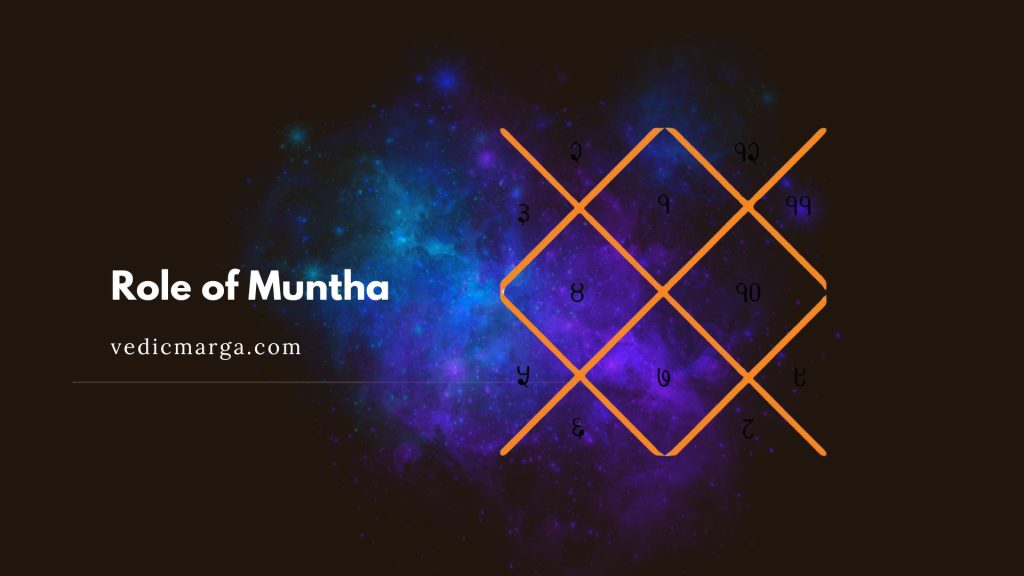
In this guide, we’ll explain what Muntha is, how to find it, and how to interpret it using house placement, planetary aspects, and the condition of its ruling planet. This helps predict everything from health and career progress to setbacks, relocations, and reputation shifts.
In this article
What Is Muntha?
Once Muntha is located in the annual chart, its interpretation follows a structured set of rules.
Muntha is not a physical planet but a mathematically derived point—calculated by advancing the natal Lagna by one sign per completed year. In the Tajika system, it acts as a progressed Lagna, highlighting the area of life most activated by past karma in the solar year.
Formula: Muntha = Natal Lagna + Age (in signs)
This point serves as the year’s karmic focal point. While the annual chart (Varsha Kundali) describes the outer circumstances of the year, Muntha reveals the karmic pressure and focus driving those experiences.
How to Interpret Muntha in the Annual Chart
Each step builds a layer of interpretation:
House Position of Muntha
- Kendras (1st, 4th, 7th, 10th): Active years with opportunities and exposure.
- Trikonas (5th, 9th): Favorable for creativity, learning, or fortune.
- Dusthanas (6th, 8th, 12th): Challenges, health concerns, spiritual lessons.
Sign Occupied by Muntha
The Rashi (sign) where Muntha falls adds an emotional and elemental tone to the year’s focus:
- Fire: boldness, risk, competition.
- Earth: structure, finance, practical gains.
- Air: communication, contracts, movement.
- Water: emotions, intuition, hidden processes.
Muntha-Lord’s Strength and Placement
- Exalted or in own sign: Supports progress.
- In Dusthanas or combust: Brings strain, delay.
- In Kendra/Trikona: Helps realization of yearly goals.
Planetary Aspects to Muntha
- Benefics like Jupiter or Venus aspecting Muntha can ease matters.
- Malefics like Saturn or Mars may obstruct or slow progress.
- Tajika aspects are determined by angular relationships between planets (e.g., sextile, trine, square) based on degrees—not rashi-based drishti as in Parashari.
Muntha Through the 12 Houses
Each house reveals where life energy concentrates during the year. Here’s a quick reference:
- 1st House: Self-reinvention, new beginnings, personal prominence. If afflicted, health concerns.
- 2nd House: Family focus, financial activity, speech. Affliction may cause disputes or overspending.
- 3rd House: Communication, courage, skill development. Sibling interactions become important.
- 4th House: Home, property, mother, inner peace. Malefic influence may bring restlessness.
- 5th House: Children, creativity, education, investments. Good for expression, planning.
- 6th House: Debts, diseases, competition. Avoid overexertion and take preventive health steps.
- 7th House: Partnerships, marriage, public life. Positive for alliances; troubled if afflicted.
- 8th House: Instability, transformation, legacy. Handle hidden matters with care.
- 9th House: Travel, luck, dharma, mentorship. Excellent for learning and expansion.
- 10th House: Career, status, profession. A year of action, recognition, or change.
- 11th House: Gains, networks, long-term goals. Fulfillment likely, especially if well-supported.
- 12th House: Expenses, isolation, spiritual growth. May bring retreats or travel.
Muntha’s Lord — The Secret Behind the Curtain
The Muntha-lord is the planet ruling the sign where Muntha is placed in the annual chart. It influences how Muntha’s promise is delivered—smoothly, with struggle, or unexpectedly.
Dignity and Strength
- Strong (exalted, own sign): Supports smooth unfolding of Muntha’s house matters.
- Weak (combust, retrograde, debilitated): Challenges in the areas Muntha points to.
Planetary Nature
- Sun: Leadership, ego, authority.
- Moon: Emotions, public life, mobility.
- Mars: Drive, disputes, action.
- Mercury: Intellect, trade, travel.
- Jupiter: Wisdom, expansion.
- Venus: Love, comforts, finance.
- Saturn: Duty, delay, maturity.
Aspects and Tajika Yogas
- Ithasala (applying): Supports fruition.
- Isarpha (separating): Denotes missed opportunity.
House Placement of Muntha-Lord
Where the Muntha-lord sits is where the results unfold:
- 1st House: Self-reinvention, new image, physical vitality.
- 2nd House: Focus on wealth, speech, or family matters.
- 3rd House: Travel, communication, short projects.
- 4th House: Home, domestic life, property matters.
- 5th House: Education, children, speculative gains.
- 6th House: Conflicts, work stress, health vigilance.
- 7th House: Marriage, public interactions, partnerships.
- 8th House: Sudden changes, secrets, inner growth.
- 9th House: Travel, teaching, dharma, father figures.
- 10th House: Year focuses on career rise.
- 11th House: Gains, social circles, aspirations.
- 12th House: Expenditure, seclusion, spiritual retreats.
The condition of the Muntha-lord becomes a decisive influence. Even a well-placed Muntha may underperform if its lord is weak or afflicted. Retrograde or combust Muntha-lord often distorts the delivery of results—either delaying them or reversing expected outcomes.
Key Takeaways
- Muntha shows where life energy is likely to be focused in the year.
- Its house placement sets the stage, the Muntha-lord governs outcomes, and planetary aspects refine timing.
- A strong Muntha-lord strengthens prediction reliability.


