


Pitra Dosha, also written Pitru Dosha or Pitra Dosh, is a pattern in the birth chart linked to ancestral karma. It is read from the Sun, the 9th house, its lord and the nodes Rahu and Ketu.
Many families speak of it with worry, often after a priest or an older relative mentions it during a difficult year. The chart shows something more useful: where a duty to the family line is still open, and how to complete it. The sections below show how to find Pitra Dosh in a kundali, what it tends to bring and which remedies the tradition gives.
To check your own chart in a few seconds, use the Pitra Dosha calculator.
In this article
What Pitra Dosha Means
The Vedic tradition speaks of 3 debts that every person is born with: to the gods, to the sages and to the ancestors. The debt to the ancestors is Pitru Rina. It is repaid through remembrance, offerings and a life that carries the family's good qualities forward into the next generation.
Pitra Dosha shows where this debt weighs more in a chart. Brihat Parashara Hora Shastra describes Pitru Shapa, the curse of the father, among the causes of trouble with children. The Pitra Dosha rules in wide use today build on this idea and read it mainly from the Sun and the 9th house.
The chart is a mirror of your own nature. Pitra Dosha reflects your relationship with your lineage: what you inherited, what remains unresolved and what you are here to settle. The work it points to is yours, and it begins inside.
How to Find Pitra Dosh in Kundali
The Sun is the karaka of the father and the soul. The 9th house is the house of the father, fortune and the family line. Pitra Dosha forms when these 2 come under strong affliction, mostly from Rahu, Ketu and Saturn.
Check your chart for these 5 factors:
| Factor | What to check | What it points to |
|---|---|---|
| 1. Sun with Rahu or Ketu | The Sun shares a sign with a node | The father's line and the self under shadow |
| 2. Rahu or Ketu in the 9th house | A node occupies the 9th from the Lagna | Unsettled matters of dharma and ancestry |
| 3. A natural malefic in the 9th house | Mars or Saturn occupies the 9th | Friction in the house of the father |
| 4. The 9th lord afflicted | The 9th lord sits in the 6th, 8th or 12th house | Fortune and family support that come late |
| 5. A luminary with Saturn and Rahu | The Sun or the Moon shares a sign with both | A heavier ancestral pattern |
One factor alone gives a mild indication. 2 or more together make the pattern clearer, and each added factor raises its weight.
Other Combinations Some Astrologers Add
Some traditions widen the list. They count the Sun and Saturn together or in mutual aspect, and the 9th lord with Rahu or Ketu. An afflicted 5th house, which holds children and past merit, is also counted. The Moon with Rahu is sometimes read as a debt on the mother's side.
These additions vary from school to school. The 5 factors above are the ones most astrologers agree on.
A Worked Example
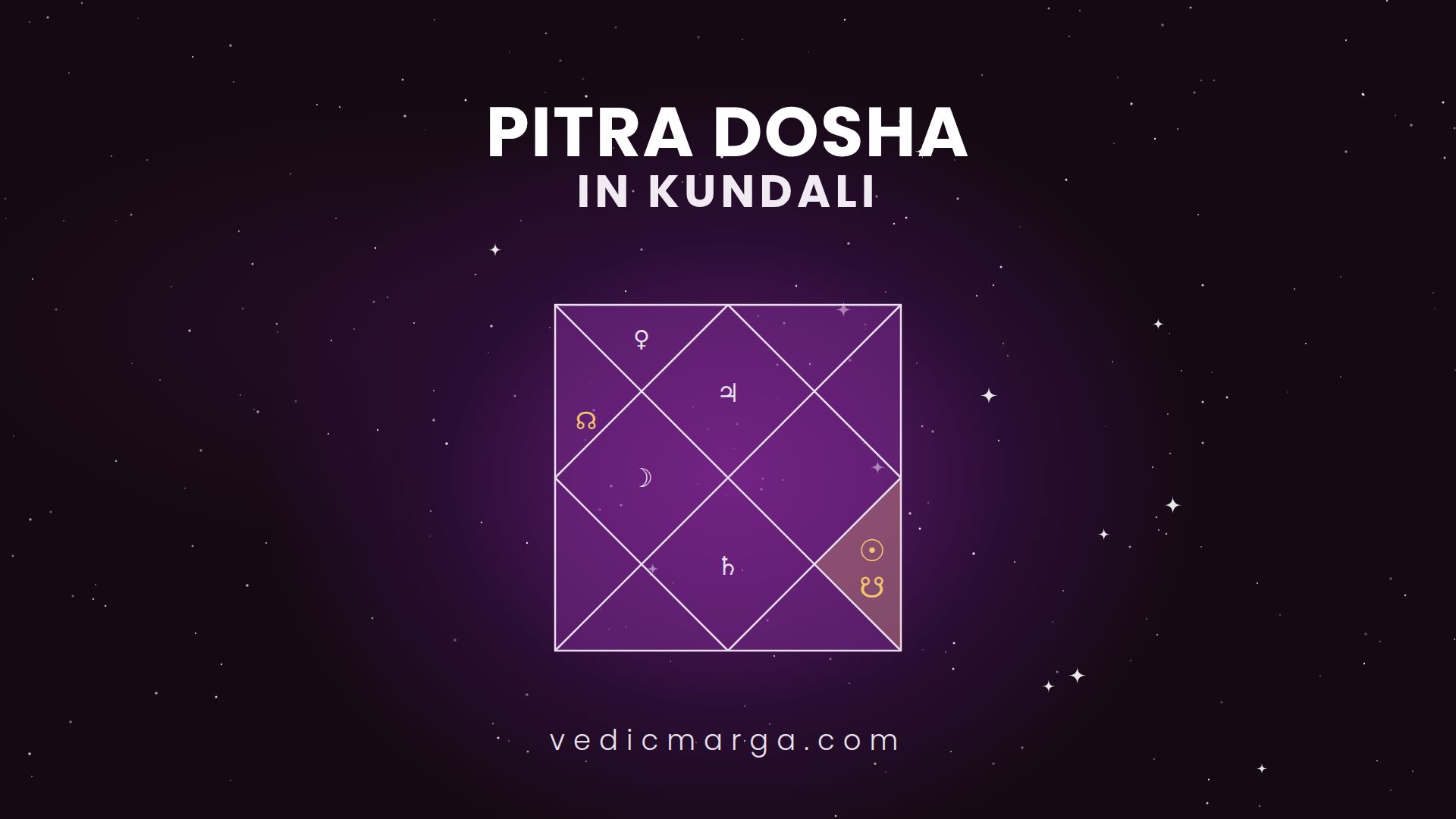
Take a Sagittarius Lagna. The 9th house is Leo, so the Sun is the 9th lord. Say the Sun sits with Ketu in Capricorn, the 2nd house, which meets factor 1.
Say Saturn occupies Leo, the 9th house. That meets factor 3. The Sun sits in the 2nd, outside the dusthanas, and no node occupies the 9th. Neither luminary sits with both Saturn and Rahu, so factors 2, 4 and 5 are absent.
The chart shows 2 of the 5 factors, a moderate Pitra Dosha. The next step is to check what softens it, and which dasha brings it forward.
Reading the 5 Factors
Each factor describes a different part of the ancestral pattern. Reading which ones are present tells you where the work lies.
The Sun with a node is the most discussed factor. Rahu with the Sun tends to show ambition or confusion around authority and the father. Ketu with the Sun tends to show distance from the father, or a sense that recognition is hard to hold.
A node in the 9th house turns the question toward belief and tradition. Rahu here often breaks from family customs, and Ketu here often carries inherited faith without feeling at home in it.
Mars or Saturn in the 9th brings friction into the house of the father. Mars tends to bring argument. Saturn tends to bring duty, distance or a father who carried heavy loads for the whole family.
An afflicted 9th lord delays fortune and family support. Its house shows where the delay is felt, which the article on the 9th lord in the 12 houses explains. A luminary with both Saturn and Rahu is the heaviest factor. It presses on the Sun or the Moon from 2 sides at once.
What Makes Pitra Dosha Stronger or Milder
The same factor weighs differently from chart to chart, because the rest of the chart supports or burdens the Sun and 9th house. These conditions soften it:
- Jupiter's aspect on the Sun, the 9th house or the 9th lord
- A strong 9th lord, in its own sign, exaltation or a kendra
- A dignified Sun, in Leo or Aries
- Benefics in the 9th beside the malefic
These conditions make it heavier: a debilitated Sun in Libra, the 9th lord combust or debilitated, and several malefics aspecting the 9th together. A well-placed Jupiter is the single strongest protection, since it rules dharma and blessing.
Effects of Pitra Dosha
Pitra Dosha tends to show in the areas the Sun and the 9th house rule. The effects below are tendencies, and their strength follows the chart as a whole.
- Delayed fortune: effort takes longer to bring results, and help arrives late.
- The father and elders: distance, strain or unfinished matters with the father or senior family members.
- Children: delays or worries around children, especially when the 5th house is also afflicted.
- Family patterns: the same difficulty repeating across generations, such as disputes over property.
- Faith and direction: doubt about one's path, or a gap between inherited values and one's own.
Many people with Pitra Dosha live full and successful lives. The pattern asks for attention in certain areas, and the chart's strengths still give their results.
Pitra Dosha and Grahan Dosha
The Sun with Rahu or Ketu is also called Grahan Dosha, the eclipse combination. The same placement appears in both names because the eclipsed Sun is read for the father and the self.
When you see both terms for one chart, they usually point to the same conjunction. Read it once.
When Pitra Dosha Becomes Active
A Pitra Dosha pattern comes forward in the dasha of a planet that forms it. The Mahadasha or Antardasha of the Sun, Rahu, Ketu, Saturn or the 9th lord is the usual window.
A running dasha shows when to give the remedies more time and attention, since the pattern is most visible in those years. The Vimshottari Dasha calculator shows which of these periods you are in now and which comes next.
Pitra Dosha Remedies
Every remedy for Pitra Dosha works on the mind. Remembrance, gratitude and service change how you hold your family's karma, and that change is what shifts the pattern. The rituals give this inner work a form and a time.
Rituals for the Ancestors
- Shraddha and Tarpana: offerings of water, sesame and food to the ancestors, above all during Pitru Paksha. This 16-day period falls in the dark fortnight before Navaratri, usually in September or October.
- Amavasya offerings: a simple Tarpana and food for the needy on each new Moon.
- Pind Daan: rice offerings for the departed, done at Gaya where possible.
- Narayan Bali and Tripindi Shraddha: longer rites some families perform for a strong pattern, with a priest who knows the tradition.
Daily Practice and Service
- Feed crows, cows and dogs in the name of your ancestors.
- Offer water to a peepal tree, and light a lamp there on Saturdays.
- Offer water to the rising Sun, or recite the Aditya Hridayam to strengthen the Sun.
- Recite the Pitru Stotra of Ruchi from the Markandeya Purana, especially on Amavasya.
- Care for your father and the elders of your family while they are alive, and keep their good name.
Choose a few remedies you can keep up with sincerity, week after week, and let them become part of your ordinary routine. A small practice kept with regularity is the heart of the remedy.
What to Do If Your Chart Shows Pitra Dosha
- Count the factors with the calculator, and write down which ones are present.
- Check what softens the pattern, especially Jupiter and the strength of the 9th lord.
- Find the dasha you are in, and see whether it belongs to a planet that forms the dosha.
- Pick 2 or 3 remedies and keep them steadily, with Pitru Paksha as the main yearly observance.
A strong pattern deserves a full reading of the chart and the running dasha. You can book a consultation to have it checked in detail.
Key Points on Pitra Dosha
Pitra Dosha reflects the debt to the ancestors. Its 5 main factors involve the Sun, the 9th house, the 9th lord and the nodes. Jupiter and a strong 9th lord soften it, and the dasha of its planets brings it forward. Remembrance, Shraddha and service to your elders are the remedies, and they work by changing how you carry your lineage.
Frequently asked questions
How do I know if I have Pitra Dosh in my kundali?
Look for the Sun with Rahu or Ketu, and for a node or a malefic in the 9th house. Then check the 9th lord's house, and whether the Sun or Moon sits with both Saturn and Rahu. The Pitra Dosha calculator checks all 5 from your birth details.
What are the effects of Pitra Dosha?
It tends to bring delays in fortune, strain with the father or elders, worries around children and repeating family patterns. The strength of these effects follows the rest of the chart.
Can Pitra Dosha be removed?
Its weight can be reduced with steady remedies. Regular Shraddha, Tarpana on Amavasya and during Pitru Paksha, and service to elders are the traditional ways to settle it.
Is Pitra Dosha the same as Grahan Dosha?
They overlap. The Sun with Rahu or Ketu is called Grahan Dosha, and the same conjunction is also the first factor of Pitra Dosha.
When should Pitra Dosha remedies be done?
Pitru Paksha is the main time each year, and every Amavasya is a monthly time. The dasha of the Sun, Rahu, Ketu, Saturn or the 9th lord is the period to give them extra attention.


