


A Rudraksha bead looks simple from the outside. Yet in Hindu tradition, it carries a story of divine compassion, spiritual practice, and cosmic symbolism that has shaped how seekers use it for meditation, mantra, and astrological balance.
The meaning of Rudraksha is deeply associated with Lord Shiva. According to the Shiva Purana, Rudraksha trees emerged from Shiva’s tears of compassion, and the beads are traditionally used with devotion, sincerity, and mantras.
In Jyotish, different Rudraksha mukhis, or faces, are also linked with specific deities and planetary energies.
In this article
The Sacred Origin of Rudraksha in the Shiva Purana

To understand the meaning of Rudraksha, begin with its most powerful origin story. The Shiva Purana describes Lord Shiva in profound meditation for many divine years. When he finally opened his eyes, tears of compassion fell to the earth. From those tears, Rudraksha trees arose.
This story explains why Rudraksha is not treated as an ordinary seed in spiritual traditions. It is seen as a living symbol of Shiva’s grace, compassion, and awakened consciousness. That is also why many devotees believe that using Rudraksha with sincerity brings them closer to Shiva.
The traditional meaning of the word reflects this connection. “Rudra” refers to Shiva, and “Aksha” is often understood as tears or eyes. Together, the term points to a sacred object born from divine sight and compassion.
That origin matters because it shapes how the bead is used. Rudraksha is not only worn as an ornament. It is approached as a spiritual tool, a support for sadhana, and a reminder of inner stillness.
And once you see it that way, the next question becomes obvious: what makes a seed spiritually transformative?
Seed of Transformative Energy
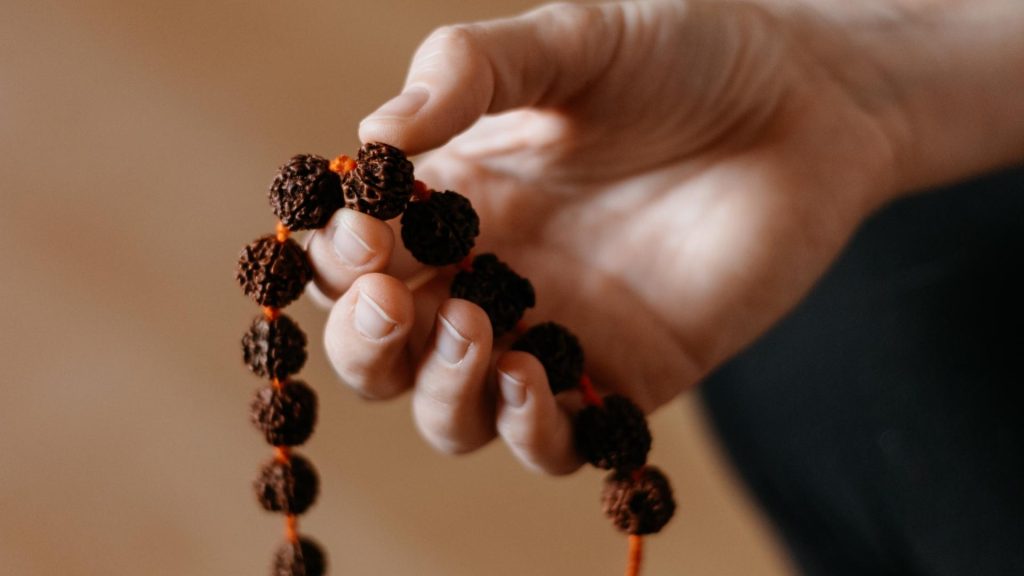
At a basic level, Rudraksha is a seed. But in spiritual practice, that simple fact carries deeper significance. A seed contains life energy in dormant form. When planted in the right conditions, that energy awakens and becomes a tree.
Rudraksha can be understood similarly. Traditionally, it is said to carry subtle energy. When used with devotion and spiritual discipline, that energy is believed to awaken and become transformative. The source content makes this point clearly: if a person has devotion and the Rudraksha used for sadhana is also awakened, it becomes transformative.
Devotion Activates the Energy
The key idea here is not blind belief. Devotion is built through practice. In Sanskrit thought, this is often linked to shraddha, but in simple terms, faith or devotion works well. You engage sincerely, observe your experience, and let understanding deepen over time.
Why “Awakened” Matters
In traditional spiritual language, an “awakened” Rudraksha is one that is not merely worn passively. It becomes part of mantra japa, meditation, and disciplined sadhana. The bead serves as a support, but the inner state of the practitioner matters just as much.
This leads naturally to the next layer of Rudraksha meaning: why mantras are considered essential to its effect.
Why Mantra Deepens the Effect
If Rudraksha is used with devotion or sincerity, it brings a person closer to Lord Shiva. If it is used with mantras, its effect increases further.
That idea is central in many spiritual traditions. A sacred object provides support, but a mantra gives it direction. Sound, repetition, and intention work together. Instead of wearing Rudraksha mechanically, the practitioner engages it through conscious spiritual effort.
How Mantra and Rudraksha Work Together
Mantras focus the mind. They also help build consistency in practice, which is often more powerful than intensity. A Rudraksha bead used during japa becomes part of a disciplined rhythm: touch, repetition, attention, breath.
For example, many seekers use a Rudraksha mala while repeating Shiva mantras during daily meditation. In that setting, the bead is not a charm. It becomes a tactile anchor that keeps the mind from scattering.
Practical Insight for Daily Sadhana
If you want to use Rudraksha traditionally, keep the approach simple:
- wear or hold it with respect
- Use it during mantra practice
- Stay consistent, rather than dramatic,
- let devotion and personal experience guide understanding
This is where faith becomes experiential. As practice deepens, trust grows. And from there, another dimension opens: the symbolic meanings of different mukhis.
Different Mukhi Rudraksha Beads
In the Shiva Purana, Rudraksha beads from one-faced to fourteen-faced are associated with different divine forms. This is one of the most important dimensions of Rudraksha, because it shows that not all beads are understood in the same way.
A one-faced Rudraksha represents Shiva. A nine-faced Rudraksha represents Durga and the Navashakti. A four-faced Rudraksha represents Brahma. A five-faced Rudraksha represents Kalagni Rudra.
These associations matter because they shape how practitioners choose and relate to a bead. The mukhi is not only a physical feature. It is a symbolic map of spiritual energy and deity connection.
Commonly Referenced Associations
Here are more of the traditional deity associations for Rudraksha beads, completing the standard 1 through 14 Mukhi list:
- 1 Mukhi — Lord Shiva Himself
- 2 Mukhi — Ardhanarishvara (the unified form of Shiva and Parvati)
- 3 Mukhi — Agni (the Fire God)
- 6 Mukhi — Kartikeya (Murugan)
- 7 Mukhi — Mahalakshmi
- 8 Mukhi — Ganesha
- 10 Mukhi — Vishnu (and his Dashavatara / ten avatars)
- 11 Mukhi — Ekadash Rudra (often closely associated with Lord Hanuman)
- 12 Mukhi — Surya (the Sun God)
- 13 Mukhi — Kamadeva and Lord Indra
- 14 Mukhi — Hanuman (also associated directly with Supreme Shiva)
Beyond 14, there are also associations for higher Mukhis, though they are rarer (for instance, 15 Mukhi is associated with Pashupatinath, and 21 Mukhi with Kubera).
Among these, the five-faced Rudraksha stands out. It is the most commonly used and is traditionally considered suitable for anyone to wear. That broad accessibility makes it the bead most people encounter first, especially in meditation and daily spiritual practice.
Once deity symbolism enters the picture, it is easy to see how Jyotish later connects Rudraksha with planetary energies as well.
Rudraksha and Planetary Link in Jyotish
From the Jyotish point of view, Rudraksha can also be used as an astrological remedy. The principle is straightforward: different mukhis are matched with different planetary energies, much like they are matched with divine forms.
This does not replace spiritual practice. Rather, it adds another interpretive layer to the Rudraksha meaning. A bead may be chosen not only for devotion to a deity, but also for its traditional relationship with a graha, or planet.
Planetary Associations (1–14 Mukhi)
| Mukhi (Faces) | Ruling Planet (Graha) |
| 1 Mukhi | Sun (Surya) |
| 2 Mukhi | Moon (Chandra) |
| 3 Mukhi | Mars (Mangal) |
| 4 Mukhi | Mercury (Budha) |
| 5 Mukhi | Jupiter (Brihaspati) |
| 6 Mukhi | Venus (Shukra) |
| 7 Mukhi | Saturn (Shani) |
| 8 Mukhi | Rahu |
| 9 Mukhi | Ketu |
| 10 Mukhi | All Planets (Navagraha) |
| 11 Mukhi | All Planets (Navagraha) |
| 12 Mukhi | Sun (Surya) |
| 13 Mukhi | Venus (Shukra) |
| 14 Mukhi | Saturn (Shani) & Mars (Mangal) |
These associations show how Rudraksha sits at the meeting point of devotion, mantra, and astrology. In practice, a Jyotish practitioner may recommend a specific mukhi based on a person’s chart, spiritual aim, or both.
At the same time, tradition repeatedly returns to one important point: the bead works best when supported by sincerity, mantra, and right understanding. Astrology may guide the choice, but practice gives it life.
How to Approach Rudraksha With Respect and Clarity
A lot of confusion around Rudraksha comes from treating it as a quick fix. Traditional teachings suggest the opposite. Rudraksha is most meaningful when approached with devotion, sincerity, and regular sadhana.
If you are new to it, the five-faced Rudraksha is often the most practical starting point because it is widely used and traditionally considered suitable for all. From there, you can learn about deity associations, mantra practice, and planetary links in a more grounded way.
A Simple Traditional Approach
Start with three questions:
- Are you using it with devotion?
- Are you pairing it with a mantra or meditation?
- Are you learning its symbolism through study and experience rather than superstition?
That last point matters. Faith here does not mean blind trust. It means trust that grows through inquiry, practice, and observation. The source text emphasizes this beautifully: as devotion deepens, the energy of Rudraksha also awakens.
So whether you approach it through Shiva bhakti, mantra japa, or Jyotish remedies, the real power lies in conscious use. The bead supports the path, but your practice activates it.
Conclusion
At its core, Rudraksha's meaning brings together three powerful ideas: Shiva’s compassion, the transformative power, and the symbolic link between spiritual and planetary energies. The bead is sacred not because it looks mystical, but because tradition treats it as a living aid for awakening.
The most memorable insight is this: Rudraksha begins as a seed, but in practice, it represents potential waiting to be awakened. Use it with devotion, use it with mantras, and its meaning becomes something you experience rather than merely read about.
If you want to go deeper, the best next step is simple: study the mukhis, learn the mantra traditions, and approach Rudraksha as a practice, not just an object.


