


Savitar is the Vedic deity of Hasta Nakshatra, which spans 10° to 23°20' Virgo and is ruled by the Moon. He is the golden-handed sun god of the Rig Veda. He sets all beings in motion at dawn and brings them to rest at night. The Gayatri mantra, one of the best-known verses of the Veda, is addressed to him.
Hasta means "hand," and Savitar is the god whose hands the Rig Veda praises in several hymns. His hands appear in the Rig Veda hymns, in a Brahmana story and in the Nakshatra Suktam verse for Hasta.
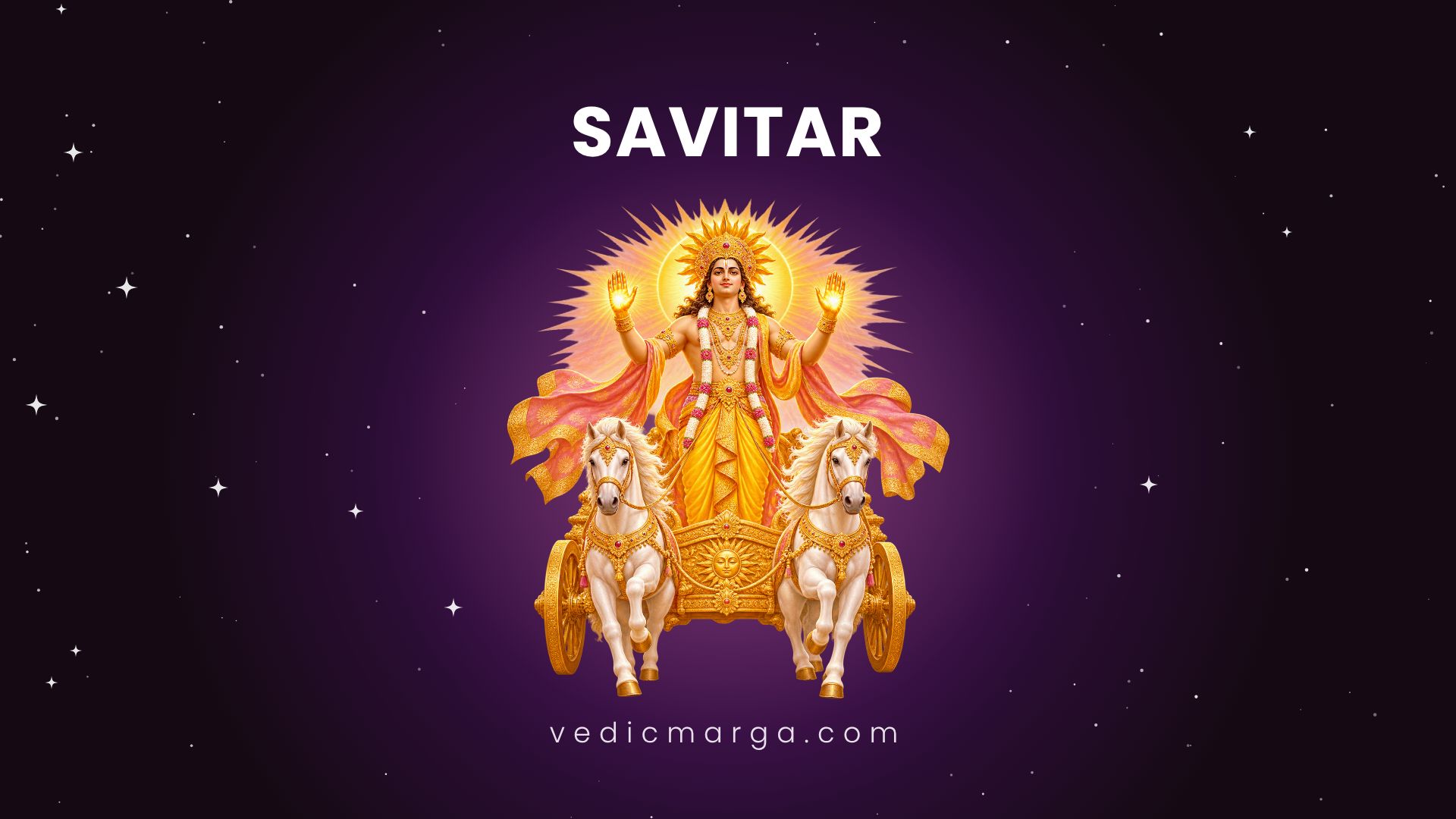
| Savitar | Key facts |
|---|---|
| Meaning of the name | The impeller, the one who sets things in motion |
| Nakshatra | Hasta (10° to 23°20' Virgo) |
| Nakshatra ruler | Moon |
| Group | One of the Adityas, the sons of Aditi |
| Epithets | Hiranyapani and Hiranyahasta, "golden-handed" |
| Best-known mantra | The Gayatri mantra (Rig Veda 3.62.10) |
| Chariot | Golden |
In this article
What Does Savitar Mean?
The name Savitar comes from the Sanskrit root su, "to set in motion" or "to urge on." Savitar is the impeller, the one who rouses beings and sets them to work.
The Vedic poets play on this root often. Rig Veda 2.38 opens with Savitar rising savaya, "for the impulsion," a word from the same root as his name.
Savitar is also a solar god, and he is closely linked with Surya. A traditional explanation calls the Sun Savitar before sunrise and Surya from sunrise to sunset. Some hymns use the 2 names for one god, and other hymns name them as 2 gods.
Savitar in the Rig Veda
Savitar has 11 hymns of his own in the Rig Veda, and his name appears about 170 times. The hymns show a god who moves on a golden chariot and sees all the worlds. Rig Veda 2.38.9 says that Indra, Varuna, Mitra, Aryaman and Rudra do not break his law.
Rig Veda 1.35 is one of his central hymns. Verse 2 says the god travels on his golden chariot, looking upon the worlds. Verse 9 gives him the title that matters most for Hasta:
हिरण्यपाणिः सविता विचर्षणिरुभे द्यावापृथिवी अन्तरीयते।
Savitar, the golden-handed, the wide-seeing, moves between heaven and earth. (Rig Veda 1.35.9, first half)
The next verse calls him hiranyahasta, using hasta, the same word that names the nakshatra. Rig Veda 2.38.2 calls him prithupani, "broad-handed," and shows him stretching out his arms.
The same hymn, 2.38, also shows Savitar at evening. He unyokes the horses of those on the road, and night follows his path. The woman at the loom rolls up her cloth, and the worker sets down a task left unfinished.
Why Is Savitar Golden-Handed?
The hymns call Savitar golden-handed without giving a reason. A story in the Brahmanas supplies one, and it belongs to the same sacrifice that blinded Bhaga and broke the teeth of Pushan.
The Shatapatha Brahmana (1.7.4) tells how a portion of the offering, struck by Rudra, harmed each god who touched it. In verse 8, Brihaspati takes it to Savitar, the impeller, and Savitar impels it. Julius Eggeling, the translator, notes that the Kaushitaki Brahmana tells this part differently. There the portion cut off Savitar's hands, and the gods gave him 2 golden ones.
Savitar's golden hands appear first in the Rig Veda. The Brahmana story came later and gives a reason for a title the hymns already used.
The Gayatri Mantra and Savitar
The Gayatri mantra is a prayer to Savitar. It comes from Rig Veda 3.62.10, a hymn of the sage Vishvamitra, and it is also called the Savitri mantra after its deity:
तत्सवितुर्वरेण्यं भर्गो देवस्य धीमहि ।
धियो यो नः प्रचोदयात् ॥tat savitur vareṇyaṃ bhargo devasya dhīmahi |
dhiyo yo naḥ pracodayāt ||We meditate on the excellent light of the god Savitar. May he inspire our thoughts. (Rig Veda 3.62.10)
The verse asks Savitar, the impeller, to set our thoughts in motion. The word pracodayat, "may he inspire" or "may he urge on," carries the same sense of impulse as his name.
In daily practice, the Gayatri is recited at sunrise and at sunset. Rig Veda 2.38 shows Savitar at work at both times.
Savitar Among the Adityas
Savitar is one of the Adityas, the sons of Aditi. The Bhagavata Purana (6.6.39) lists the 12 Adityas as Vivasvan, Aryaman, Pushan, Tvashta, Savita, Bhaga, Dhata, Vidhata, Varuna, Mitra, Shatru and Urukrama.
Savitar is also named in the 12 mantras chanted in Surya Namaskar. Om Savitre Namah is one of them, so Savitar is honoured each time the full salutation is done.
Savitar and Hasta Nakshatra
Hasta is the hand, and its symbol is an open palm. The Nakshatra Suktam joins the god and the nakshatra directly. Its Hasta verse asks Savitar to come on his golden chariot, bringing Hasta, "the lucky hand skilled in its work."
People with the Moon in Hasta are often skilled with their hands, quick with speech and good at craft, healing or detailed work. The Moon, the nakshatra ruler, adds sensitivity and a good memory. You can find your own birth nakshatra with the nakshatra calculator.
Our Hasta page gives its shakti as Hasta Sthapaniya Agama Shakti, the power to place what one seeks in one's hand. The Nakshatra Suktam verse speaks in the same terms. It asks for gifts and says, "We receive it with our right hand."
Savitar Mantra
The Gayatri is Savitar's best-known mantra. The Vedic verse that ties him to Hasta is the Hasta verse of the Nakshatra Suktam in the Taittiriya Brahmana (3.1):
आयातु देवः सविता उपयातु ।
हिरण्ययेन सुवृता रथेन ।
वहन् हस्तग्ं सुभगं विद्मनापसम् ।
प्रयच्छन्तं पपुरिं पुण्यमच्छ ।
हस्तः प्रयच्छत्वमृतं वसीयः ।
दक्षिणेन प्रतिगृभ्णीम एनत् ।
दातारमद्य सविता विदेय ।
यो नो हस्ताय प्रसुवाति यज्ञम् ॥Ayatu devah Savita upayatu |
hiranyayena suvrita rathena |
vahan Hastagum subhagam vidmanapasam |
prayachchhantam papurim punyamachchha |
Hastah prayachchhatvamritam vasiyah |
dakshinena pratigribhnima enat |
dataramadya Savita videya |
yo no hastaya prasuvati yagyam ||
Meaning: May the god Savitar come near on his golden chariot that rolls well. May he bring Hasta, the lucky hand skilled in its work, which gives, fills and brings merit.
May Hasta give us the deathless and the better thing. We receive it with our right hand. Today may I find Savitar, the giver, who sends our sacrifice forward to Hasta.
The verses for all 27 nakshatras are on our page of nakshatra mantras. Learn the accents from a teacher or a recording before you recite a Vedic verse.
Name Mantra
ॐ सवित्रे नमः
Om Savitre Namaḥ
It means "Om, salutation to Savitar." Savitre is the Sanskrit form for "to Savitar," and the same line is one of the 12 Surya Namaskar mantras.
How to Worship Savitar
The simplest worship of Savitar is the Gayatri at sunrise. Many recite it 108 times on a mala, and others recite it 3 or 10 times with full attention.
On the days the Moon passes through Hasta, about once every 27 days, add the Nakshatra Suktam verse or the name mantra. Offering water to the rising Sun also fits, since Savitar is linked with the Sun at dawn.
All of this works on the mind. In Rig Veda 2.38, Savitar starts the day's work and also brings it to rest. Finishing a task you began, and resting when the day ends, fits that hymn. For a reading of your own Moon nakshatra and running dasha, you can book a Vedic astrology consultation.
Frequently Asked Questions
Who is the deity of Hasta Nakshatra?
Savitar, the golden-handed sun god of the Rig Veda, is the deity of Hasta. The Nakshatra Suktam verse for Hasta asks him to bring "the lucky hand skilled in its work."
Is Savitar the same as Surya?
Savitar and Surya are both solar gods, and some hymns use the names for one god. A traditional explanation calls the Sun Savitar before sunrise and Surya after it.
Which god is the Gayatri mantra addressed to?
The Gayatri mantra (Rig Veda 3.62.10) is addressed to Savitar. For this reason it is also called the Savitri mantra.
Why is Savitar called golden-handed?
The Rig Veda calls him hiranyapani and hiranyahasta, "golden-handed," in 1.35.9 and 1.35.10. The translator Eggeling cites a Kaushitaki Brahmana story about it. There, his hands were cut off at a sacrifice and replaced with golden ones.
Which planet rules Hasta Nakshatra?
The Moon rules Hasta. The nakshatra lies fully in Virgo, so Mercury, the lord of Virgo, also shapes it through the sign.
Summary
Savitar is the golden-handed impeller of the Rig Veda and the deity of Hasta, the nakshatra of the hand. He wakes beings at dawn, sends them to rest at night, and is the god to whom the Gayatri mantra is addressed.
The Nakshatra Suktam asks him to bring Hasta, the skilled hand, and Surya Namaskar honours him by name. Recite the Gayatri at sunrise and the Hasta verse on the Hasta star day, and finish the work you begin each day.


