


Bhaga is the deity of Purva Phalguni Nakshatra in the jyotish books, the nakshatra that spans 13°20' to 26°40' Leo under Venus. He is one of the Adityas, the sons of Aditi, and his name means "share" or "good fortune." In the Rig Veda he is the god who gives each person a fair portion of wealth, happiness and love.
The Vedic Nakshatra Suktam gives his verse to Uttara Phalguni, the nakshatra that follows, and gives the Purva Phalguni verse to Aryaman.
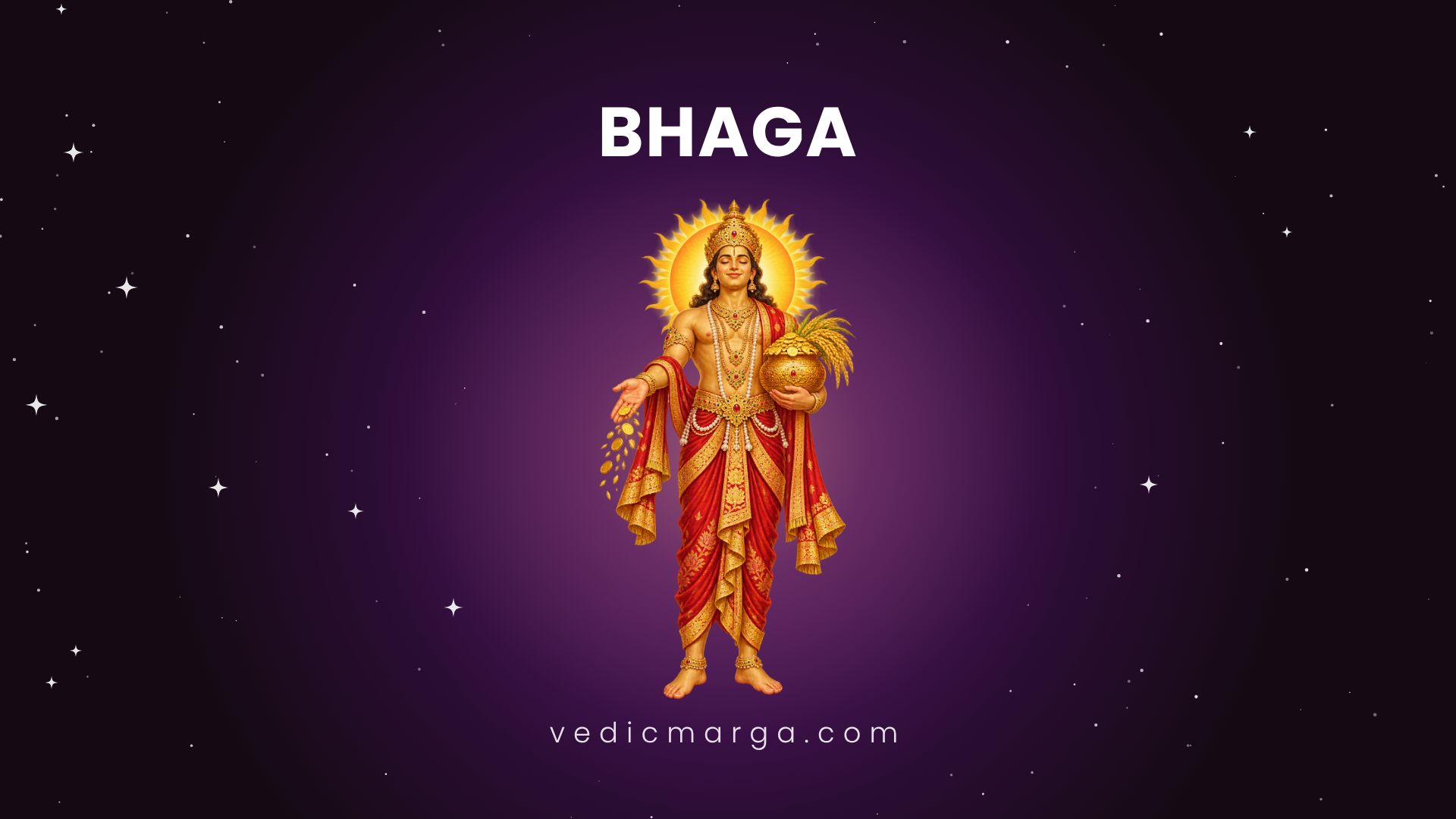
| Bhaga | Key facts |
|---|---|
| Meaning of the name | Share, portion, good fortune |
| Nakshatra (jyotish books) | Purva Phalguni (13°20' to 26°40' Leo) |
| Nakshatra (Nakshatra Suktam) | Uttara Phalguni |
| Nakshatra ruler | Venus |
| Group | One of the Adityas, the sons of Aditi |
| Vedic partner | Aryaman |
| Main Rig Veda hymn | 7.41, the morning hymn to Bhaga |
In this article
What Does Bhaga Mean?
The Sanskrit word bhaga means a share or portion, and from there good fortune, wealth and happiness. A person's bhaga is the part of life's goods that falls to them. As a god, Bhaga is the one who hands out these shares.
The same word gives bhagavan, "the one who has bhaga," a title later used for God. The Vishnu Purana (6.5.74) defines bhaga as 6 qualities held in full: sovereignty, power, fame, splendour, knowledge and dispassion. One who holds all 6 is called Bhagavan.
Related words appear outside India. Avestan and Old Persian use baga for a god or lord. Many linguists connect the Slavic word for God, bog, with the same root.
Bhaga in the Rig Veda
Bhaga has one hymn of his own, Rig Veda 7.41, sung at dawn by the sage Vasishtha. It calls on the gods of the morning and then turns to Bhaga as the giver of wealth. Its second verse shows who called on him:
प्रातर्जितं भगमुग्रं हुवेम वयं पुत्रमदितेर्यो विधर्ता ।
आध्रश्चिद्यं मन्यमानस्तुरश्चिद्राजा चिद्यं भगं भक्षीत्याह ॥We call on Bhaga, the strong one who wins at dawn, the son of Aditi who upholds all. The poor man, the mighty man and even the king say of him, "Give me my share." (Rig Veda 7.41.2)
The hymn asks Bhaga to guide the singers and to increase their cattle, horses and people. Verse 4 asks that they be fortunate now and through the whole day, from morning to evening. In verse 5 the poet prays that Bhaga himself may be bhagavan, rich in fortune, so that the people may share in it.
Bhaga belongs to the morning. Rig Veda 7.66.4 names Mitra, Aryaman, Savitar and Bhaga together at sunrise. Rig Veda 1.123.5 calls Ushas, the dawn, the sister of Bhaga.
Bhaga and Aryaman, Gods of Marriage
Bhaga and Aryaman are a pair in the Rig Veda wedding hymn. Rig Veda 10.85.23 asks that Aryaman and Bhaga lead the couple together. In verse 36 the groom says that Bhaga, Aryaman, Savitar and Purandhi have given the bride to him.
Both are Adityas. Rig Veda 2.27.1 names 6 of them together: Mitra, Aryaman, Bhaga, Varuna, Daksha and Amsha. Amsha also means "portion," so 2 of the 6 carry names for a share.
The Bhagavata Purana (6.6.39) later names Bhaga among 12 sons of Aditi. The nakshatras of Bhaga and Aryaman, the 2 Phalgunis, sit side by side in the sky.
Why Is Bhaga Blind?
Bhaga is called the blind god, and the story goes back to the Brahmanas. The Shatapatha Brahmana (1.7.4.6) describes a portion of the sacrifice so powerful that no god could safely take it. When Bhaga looked at it, it burnt out his eyes. The text adds that this is why people say Bhaga is blind.
The Puranas tell the story through Daksha's sacrifice. Daksha held a great yajna and left out Shiva, his son-in-law. Sati, Shiva's wife and Daksha's daughter, gave up her body there after hearing her father insult him.
Shiva then sent Virabhadra to the sacrifice. At an earlier assembly, while Shiva was being cursed, Bhaga had moved his eyebrows in approval. Virabhadra threw Bhaga down and plucked out his eyes (Bhagavata Purana 4.5.20).
When the sacrifice was restored, Shiva granted that Bhaga would see his share of the offerings through the eyes of Mitra (Bhagavata Purana 4.7.3). In the next verse, Pushan is allowed to eat through the teeth of his disciples.
Which Phalguni Belongs to Bhaga?
The jyotish books make Bhaga the deity of Purva Phalguni and Aryaman the deity of Uttara Phalguni. Vedicmarga follows this order in its nakshatra pages.
The Nakshatra Suktam of the Taittiriya Brahmana (3.1) gives the reverse. Its Purva Phalguni verse is addressed to Aryaman, and its Uttara Phalguni verse to Bhaga.
Bhaga and Purva Phalguni Nakshatra
The 2 main stars of Purva Phalguni are Delta and Theta Leonis, in the hindquarters of the Lion. Its symbol is the front legs of a bed, linked with rest, comfort and marriage. Venus, the nakshatra ruler, adds an interest in beauty and the arts.
People with the Moon in Purva Phalguni are often warm and generous, and they enjoy company. Many like hosting friends at home and sharing what they have. You can find your own birth nakshatra with the nakshatra calculator.
In muhurta, Purva Phalguni is an ugra, or fierce, nakshatra. It is not among the nakshatras used for fixing a wedding date.
Bhaga Mantra
The Vedic verse that names Bhaga is the Phalguni verse of the Nakshatra Suktam. The Taittiriya Brahmana assigns it to Uttara Phalguni. Its first half reads:
श्रेष्ठो देवानां भगवो भगासि ।
तत्त्वा विदुः फल्गुनीस्तस्य वित्तात् ।
अस्मभ्यं क्षत्रमजरग्ं सुवीर्यम् ।
गोमदश्ववदुपसन्नुदेह ॥Shreshtho devanam Bhagavo Bhagasi |
tattva viduh Phalgunistasya vittat |
asmabhyam kshatramajaragum suviryam |
gomadashvavadupasannudeha ||
Meaning: O Bhaga, giver of good fortune, you are the best of the gods. The Phalgunis know you this way; may they know it well. Give us power that does not age and great strength, rich in cattle and horses.
The full verse, with its second half, is on our page of nakshatra mantras. People born in either Phalguni can recite it, since it names Bhaga and the Phalgunis together. Learn the accents from a teacher or a recording first.
Name Mantra
We could not find a fixed name mantra for Bhaga in a classical text. A plain salutation to the deity is:
ॐ भगाय नमः
Om Bhagaya Namaḥ
It means "Om, salutation to Bhaga." Bhagaya is the Sanskrit form for "to Bhaga."
How to Worship Bhaga
Recite the Nakshatra Suktam verse or the name salutation on the days the Moon passes through Purva Phalguni. This happens about once every 27 days. Rig Veda 7.41 is a morning hymn, so dawn suits this worship.
Bhaga is the god of the fair share, so giving suits his worship. Sharing food, helping a family with a wedding and paying what is owed on time all fit his nature.
All of this works on the mind. Steady gratitude for what has come, and a willingness to share it, change how a person meets a Venus period. For a reading of your own Moon nakshatra and running dasha, you can book a Vedic astrology consultation.
Frequently Asked Questions
Who is the deity of Purva Phalguni Nakshatra?
Bhaga is the deity of Purva Phalguni in the jyotish books. The Vedic Nakshatra Suktam gives the Purva Phalguni verse to Aryaman and the Uttara Phalguni verse to Bhaga.
What is Bhaga the god of?
Bhaga is the god of the fair share, good fortune and prosperity. The Rig Veda calls on him for wealth, and the wedding hymn calls on him with Aryaman to bless the couple.
Is the word Bhagavan related to Bhaga?
Yes. Bhagavan means "one who has bhaga." The Vishnu Purana (6.5.74) defines bhaga as sovereignty, power, fame, splendour, knowledge and dispassion held in full.
Why is Bhaga blind?
The Shatapatha Brahmana says a portion of the sacrifice burnt out his eyes when he looked at it. The Bhagavata Purana says Virabhadra plucked out his eyes at Daksha's sacrifice.
Which planet rules Purva Phalguni Nakshatra?
Venus rules Purva Phalguni. The nakshatra lies fully in Leo, so the Sun, the lord of Leo, also shapes it through the sign.
Summary
Bhaga is the Aditya of the fair share and good fortune, and the jyotish books make him the deity of Purva Phalguni. Rig Veda 7.41 is his morning hymn, where the poor man and the king alike ask him for their share. The title Bhagavan comes from the same word.
The Brahmanas and Puranas explain why he is blind, and the Nakshatra Suktam gives his verse to Uttara Phalguni. To work with this nakshatra, recite his verse at dawn on the star day and share what has come to you.


