


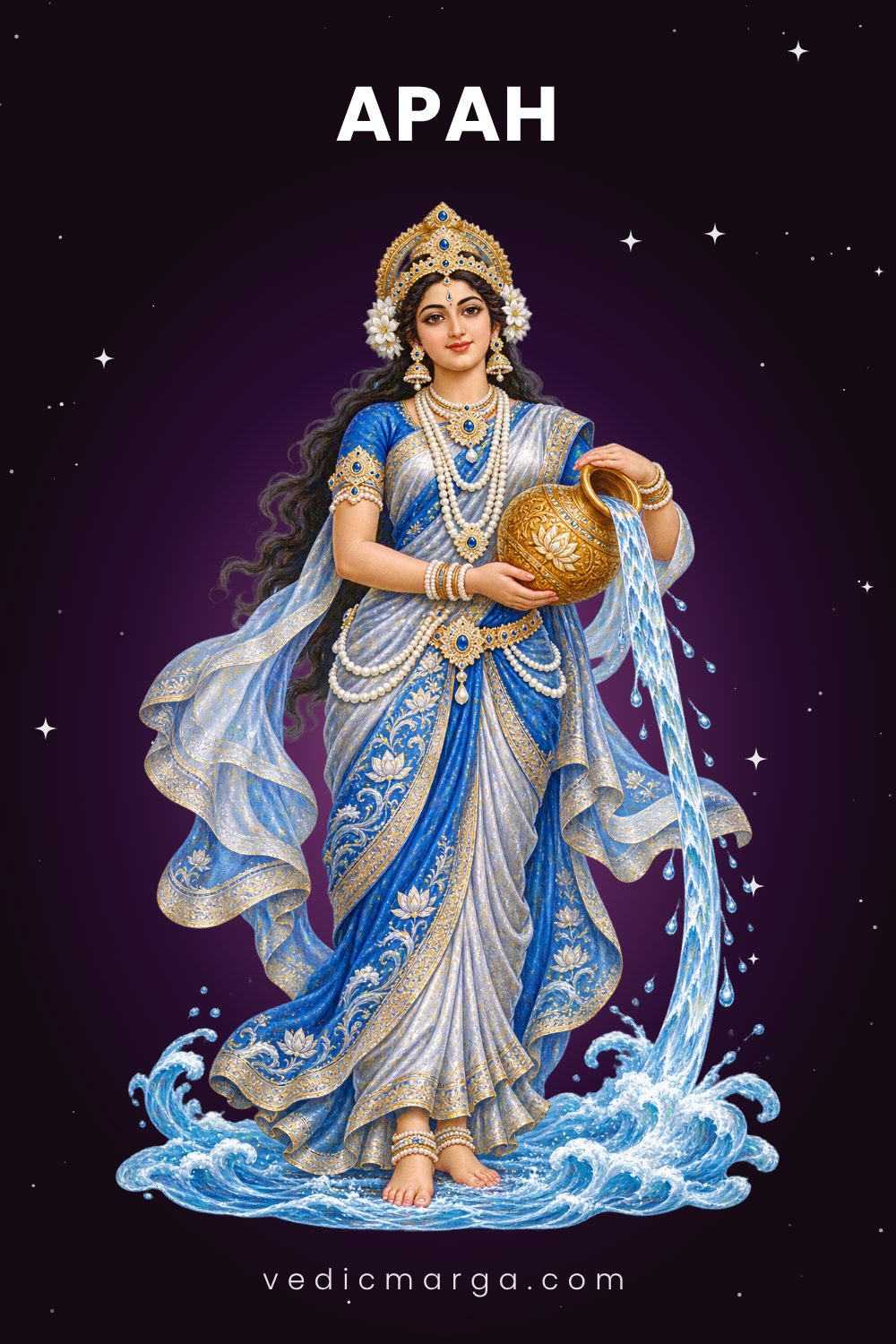
Apah is the deity of Purva Ashadha Nakshatra, which spans 13°20' to 26°40' Sagittarius under Venus. The name means "the waters," and the Rig Veda praises them as goddesses and mothers who cleanse, heal and give strength. Rig Veda hymn 10.9, which opens with Apo hi shtha, is still recited for purification in daily worship.
The name is also written Apas. Purva Ashadha, "the earlier unconquered," is linked in jyotish with cleansing and renewal.
| Apah | Key facts |
|---|---|
| Meaning of the name | The waters |
| Other spelling | Apas |
| Nakshatra | Purva Ashadha (13°20' to 26°40' Sagittarius) |
| Nakshatra ruler | Venus |
| Form | A group of goddesses, called mothers in the Veda |
| Main Rig Veda hymns | 10.9, 7.47 and 7.49 |
| Best-known verse | Apo hi shtha mayobhuvah (Rig Veda 10.9.1) |
| Linked gods | Varuna, Soma, Agni and Apam Napat |
In this article
What Does Apah Mean?
The Sanskrit word ap means water, and apah is its plural. The Veda almost always speaks of the waters in the plural, as many goddesses moving together. Rig Veda 10.9.4 calls them devih, goddesses. Both spellings, Apah and Apas, name the same deity.
Apah in the Rig Veda
Several hymns of the Rig Veda are addressed to the waters. The best known is 10.9, a short hymn whose first 3 verses are used for purification:
आपो हि ष्ठा मयोभुवस्ता न ऊर्जे दधातन ।
महे रणाय चक्षसे ॥Waters, you are the source of well-being. Set us in strength, so that we may see great joy. (Rig Veda 10.9.1)
Verse 2 asks the waters to share their most kindly essence with us, like loving mothers. In verse 6, the poet reports Soma's words that all medicines lie within the waters. The same verse names Agni, who brings blessings to all.
Rig Veda 7.49 is a prayer for protection, and each of its verses ends by asking the divine waters to protect the speaker. It names the waters that fall from the sky, flow in dug channels and rise of themselves. All of them, the hymn says, are heading for the sea.
Rig Veda 7.47 adds 2 more details. Verse 3 says the goddess-waters travel the paths of the gods and do not break Indra's laws. Verse 4 says the Sun stretched out the rivers with his rays.
How Are Apah and Varuna Related?
Rig Veda 7.49.3 describes the waters in whose midst King Varuna moves, looking down on the truth and falsehood of people. The next verse says that Varuna and Soma live in the waters, and that Agni Vaishvanara has entered them. In later texts Varuna becomes the lord of the waters and of the ocean.
The waters also hold a god of their own, Apam Napat, "the child of the waters." Rig Veda 2.35 is his hymn. Its fourth verse describes him shining within the waters without fuel, with the young waters around him.
The Waters in Creation
The Brahmanas place the waters at the start of creation. According to the Shatapatha Brahmana (11.1.6.1), in the beginning this world was water, one great sea. The waters performed tapas, and from their heat a golden egg arose. Prajapati was born from that egg (11.1.6.2).
The Manusmriti (1.10) gives a related teaching. The waters are called narah, the offspring of Nara, and since they were his first home (ayana), he is called Narayana.
Apah and Purva Ashadha Nakshatra
Purva Ashadha means "the earlier unconquered," and Uttara Ashadha follows it as the second of the pair. Its symbols are the elephant tusk, the fan and the winnowing basket. Our Purva Ashadha page gives its shakti as Varchograhana shakti, the power to invigorate. Rig Veda 10.9.3 asks the waters to give the worshippers new life and strength.
The month of Ashadha is named after these stars, since its full Moon falls near them. In Nepal, Ashadh is the rice-planting month, when monsoon rain fills the terraced fields.
People with the Moon in Purva Ashadha are often confident, persuasive and loyal to what they believe. Many recover quickly from setbacks and feel refreshed near a river, a lake or the sea. Venus, the nakshatra ruler, adds charm and a love of the arts. You can find your own birth nakshatra with the nakshatra calculator.
In muhurta, Purva Ashadha is an ugra, or fierce, nakshatra. Classical muhurta keeps the ugra nakshatras for harsh or forceful work.
Apah Mantra
The Vedic verse for Purva Ashadha in the Nakshatra Suktam of the Taittiriya Brahmana (3.1) is addressed to the waters:
या दिव्या आपः पयसा सम्बभूवुः ।
या अन्तरिक्ष उत पार्थिवीर्याः ।
यासामषाढा अनुयन्ति कामम् ।
ता न आपः शग्ं स्योना भवन्तु ।
याश्च कूप्या याश्च नाद्याः समुद्रियाः ।
याश्च वैशन्तीरुत प्रासचीर्याः ।
यासामषाढा मधु भक्षयन्ति ।
ता न आपः शग्ं स्योना भवन्तु ॥Ya divya apah payasa sambabhuvuh |
ya antariksha uta parthiviryah |
yasamashadha anuyanti kamam |
ta na apah shagum syona bhavantu |
yashcha kupya yashcha nadyah samudriyah |
yashcha vaishantiruta prasachiryah |
yasamashadha madhu bhakshayanti |
ta na apah shagum syona bhavantu ||
Meaning: Some heavenly waters were born with milk. Some belong to the sky and some to the earth. The Ashadha stars follow their wish. May those waters be kind and pleasant to us.
There are waters of wells, of rivers and of the sea, and waters of ponds and of flowing streams. The Ashadha stars enjoy their sweetness. May those waters be kind and pleasant to us.
The verses for all 27 nakshatras are on our page of nakshatra mantras. Learn the accents from a teacher or a recording before you recite a Vedic verse.
Name Mantra
We could not find a fixed name mantra for Apah in a classical text. A plain salutation to the deity is:
ॐ अद्भ्यो नमः
Om Adbhyo Namah
It means "Om, salutation to the waters." Adbhyah is the Sanskrit form for "to the waters."
How to Worship Apah
Many families recite the first 3 verses of Rig Veda 10.9 in the daily sandhya. Water is sprinkled on the head as the verses are said, and this cleansing rite is called marjana.
On the days the Moon passes through Purva Ashadha, about once every 27 days, add the Nakshatra Suktam verse or the name salutation. Service to water also suits this deity. Keeping a well or a stream clean and setting out drinking water for travellers (jal daan) both fit.
All of this works on the mind. Using water with care each day, and treating rivers as sacred, keeps the deity in mind. For a reading of your own Moon nakshatra and running dasha, you can book a Vedic astrology consultation.
Frequently Asked Questions
Who is the deity of Purva Ashadha Nakshatra?
Apah, the divine waters, is the deity of Purva Ashadha. Its Nakshatra Suktam verse asks the waters of sky, earth, wells, rivers and sea to be kind to us.
What is Apo hi shtha?
Apo hi shtha mayobhuvah is the opening of Rig Veda 10.9, a hymn to the waters. Its first 3 verses are recited in the daily sandhya as water is sprinkled for purification.
Is Apah a goddess?
Yes. The Veda treats the waters as a group of goddesses, called devih in Rig Veda 10.9.4. Verse 2 of the same hymn compares them to loving mothers.
How are Apah and Varuna connected?
Rig Veda 7.49.3 says King Varuna moves in the midst of the waters, watching the truth and falsehood of people. Later texts make Varuna the lord of the waters.
Which planet rules Purva Ashadha Nakshatra?
Venus rules Purva Ashadha. The nakshatra lies fully in Sagittarius, so Jupiter, the lord of Sagittarius, also shapes it through the sign.
What is the mantra of Apah?
The Vedic mantra is the Purva Ashadha verse of the Nakshatra Suktam, which begins "Ya divya apah payasa sambabhuvuh." The plain name salutation is Om Adbhyo Namah.
Summary
Apah, the divine waters, is the deity of Purva Ashadha Nakshatra. The Rig Veda praises the waters as goddesses and mothers, and hymn 10.9 asks them for strength and healing. Varuna moves in their midst, and the Shatapatha Brahmana places them at the start of creation.
Purva Ashadha shares their themes of cleansing and renewal. To work with this nakshatra, recite the Apo hi shtha verses at the daily sandhya. Recite the Purva Ashadha verse on its star day, and use water with care.


