
Ashtakavarga is a scoring system in Vedic astrology that measures the strength of each sign and house using points called bindus. It gives a numerical view of which parts of a chart carry support and which are weak. The system is used heavily in transit work. This calculator generates your full Ashtakavarga from your birth details, including each planet's own table and the combined Sarvashtakavarga. Enter your details below to see your bindu scores.
Calculator
Ashtakavarga Calculator: Check Your Bindu Scores
Ashtakavarga
Enter the date, time and place of birth.
- Sidereal zodiac
- Lahiri ayanamsa
- North Indian chart
- Vimshottari dasha
Discover what your birth chart reveals about you. Get a personalized Vedic astrology profile and begin your journey of self-understanding.
Get Started NowYou get both the Bhinnashtakavarga, which is each planet's own table, and the Sarvashtakavarga, which sums them into a single score per sign. Higher bindu counts point to signs and houses that carry more support.
The calculation follows classical Parashari rules and runs automatically once your birth details are entered.
How Is Ashtakavarga Calculated?
The name comes from ashta, meaning eight. Bindus are assigned using eight reference points: the seven planets from the Sun to Saturn, plus the Ascendant of the birth chart. Rahu and Ketu are left out of the standard method.
For each planet, points are given to signs counted from each of those eight reference points. The rules for this are fixed in the classical texts. The result is that planet's Bhinnashtakavarga, a bindu count for all twelve signs.
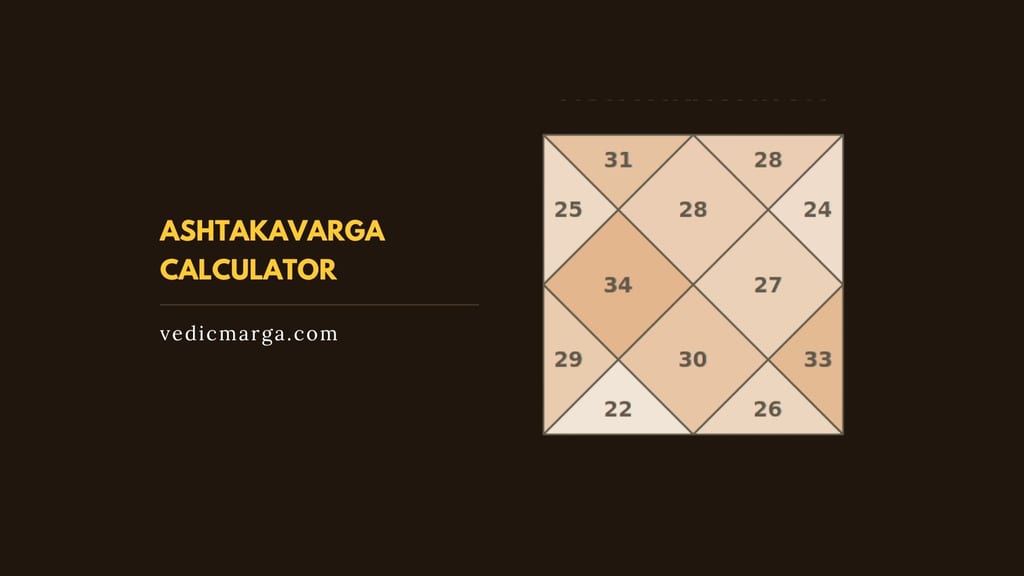
Adding the seven planetary tables together gives the Sarvashtakavarga. Its bindus total 337 across the twelve signs, so the average score for a sign is about 28. Signs scoring well above that average are read as supported, and low scores point to weaker ground. The calculator applies every rule and totals the bindus for you.
Understanding Your Result
Your calculator result shows:
- Bhinnashtakavarga tables, the bindu score for each planet across all signs
- Sarvashtakavarga, the combined score for every sign
- The highest and lowest scoring signs in your chart
- Bindus by house, counted from your Ascendant
- Sign totals you can compare against the average of 28
Bindu scores measure relative support, and they work as one input to a reading. A sign with a high Sarvashtakavarga carries more strength. The planets placed there still need to be judged on their own dignity and placement. Timing comes from the dasha and transits, so the scores are most useful when read against the Vimshottari Dasha running in your life.
Learn More About Ashtakavarga
The calculator gives you the numbers. Using them well means understanding how bindus are read and how the system supports transit analysis. It also means seeing how the scores sit alongside the rest of the chart. Our complete guide covers the classical system and its application.
The Ashtakavarga System in Vedic Astrology
Frequently asked questions
What is a good bindu score for a sign?
In the Sarvashtakavarga 337 bindus are spread over twelve signs, so 28 is the average. A sign at 30 or above carries support. One under 25 gives less and asks for more patience.
How do I use bindus for a transit?
Read the bindus the transiting planet holds in its own Bhinnashtakavarga for the sign it is crossing. Four or more supports the transit; three or fewer weakens it. The Sarvashtakavarga of that sign gives the second reading.
Does Ashtakavarga replace dasha reading?
No. Ashtakavarga measures the support a sign gives, and the dasha says which planet's period is running. Read both together. Our Vimshottari Dasha Calculator gives you the timing side.
Why do the scores of my houses vary so much?
Each planet contributes bindus by its own rules, and the twelve signs collect them unevenly. A house with many bindus is a part of life where effort returns results. A low house is a place to work with more care and less expectation.