


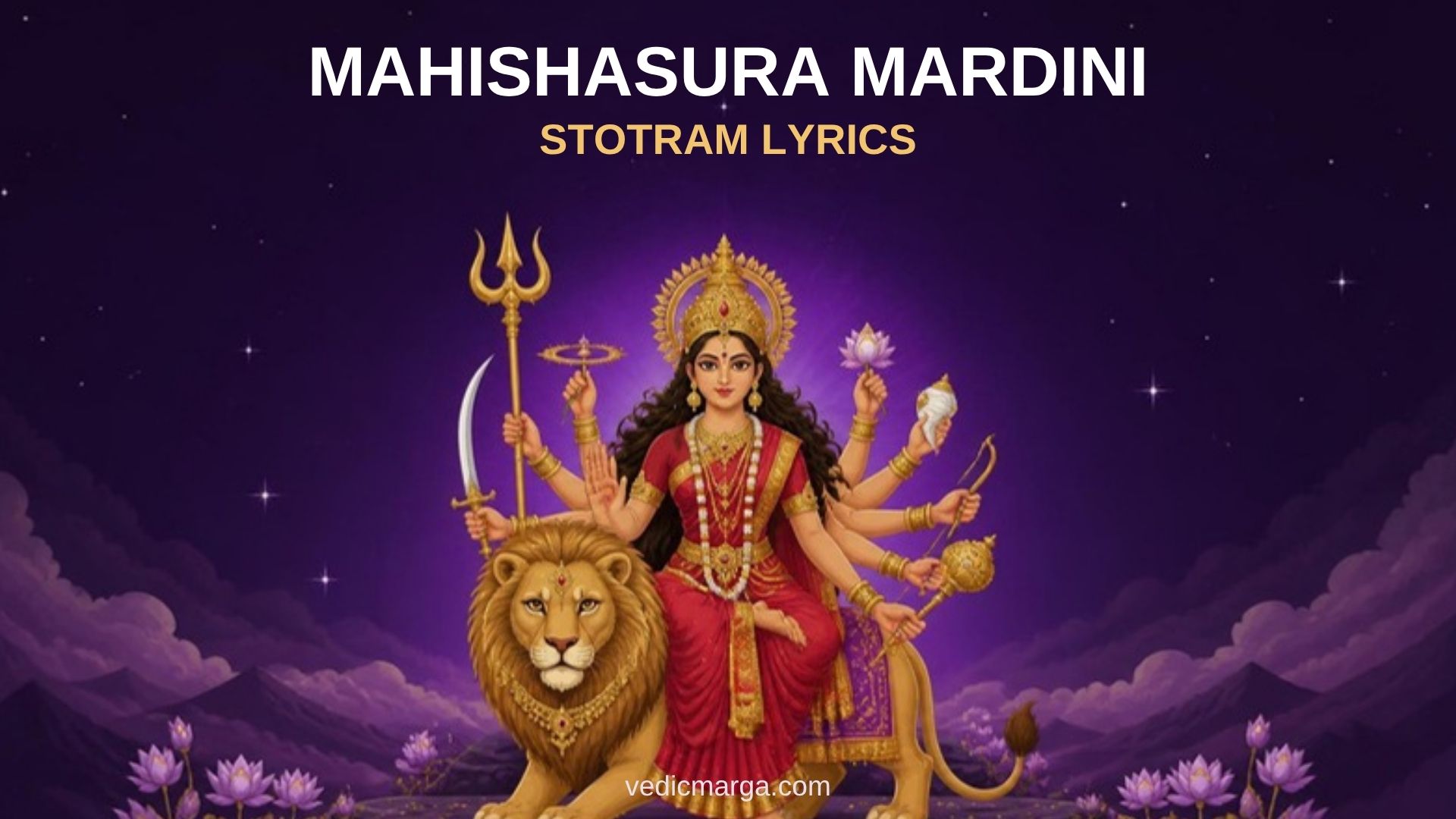
Mahishasura Mardini Stotram is a hymn of 21 verses to Goddess Durga as the slayer of Mahishasura, the buffalo demon. Most people know it by its opening words, Aigiri Nandini, and by the refrain that closes every verse: jaya jaya he Mahishasuramardini.
It is one of the most sung hymns of Navaratri. The verses move fast. They are full of sound words that copy drums, anklets and the clash of battle.
Below you will find the full Sanskrit text with transliteration, the meaning of every verse in simple English, and how to recite it.
In this article
The Story Behind the Hymn
The story comes from the Devi Mahatmya, a part of the Markandeya Purana. The demon Mahisha, who could take the form of a buffalo, drove the gods out of heaven. The gods poured their anger and power into one form, and the goddess Durga appeared.
She rode a lion into battle and destroyed Mahisha and his army. The same text tells how the demons Madhu and Kaitabha were killed through her power. Later she defeats Dhumralochana, Raktabija, and the brothers Shumbha and Nishumbha. The stotram recalls all of these battles.
The hymn is popularly credited to Adi Shankaracharya. Some sources give another poet, Ramakrishna Kavi, and the author is not certain.
How to Recite Mahishasura Mardini Stotram
Recite it during Navaratri, on any of the 9 nights, or daily in the morning or evening.
Sit before an image of Durga, light a lamp, and offer a red flower if you have one.
Sing the refrain after every verse. It is the most repeated line of the hymn and the easiest to learn first.
If the full hymn is too long, start with the first 5 verses and add more as they become familiar.
Read the meaning before you chant. The words are dense, and knowing what they say keeps the mind with the hymn.
Mahishasura Mardini Stotram Lyrics with Meaning
The hymn is given here in 5 parts. The refrain in the last line of every verse means: "Victory, victory to you, slayer of the demon Mahisha, with beautiful braided hair, daughter of the mountain." Its meaning is shown once, under verse 1.
Verses 1 to 3: Praise of the Mountain's Daughter
अयि गिरिनन्दिनि नन्दितमेदिनि विश्वविनोदिनि नन्दिनुते
गिरिवरविन्ध्यशिरोऽधिनिवासिनि विष्णुविलासिनि जिष्णुनुते ।
भगवति हे शितिकण्ठकुटुम्बिनि भूरिकुटुम्बिनि भूरिकृते
जय जय हे महिषासुरमर्दिनि रम्यकपर्दिनि शैलसुते ॥ १ ॥Ayi Girinandini nanditamedini vishvavinodini Nandinute
girivaravindhyashiro'dhinivasini Vishnuvilasini Jishnunute |
bhagavati he Shitikanthakutumbini bhurikutumbini bhurikrite
jaya jaya he Mahishasuramardini ramyakapardini Shailasute || 1 ||
Meaning: O daughter of the mountain, you gladden the earth, delight the whole world and are praised by Nandi. You live on the peak of the great Vindhya mountain, delight Vishnu and are praised by Indra. O blessed goddess, you are the wife of the blue-throated Shiva, mother of a vast family, doer of many deeds. Victory, victory to you, slayer of the demon Mahisha, with beautiful braided hair, daughter of the mountain.
सुरवरवर्षिणि दुर्धरधर्षिणि दुर्मुखमर्षिणि हर्षरते
त्रिभुवनपोषिणि शङ्करतोषिणि किल्बिषमोषिणि घोषरते
दनुजनिरोषिणि दितिसुतरोषिणि दुर्मदशोषिणि सिन्धुसुते
जय जय हे महिषासुरमर्दिनि रम्यकपर्दिनि शैलसुते ॥ २ ॥Suravaravarshini durdharadharshini durmukhamarshini harsharate
tribhuvanaposhini Shankaratoshini kilbishamoshini ghosharate
danujaniroshini ditisutaroshini durmadashoshini Sindhusute
jaya jaya he Mahishasuramardini ramyakapardini Shailasute || 2 ||
Meaning: You shower gifts on the gods, overpower Durdhara and subdue Durmukha, and delight in joy. You nourish the 3 worlds, please Shankara, remove sin and delight in the sound of praise. You are angry with the Danavas and the sons of Diti and dry up the pride of the wicked, O daughter of the ocean.
अयि जगदम्ब मदम्ब कदम्ब वनप्रियवासिनि हासरते
शिखरि शिरोमणि तुङ्गहिमालय शृङ्गनिजालय मध्यगते ।
मधुमधुरे मधुकैटभगञ्जिनि कैटभभञ्जिनि रासरते
जय जय हे महिषासुरमर्दिनि रम्यकपर्दिनि शैलसुते ॥ ३ ॥Ayi Jagadamba madamba kadamba vanapriyavasini hasarate
shikhari shiromani tungahimalaya shringanijalaya madhyagate |
madhumadhure Madhukaitabhaganjini Kaitabhabhanjini rasarate
jaya jaya he Mahishasuramardini ramyakapardini Shailasute || 3 ||
Meaning: O mother of the world, my mother, you love to live in the kadamba forest and delight in laughter. Your home is among the high peaks of the Himalaya, the crown of all mountains. Sweet as honey, you humbled Madhu and Kaitabha, crushed Kaitabha and delight in the rasa dance.
Verses 4 to 8: The Goddess in Battle
अयि शतखण्ड विखण्डितरुण्ड वितुण्डितशुण्ड गजाधिपते
रिपुगजगण्ड विदारणचण्ड पराक्रमशुण्ड मृगाधिपते ।
निजभुजदण्ड निपातितखण्ड विपातितमुण्ड भटाधिपते
जय जय हे महिषासुरमर्दिनि रम्यकपर्दिनि शैलसुते ॥ ४ ॥Ayi shatakhanda vikhanditarunda vitunditashunda gajadhipate
ripugajaganda vidaranachanda parakramashunda mrigadhipate |
nijabhujadanda nipatitakhanda vipatitamunda bhatadhipate
jaya jaya he Mahishasuramardini ramyakapardini Shailasute || 4 ||
Meaning: O goddess, you cut the enemies into a hundred pieces and cut off the trunks of the lordly elephants. Your lion, lord of beasts, fiercely tears open the temples of the enemy elephants. Your own strong arms struck down and beheaded the enemy chiefs.
अयि रणदुर्मद शत्रुवधोदित दुर्धरनिर्जर शक्तिभृते
चतुरविचार धुरीणमहाशिव दूतकृत प्रमथाधिपते ।
दुरितदुरीह दुराशयदुर्मति दानवदूत कृतान्तमते
जय जय हे महिषासुरमर्दिनि रम्यकपर्दिनि शैलसुते ॥ ५ ॥Ayi ranadurmada shatruvadhodita durdharanirjara shaktibhrite
chaturavichara dhurinamahashiva dutakrita pramathadhipate |
duritaduriha durashayadurmati danavaduta kritantamate
jaya jaya he Mahishasuramardini ramyakapardini Shailasute || 5 ||
Meaning: O goddess, you hold an unbearable power that rose up to kill enemies wild with pride in battle. You sent Shiva, wise and foremost lord of the Pramathas, as your messenger. You resolved to end the evil-minded messenger of the demons.
अयि शरणागत वैरिवधूवर वीरवराभय दायकरे
त्रिभुवनमस्तक शूलविरोधि शिरोऽधिकृतामल शूलकरे ।
दुमिदुमितामर धुन्दुभिनादमहोमुखरीकृत दिङ्मकरे
जय जय हे महिषासुरमर्दिनि रम्यकपर्दिनि शैलसुते ॥ ६ ॥Ayi sharanagata vairivadhuvara viravarabhaya dayakare
tribhuvanamastaka shulavirodhi shiro'dhikritamala shulakare |
dumidumitamara dhundubhinadamahomukharikrita dinmakare
jaya jaya he Mahishasuramardini ramyakapardini Shailasute || 6 ||
Meaning: O goddess, you give fearlessness to brave enemies and their wives when they seek refuge in you. Your hand holds the spotless trident, set on the head of the one who was a spear against the 3 worlds. You fill every direction with the loud beat of the gods' drums.
अयि निजहुङ्कृति मात्रनिराकृत धूम्रविलोचन धूम्रशते
समरविशोषित शोणितबीज समुद्भवशोणित बीजलते ।
शिवशिवशुम्भ निशुम्भमहाहव तर्पितभूत पिशाचरते
जय जय हे महिषासुरमर्दिनि रम्यकपर्दिनि शैलसुते ॥ ७ ॥Ayi nijahunkriti matranirakrita Dhumravilochana dhumrashate
samaravishoshita shonitabija samudbhavashonita bijalate |
shivashivashumbha Nishumbhamahahava tarpitabhuta pishacharate
jaya jaya he Mahishasuramardini ramyakapardini Shailasute || 7 ||
Meaning: O goddess, with a mere hum you destroyed Dhumralochana and his hundreds of smoky warriors. You dried up Raktabija in battle, and every Raktabija born from his blood. You fed the ghosts and goblins in the great war with Shumbha and Nishumbha.
धनुरनुषङ्ग रणक्षणसङ्ग परिस्फुरदङ्ग नटत्कटके
कनकपिशङ्ग पृषत्कनिषङ्ग रसद्भटशृङ्ग हताबटुके ।
कृतचतुरङ्ग बलक्षितिरङ्ग घटद्बहुरङ्ग रटद्बटुके
जय जय हे महिषासुरमर्दिनि रम्यकपर्दिनि शैलसुते ॥ ८ ॥Dhanuranushanga ranakshanasanga parisphuradanga natatkatake
kanakapishanga prishatkanishanga rasadbhatashringa hatabatuke |
kritachaturanga balakshitiranga ghatadbahuranga ratadbatuke
jaya jaya he Mahishasuramardini ramyakapardini Shailasute || 8 ||
Meaning: Your limbs flash as you take up the bow in the moment of battle, your bracelets dancing. With your golden quiver of arrows you strike down the chiefs of the roaring warriors. You break the fourfold army on a battlefield full of colour and crying soldiers.
Verses 9 to 10: The Dance of Heaven
सुरललना ततथेयि तथेयि कृताभिनयोदर नृत्यरते
कृत कुकुथः कुकुथो गडदादिकताल कुतूहल गानरते ।
धुधुकुट धुक्कुट धिंधिमित ध्वनि धीर मृदंग निनादरते
जय जय हे महिषासुरमर्दिनि रम्यकपर्दिनि शैलसुते ॥ ९ ॥Suralalana tatatheyi tatheyi kritabhinayodara nrityarate
krita kukuthah kukutho gadadadikatala kutuhala ganarate |
dhudhukuta dhukkuta dhindhimita dhvani dhira mridanga ninadarate
jaya jaya he Mahishasuramardini ramyakapardini Shailasute || 9 ||
Meaning: The women of heaven dance for you to the beat of 'ta ta theyi, ta theyi', telling the story with gestures. You delight in songs set to rhythms like 'kukutha, kukutha, gadada'. You delight in the deep sound of the mridanga drum going 'dhudhukuta, dhukkuta, dhimdhimi'.
जय जय जप्य जयेजयशब्द परस्तुति तत्परविश्वनुते
झणझणझिञ्झिमि झिङ्कृत नूपुरशिञ्जितमोहित भूतपते ।
नटित नटार्ध नटी नट नायक नाटितनाट्य सुगानरते
जय जय हे महिषासुरमर्दिनि रम्यकपर्दिनि शैलसुते ॥ १० ॥Jaya jaya japya jayejayashabda parastuti tatparavishvanute
jhanajhanajhinjhimi jhinkrita nupurashinjitamohita bhutapate |
natita natardha nati nata nayaka natitanatya suganarate
jaya jaya he Mahishasuramardini ramyakapardini Shailasute || 10 ||
Meaning: Victory, victory! The whole world praises you, eager to sing 'jaya, jaya' in your honour. The jingling of your anklets, 'jhana jhana jhinjhimi', charms Shiva, lord of beings. You delight in the song and dance of Shiva, lord of dancers, of whom you are the dancing half.
Verses 11 to 17: Her Beauty and Glory
अयि सुमनःसुमनःसुमनः सुमनःसुमनोहरकान्तियुते
श्रितरजनी रजनीरजनी रजनीरजनी करवक्त्रवृते ।
सुनयनविभ्रमर भ्रमरभ्रमर भ्रमरभ्रमराधिपते
जय जय हे महिषासुरमर्दिनि रम्यकपर्दिनि शैलसुते ॥ ११ ॥Ayi sumanahsumanahsumanah sumanahsumanoharakantiyute
shritarajani rajanirajani rajanirajani karavaktravrite |
sunayanavibhramara bhramarabhramara bhramarabhramaradhipate
jaya jaya he Mahishasuramardini ramyakapardini Shailasute || 11 ||
Meaning: O goddess, you shine with a beauty that charms the good-hearted, lovely as flowers. Your face is like the moon that brings the night, framed by hair dark as night. Your lovely eyes dart like black bees, O queen of the bees.
सहितमहाहव मल्लमतल्लिक मल्लितरल्लक मल्लरते
विरचितवल्लिक पल्लिकमल्लिक झिल्लिकभिल्लिक वर्गवृते ।
शितकृतफुल्ल समुल्लसितारुण तल्लजपल्लव सल्ललिते
जय जय हे महिषासुरमर्दिनि रम्यकपर्दिनि शैलसुते ॥ १२ ॥Sahitamahahava mallamatallika mallitarallaka mallarate
virachitavallika pallikamallika jhillikabhillika vargavrite |
shitakritaphulla samullasitaruna tallajapallava sallalite
jaya jaya he Mahishasuramardini ramyakapardini Shailasute || 12 ||
Meaning: You delight in the wrestling of mighty fighters in the great battle. The tribal women of the hills gather round you, decked with creepers and jasmine. You are lovely as tender red leaves, bright and full of bloom.
अविरलगण्ड गलन्मदमेदुर मत्तमतङ्गज राजपते
त्रिभुवनभूषण भूतकलानिधि रूपपयोनिधि राजसुते ।
अयि सुदतीजन लालसमानस मोहन मन्मथराजसुते
जय जय हे महिषासुरमर्दिनि रम्यकपर्दिनि शैलसुते ॥ १३ ॥Aviralaganda galanmadamedura mattamatangaja rajapate
tribhuvanabhushana bhutakalanidhi rupapayonidhi rajasute |
ayi sudatijana lalasamanasa mohana manmatharajasute
jaya jaya he Mahishasuramardini ramyakapardini Shailasute || 13 ||
Meaning: You walk like a lordly elephant in rut, its temples streaming. You are the ornament of the 3 worlds, a treasure of beauty like the moon and the ocean, daughter of the mountain king. O daughter of the king, you fill lovely women with longing and charm even Manmatha, the god of love.
कमलदलामल कोमलकान्ति कलाकलितामल भाललते
सकलविलास कलानिलयक्रम केलिचलत्कल हंसकुले ।
अलिकुलसङ्कुल कुवलयमण्डल मौलिमिलद्बकुलालिकुले
जय जय हे महिषासुरमर्दिनि रम्यकपर्दिनि शैलसुते ॥ १४ ॥Kamaladalamala komalakanti kalakalitamala bhalalate
sakalavilasa kalanilayakrama kelichalatkala hamsakule |
alikulasankula kuvalayamandala maulimiladbakulalikule
jaya jaya he Mahishasuramardini ramyakapardini Shailasute || 14 ||
Meaning: Your brow is spotless and soft as a lotus petal, marked with the crescent moon. Your graceful movements are like a flock of swans that hold every art of play. Your hair is crowned with lilies and bakula flowers, crowded with swarms of bees.
करमुरलीरव वीजितकूजित लज्जितकोकिल मञ्जुमते
मिलितपुलिन्द मनोहरगुञ्जित रञ्जितशैल निकुञ्जगते ।
निजगणभूत महाशबरीगण सद्गुणसम्भृत केलितले
जय जय हे महिषासुरमर्दिनि रम्यकपर्दिनि शैलसुते ॥ १५ ॥Karamuralirava vijitakujita lajjitakokila manjumate
militapulinda manoharagunjita ranjitashaila nikunjagate |
nijaganabhuta mahashabarigana sadgunasambhrita kelitale
jaya jaya he Mahishasuramardini ramyakapardini Shailasute || 15 ||
Meaning: The music of the flute in your hand puts the singing koel to shame, O gentle one. You roam the mountain groves, charmed by the humming songs of the Pulinda tribes. Your playground is full of your own attendants and the tribal women, rich in good qualities.
कटितटपीत दुकूलविचित्र मयूखतिरस्कृत चन्द्ररुचे
प्रणतसुरासुर मौलिमणिस्फुर दंशुलसन्नख चन्द्ररुचे
जितकनकाचल मौलिमदोर्जित निर्भरकुञ्जर कुम्भकुचे
जय जय हे महिषासुरमर्दिनि रम्यकपर्दिनि शैलसुते ॥ १६ ॥Katitatapita dukulavichitra mayukhatiraskrita chandraruche
pranatasurasura maulimanisphura damshulasannakha chandraruche
jitakanakachala maulimadorjita nirbharakunjara kumbhakuche
jaya jaya he Mahishasuramardini ramyakapardini Shailasute || 16 ||
Meaning: The bright yellow silk at your waist outshines the moonlight. Your toenails shine like moons, lit by the jewels in the crowns of the gods and demons who bow to you. Your bosom is full like the temples of a mighty elephant, outshining the golden mountain.
विजितसहस्रकरैक सहस्रकरैक सहस्रकरैकनुते
कृतसुरतारक सङ्गरतारक सङ्गरतारक सूनुसुते ।
सुरथसमाधि समानसमाधि समाधिसमाधि सुजातरते ।
जय जय हे महिषासुरमर्दिनि रम्यकपर्दिनि शैलसुते ॥ १७ ॥Vijitasahasrakaraika sahasrakaraika sahasrakaraikanute
kritasurataraka sangarataraka sangarataraka sunusute |
Surathasamadhi samanasamadhi samadhisamadhi sujatarate |
jaya jaya he Mahishasuramardini ramyakapardini Shailasute || 17 ||
Meaning: You are praised by the Sun with his thousand rays, whom you surpass. You are the mother of Kartikeya, the son who saved the gods by winning the battle against Taraka. You are pleased with the equal devotion of King Suratha and the merchant Samadhi.
Verses 18 to 21: A Prayer for Grace
पदकमलं करुणानिलये वरिवस्यति योऽनुदिनं सुशिवे
अयि कमले कमलानिलये कमलानिलयः स कथं न भवेत् ।
तव पदमेव परम्पदमित्यनुशीलयतो मम किं न शिवे
जय जय हे महिषासुरमर्दिनि रम्यकपर्दिनि शैलसुते ॥ १८ ॥Padakamalam karunanilaye varivasyati yo'nudinam sushive
ayi Kamale Kamalanilaye kamalanilayah sa katham na bhavet |
tava padameva parampadamityanushilayato mama kim na Shive
jaya jaya he Mahishasuramardini ramyakapardini Shailasute || 18 ||
Meaning: O home of compassion, O kind one, whoever worships your lotus feet every day becomes the home of Lakshmi. O Kamala who lives in the lotus, how could it be otherwise? I hold that your feet alone are the highest state; what is there, O Shiva's queen, that I cannot have?
कनकलसत्कलसिन्धुजलैरनुषिञ्चति तेगुणरङ्गभुवम्
भजति स किं न शचीकुचकुम्भतटीपरिरम्भसुखानुभवम् ।
तव चरणं शरणं करवाणि नतामरवाणि निवासि शिवम्
जय जय हे महिषासुरमर्दिनि रम्यकपर्दिनि शैलसुते ॥ १९ ॥Kanakalasatkalasindhujalairanushinchati tegunarangabhuvam
bhajati sa kim na shachikuchakumbhatatiparirambhasukhanubhavam |
tava charanam sharanam karavani natamaravani nivasi shivam
jaya jaya he Mahishasuramardini ramyakapardini Shailasute || 19 ||
Meaning: Whoever washes your courtyard with the shining waters of the golden river gains the happiness of Indra held in the arms of Shachi. I take your feet as my refuge, the auspicious place where even the goddess of speech bows.
तव विमलेन्दुकुलं वदनेन्दुमलं सकलं ननु कूलयते
किमु पुरुहूतपुरीन्दु मुखी सुमुखीभिरसौ विमुखीक्रियते ।
मम तु मतं शिवनामधने भवती कृपया किमुत क्रियते
जय जय हे महिषासुरमर्दिनि रम्यकपर्दिनि शैलसुते ॥ २० ॥Tava vimalendukulam vadanendumalam sakalam nanu kulayate
kimu puruhutapurindu mukhi sumukhibhirasau vimukhikriyate |
mama tu matam shivanamadhane bhavati kripaya kimuta kriyate
jaya jaya he Mahishasuramardini ramyakapardini Shailasute || 20 ||
Meaning: Your pure face, like the spotless moon, outshines the whole family of the moon. The moon-faced beauties of Indra's city turn away from it in shame. In my view, O treasure of Shiva's name, what could you not do for me by your grace?
अयि मयि दीन दयालुतया कृपयैव त्वया भवितव्यमुमे
अयि जगतो जननी कृपयासि यथासि तथानुमितासिरते ।
यदुचितमत्र भवत्युररीकुरुतादुरुतापमपाकुरुते
जय जय हे महिषासुरमर्दिनि रम्यकपर्दिनि शैलसुते ॥ २१ ॥Ayi mayi dina dayalutaya kripayaiva tvaya bhavitavyamume
ayi jagato janani kripayasi yathasi tathanumitasirate |
yaduchitamatra bhavatyurarikurutadurutapamapakurute
jaya jaya he Mahishasuramardini ramyakapardini Shailasute || 21 ||
Meaning: O Uma, you must be kind to me, a poor soul, out of your compassion. O mother of the world, you are known to be as merciful as you truly are. Do here whatever is right, and take away my great suffering.
Source: traditional stotra, commonly attributed to Adi Shankaracharya. The transliteration and English meaning are by Vedicmarga.
Benefits of Reciting Mahishasura Mardini Stotram
The closing verses of the hymn state what the devotee asks for. Verse 18 says that whoever worships the goddess's feet every day becomes a home of good fortune.
In verse 21 the singer asks Uma to be kind to him and to take away his great suffering. Devotees recite the stotram for courage in hard times, for protection, and for strength during a long struggle.
Durga and Rahu in Your Chart
In Vedic astrology, Durga worship is a common remedy for Rahu. Rahu brings confusion, fear and sudden change, and tradition turns to Durga for protection from them. Read more about Rahu in Vedic astrology.
The stotram suits a Rahu Mahadasha or Antardasha, Rahu joined with the Moon or the Sun, or a time of worry you cannot explain. Navaratri is the natural time to begin. The 9 Mukhi Rudraksha is also worn as a bead of Durga.
For another hymn to the same goddess, read Ya Devi Sarvabhuteshu, the hymn of the gods from the Devi Mahatmya. To see what Rahu does in your own chart, book a Vedic astrology consultation.
Summary
Mahishasura Mardini Stotram is a 21-verse hymn to Durga as the slayer of the buffalo demon, sung most of all at Navaratri. Its verses praise her as the daughter of the mountain and retell her battles from the Devi Mahatmya. They end with a prayer for her grace. Recite it with the refrain after every verse, and read the meaning first.


