


Vishnu is the deity of Shravana Nakshatra, which spans 10° to 23°20' Capricorn and is ruled by the Moon. In the Rig Veda he is the god of the 3 wide strides, which measure out the earth, the sky and heaven. The Brahmanas call him the sacrifice itself. In the Puranas he takes those 3 steps as Vamana, who was born in Shravana.
Shravana means "hearing," and its symbols are an ear and 3 footprints. Its Vedic verse says that Vishnu, who strides far, took 3 steps across heaven, earth and sky.
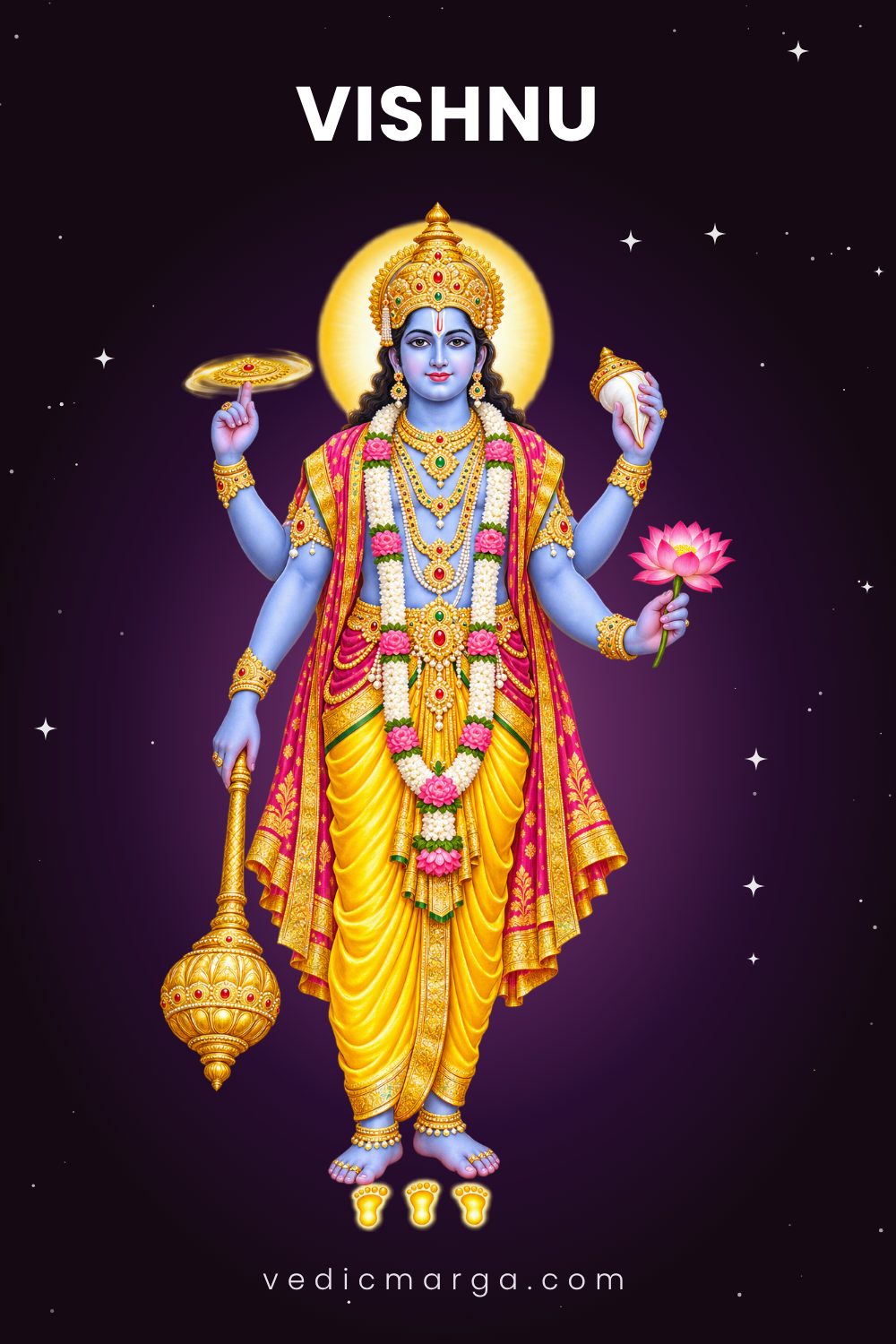
| Vishnu | Key facts |
|---|---|
| Vedic names | Urukrama and Urugaya, "the wide-strider" |
| Nakshatra | Shravana (10° to 23°20' Capricorn) |
| Vedic name of the nakshatra | Shrona |
| Nakshatra ruler | Moon |
| Rig Veda hymns | 1.154, 1.22.16-21 and others |
| Best-known verse | "Tad vishnoh paramam padam" (Rig Veda 1.22.20) |
| Avatar born in Shravana | Vamana (Bhagavata Purana 8.18.5) |
| Symbols of the nakshatra | An ear and 3 footprints |
In this article
Who Is Vishnu in the Veda?
In the Rig Veda, Vishnu is known for one great act: his 3 strides. He is called Urukrama and Urugaya, "the wide-strider." Only a few hymns of the Rig Veda are addressed to him alone.
The Bhagavata Purana (6.6.38-39) lists Urukrama among the 12 sons of Aditi. In the Bhagavad Gita (10.21), Krishna says, "Of the Adityas I am Vishnu."
The 3 Strides of Vishnu
Rig Veda 1.154 is the main hymn to Vishnu. Verses 1 and 2 praise his 3 strides, and verse 2 says that all the worlds live within them. Verse 4 says that he alone holds up the earth, the sky and all the worlds.
Verse 5 describes his highest step. There, it says, is a spring of honey in the highest footstep of the wide-strider, Urukrama. The poet asks to reach that dear place, where people who love the gods rejoice.
Tad Vishnoh Paramam Padam
Rig Veda 1.22 also speaks of the strides. Verse 17 says that Vishnu strode and set his foot down 3 times. In verse 18 he takes 3 steps and upholds the laws of the world from there. Verse 20 speaks of the highest step:
तद्विष्णोः परमं पदं सदा पश्यन्ति सूरयः ।
दिवीव चक्षुराततम् ॥The wise always see that highest step of Vishnu, like an eye spread out in the sky. (Rig Veda 1.22.20)
Vishnu, the Dwarf and the Sacrifice
The Shatapatha Brahmana (1.2.5) tells an early form of the Vamana story. The gods and the demons, both born of Prajapati, fought for the world. Soon the demons began to divide the earth among themselves with ox-hides.
The gods came to claim a share, led by Vishnu, who was the sacrifice. The demons said they would give as much land as Vishnu could lie on. Vishnu was a dwarf, so the offer seemed small.
The gods laid the dwarf down and surrounded him with the Vedic metres, with Agni on the east. In this way they won the whole earth (1.2.5.1-7). The text names the altar, the vedi, after this winning.
Was Vamana Born in Shravana?
Yes. The Bhagavata Purana (8.18.5) places Vamana's birth on Shravana Dvadashi, with the Moon in Shravana, at the Abhijit muhurta. He was born to Aditi and Kashyapa as their son (8.18.1).
As Vamana, a young brahmin boy, he asked King Bali for 3 steps of land. With 2 steps he covered the earth and the sky, and Bali offered his own head for the 3rd. Our Shravana page tells the story in full, along with the festival of Onam held in Bali's memory.
Vishnu and Shravana Nakshatra
Shravana comes from the root shru, "to hear." Its 3 footprints recall Vishnu's strides, and its ear recalls the Vedas, passed down by hearing. Our Shravana page gives its shakti as Samhanana shakti, the power of connection.
The Moon, the nakshatra ruler, gives a careful mind in Saturn's sign of Capricorn. Mars is exalted throughout Shravana, and Jupiter is debilitated there.
People with the Moon in Shravana are often good listeners, polite and steady. Many keep learning all their lives and teach what they learn. You can find your own birth nakshatra with the nakshatra calculator.
Vishnu Mantra
The Vedic verse for Shravana in the Nakshatra Suktam of the Taittiriya Brahmana (3.1) calls this nakshatra Shrona and recalls Vishnu's 3 steps:
शृण्वन्ति श्रोणाममृतस्य गोपाम् ।
पुण्यामस्या उपशृणोमि वाचम् ।
महीं देवीं विष्णुपत्नीमजूर्याम् ।
प्रतीचीमेनाग्ं हविषा यजामः ।
त्रेधा विष्णुरुरुगायो विचक्रमे ।
महीं दिवं पृथिवीमन्तरिक्षम् ।
तच्छ्रोणैति श्रव इच्छमाना ।
पुण्यग्ं श्लोकं यजमानाय कृण्वती ॥Shrinvanti Shronamamritasya gopam |
punyamasya upashrinomi vacham |
mahim devim Vishnupatnimajuryam |
pratichimenagum havisha yajamah |
tredha Vishnururugayo vichakrame |
mahim divam prithivimantariksham |
tachchhronaiti shrava ichchhamana |
punyagum shlokam yajamanaya krinvati ||
Meaning: They listen to Shrona, the guardian of the deathless. I listen closely to her holy voice. The great goddess, wife of Vishnu, never ages. We worship her, facing us, with this offering.
Vishnu, who strides far, took 3 steps across the wide heaven, the earth and the sky. Shrona goes there, seeking fame, and makes a good name for the one who offers.
The verses for all 27 nakshatras are on our page of nakshatra mantras. Learn the accents from a teacher or a recording before you recite a Vedic verse.
Name Mantra
We could not find a fixed name mantra for Vishnu in the Vedic texts. A plain salutation to the god is:
ॐ विष्णवे नमः
Om Vishnave Namah
It means "Om, salutation to Vishnu." Vishnave is the Sanskrit form for "to Vishnu." Our Shravana page also suggests Om Namo Narayanaya.
How to Worship Vishnu
Recite the Nakshatra Suktam verse or the name salutation on the days the Moon passes through Shravana. This happens about once every 27 days. Rig Veda 1.22.20 can be recited with it.
Shravana is the nakshatra of hearing, so listening to scripture suits this worship. In the Mahabharata's Anushasana Parva, Bhishma teaches Yudhishthira the Vishnu Sahasranama, the 1,000 names of Vishnu, and many families recite it.
All of this works on the mind. Listening carefully before you speak is the practice closest to this nakshatra. For a reading of your own Moon nakshatra and running dasha, you can book a Vedic astrology consultation.
Frequently Asked Questions
Who is the deity of Shravana Nakshatra?
Vishnu is the deity of Shravana. Its Nakshatra Suktam verse recalls his 3 steps across heaven, earth and sky.
What are the 3 strides of Vishnu?
Rig Veda 1.154 praises the 3 strides in which all the worlds live. In the Puranas, Vamana takes 3 steps to win back the worlds from Bali.
What does "tad vishnoh paramam padam" mean?
It is Rig Veda 1.22.20: "The wise always see that highest step of Vishnu, like an eye spread out in the sky."
Is Vishnu one of the Adityas?
Yes. The Bhagavata Purana lists Urukrama among Aditi's 12 sons, and the Gita (10.21) says, "Of the Adityas I am Vishnu."
Which planet rules Shravana Nakshatra?
The Moon rules Shravana. The nakshatra lies fully in Capricorn, so Saturn, the lord of Capricorn, also shapes it through the sign.
Summary
Vishnu is the god of the 3 wide strides and the deity of Shravana Nakshatra. Rig Veda 1.154 says all the worlds live in his strides, and 1.22.20 praises his highest step. The Shatapatha Brahmana tells how the dwarf Vishnu won the earth for the gods.
The Bhagavata places Vamana's birth in Shravana, and the Gita names Vishnu the chief of the Adityas. To work with Shravana, recite its verse on the Shravana day and listen well before you speak.


