


Vayu, the Vedic god of the wind, is the deity of Swati Nakshatra, which spans 6°40' to 20° Libra under Rahu. He is the moving air and the breath of life. The Rig Veda invites him to drink the Soma first. The Chandogya Upanishad teaches that fire, sun, moon and water all go back into him.
Swati's symbol is a young shoot swaying in the wind. Its Vedic verse calls the nakshatra Nishtya and says that Vayu comes to it like a sharp-horned bull, roaring loudly.
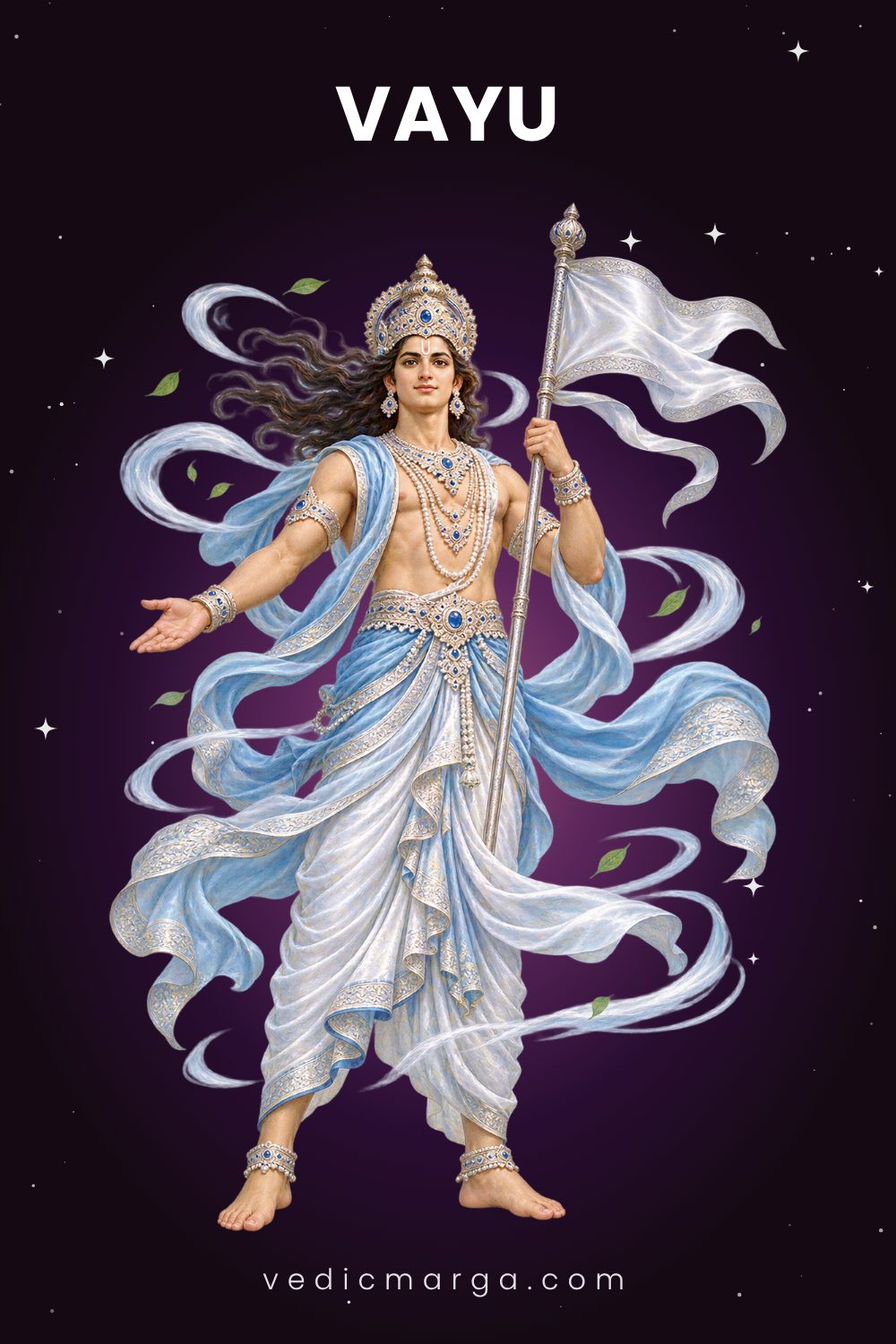
| Vayu | Key facts |
|---|---|
| Meaning of the name | Wind, air, the one who blows |
| Other names | Vata, Pavana, Anila |
| Nakshatra | Swati (6°40' to 20° Libra) |
| Vedic name of the nakshatra | Nishtya |
| Nakshatra ruler | Rahu |
| First hymn | Rig Veda 1.2, the second hymn of the Rig Veda |
| Sons | Hanuman and Bhima |
| Direction | North-west |
In this article
What Does Vayu Mean?
Vayu means wind or air. The name comes from the Sanskrit root va, "to blow." The Veda also calls the wind god Vata, and hymn 10.168 of the Rig Veda uses that name throughout.
Later texts add more names. In the Bhagavad Gita (10.31), Krishna says, "Of purifiers I am the wind," using the word pavana. Anila, another word for wind, is one of the 8 Vasus in the Mahabharata list. In later tradition Vayu is also one of the 8 guardians of the directions, ruling the north-west.
Vayu in the Rig Veda
Hymn 1.2, the second hymn of the Rig Veda, opens by calling Vayu to the Soma:
वायवा याहि दर्शतेमे सोमा अरंकृताः ।
तेषां पाहि श्रुधी हवम् ॥Come, Vayu, beautiful one. These Soma drinks are ready. Drink of them and hear our call. (Rig Veda 1.2.1)
The first 3 verses of this hymn praise Vayu alone. Verses 4 to 6 call on Indra and Vayu together, as the pair Indravayu.
Vayu, First to Drink the Soma
The Rig Veda gives Vayu the first draught of Soma in hymn 1.134. Its first verse asks swift horses to bring him to the feast, so that he may drink the Soma first. Verse 6 calls him first among all and worthy to drink the offerings.
Vata, the Roaring Wind
Rig Veda 10.168 is a hymn to the wind as Vata. Its first verse describes his chariot rushing with a roar, touching the sky and raising dust across the earth.
Verse 3 says he travels the paths of the air and never rests. It calls him the friend of the waters and the firstborn, and asks where he was born. Verse 4 calls him the breath of the gods and the germ of the world. His sound is heard, the verse says, and his form is never seen.
Vayu in the Upanishads
The Chandogya Upanishad (4.3) teaches that air swallows everything. When fire goes out, it goes into the air. When the sun and the moon set, they go into the air, and when water dries up, it goes into the air (4.3.1-2).
The next verse gives the same teaching for the body. Prana, the breath, swallows everything there. In sleep, speech, the eyes, the ears and the mind all go into prana (4.3.3).
Verse 4.3.4 sums up the teaching. These 2 swallow everything: air among the gods, and prana among the organs of the body.
Is Vayu the Father of Hanuman?
Yes. The Valmiki Ramayana calls Hanuman the son of Vayu, born to Anjana. In the Kishkindha Kanda (sarga 66), Jambavan tells Hanuman the story of his birth before the leap to Lanka.
The Wind god promised Anjana a brave and wise son (verse 18). As a child, Hanuman saw the rising sun, took it for a fruit and leapt into the sky (verse 21). Indra struck him with the vajra, and his jaw (hanu) was broken, which gave him the name Hanuman (verses 23-24).
Bhima of the Mahabharata is a son of Vayu as well. In the Adi Parva (section 123 in the Ganguli translation), Kunti invokes Vayu, and Bhima is born. When the infant fell from his mother's lap, the stone beneath him broke into pieces and the child was unhurt.
Vayu and Swati Nakshatra
Swati is the nakshatra of the wind. Its symbol is a young shoot moving in the breeze. Our Swati page gives its shakti as Pradhvamsa shakti, the power to scatter like the wind. Swati is a movable nakshatra, suited to travel and change.
Rahu, the nakshatra ruler, adds a strong drive for success and new experience. The nakshatra lies fully in Libra, a sign of balance and fair dealing.
People with the Moon in Swati often value their freedom and adapt quickly to change. Many are good speakers and do well in trade, travel and independent work. You can find your own birth nakshatra with the nakshatra calculator.
Vayu Mantra
The Vedic verse for Swati in the Nakshatra Suktam of the Taittiriya Brahmana (3.1) is addressed to Vayu. It names the nakshatra Nishtya:
वायुर्नक्षत्रमभ्येति निष्ट्याम् ।
तिग्मशृङ्गो वृषभो रोरुवाणः ।
समीरयन् भुवना मातरिश्वा ।
अप द्वेषाग्ंसि नुदतामरातीः ।
तन्नो वायुस्तदु निष्ट्या शृणोतु ।
तन्नक्षत्रं भूरिदा अस्तु मह्यम् ।
तन्नो देवासो अनुजानन्तु कामम् ।
यथा तरेम दुरितानि विश्वा ॥Vayurnakshatramabhyeti Nishtyam |
tigmashringo vrishabho roruvanah |
samirayan bhuvana Matarishva |
apa dveshagumsi nudatamaratih |
tanno Vayustadu Nishtya shrinotu |
tannakshatram bhurida astu mahyam |
tanno devaso anujanantu kamam |
yatha tarema duritani vishva ||
Meaning: Vayu goes to his nakshatra, Nishtya (Swati), a bull with sharp horns, roaring loudly. Matarishvan, the wind, sets the worlds in motion. May he drive away hatred and enemies.
May Vayu and Nishtya hear this from us. May that nakshatra give me plenty. May the gods grant us our wish, so that we may cross over every difficulty.
The verses for all 27 nakshatras are on our page of nakshatra mantras. Learn the accents from a teacher or a recording before you recite a Vedic verse.
Name Mantra
We could not find a fixed name mantra for Vayu in a classical text. A plain salutation to the deity is:
ॐ वायवे नमः
Om Vayave Namah
It means "Om, salutation to Vayu." Vayave is the Sanskrit form for "to Vayu."
How to Worship Vayu
Recite the Nakshatra Suktam verse or the name salutation on the days the Moon passes through Swati. This happens about once every 27 days. Rig Veda 1.2.1, the first call to Vayu, can be recited at the same time.
Pranayama, the practice of the breath, suits this deity, since the Chandogya Upanishad pairs the wind outside with the breath within. Many families also worship Hanuman as the son of Vayu.
All of this works on the mind. A few minutes of slow, steady breathing each morning is the practice closest to Vayu. For a reading of your own Moon nakshatra and running dasha, you can book a Vedic astrology consultation.
Frequently Asked Questions
Who is the deity of Swati Nakshatra?
Vayu, the god of the wind, is the deity of Swati. The Nakshatra Suktam verse for Swati names him and calls the nakshatra Nishtya.
Who is the wind god in Hinduism?
Vayu is the wind god. The Rig Veda also calls him Vata, and later texts use names such as Pavana and Anila.
Is Vayu the father of Hanuman and Bhima?
Yes. The Valmiki Ramayana (Kishkindha Kanda 66) names Hanuman as the son of Vayu and Anjana. The Mahabharata (Adi Parva) tells how Kunti invoked Vayu and gave birth to Bhima.
Why is Vayu called the first drinker of Soma?
Rig Veda 1.134 asks Vayu to drink the Soma first and calls him first among all the gods worthy to drink it.
Which planet rules Swati Nakshatra?
Rahu rules Swati. The nakshatra lies fully in Libra, so Venus, the lord of Libra, also shapes it through the sign.
What is the mantra of Vayu?
The Vedic mantra is the Swati verse of the Nakshatra Suktam, which begins "Vayurnakshatramabhyeti Nishtyam." The plain name salutation is Om Vayave Namah.
Summary
Vayu is the Vedic god of the wind and the deity of Swati Nakshatra. The Rig Veda calls him to the Soma in its second hymn and gives him the first draught in hymn 1.134. Hymn 10.168 praises him as Vata, the breath of the gods.
The Chandogya Upanishad teaches that all things go into the air, and that the breath does the same in the body. Hanuman and Bhima are his sons. To work with Swati, recite the Nishtya verse on the Swati day and keep a short daily practice of steady breathing.


