


Brahma, the 4-faced creator, is the deity of Abhijit Nakshatra, the small 28th nakshatra that spans 6°40' to 10°53'20" Capricorn. The Mundaka Upanishad calls him the first of the gods and the maker of the universe. In the Puranas he is born on a lotus that grows from Vishnu's navel.
Abhijit means "the victorious." Its Vedic verse says that Brahma won all the worlds in this nakshatra, this world and the world beyond.
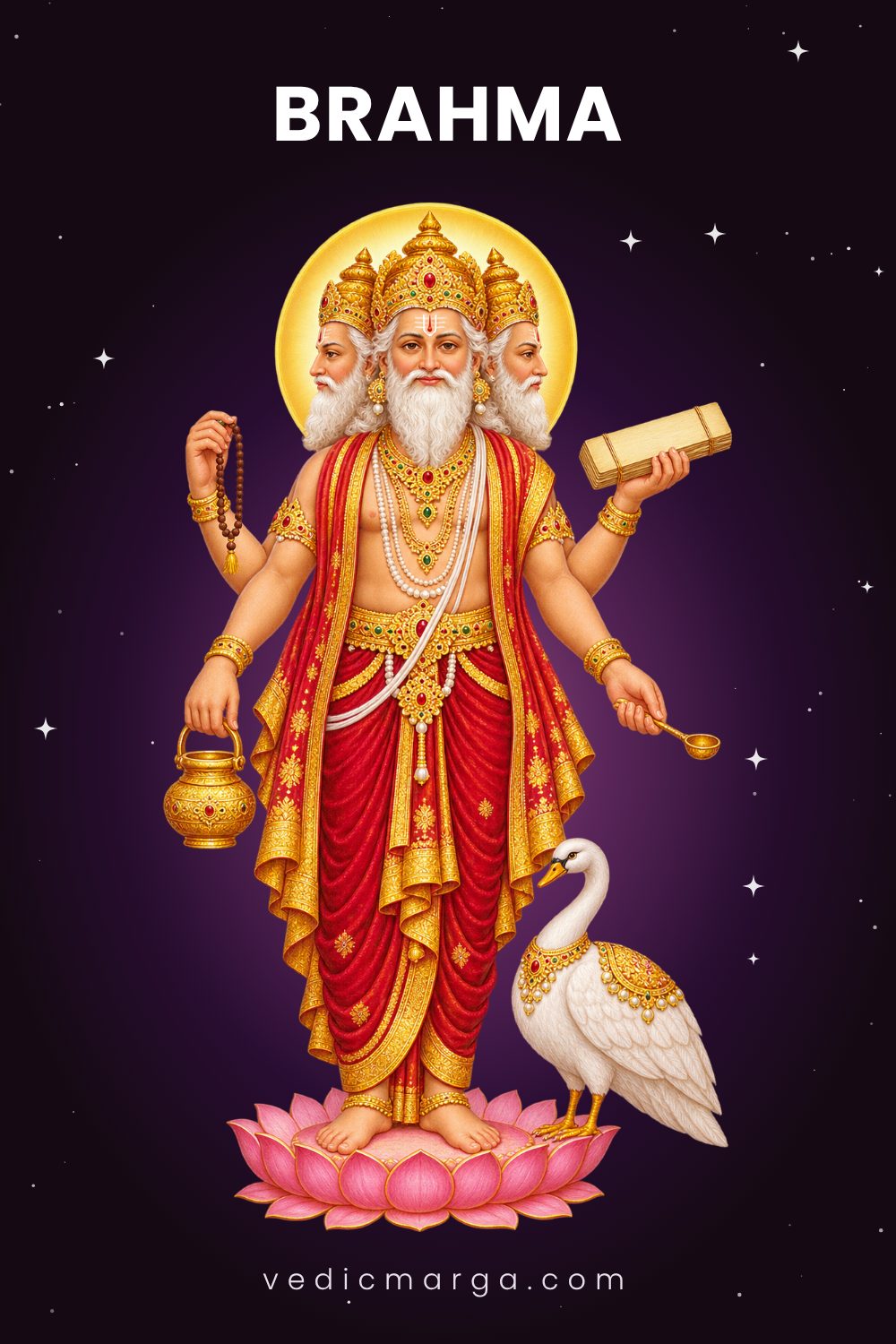
| Brahma | Key facts |
|---|---|
| Meaning of the name | From the root brih, "to grow" or "to expand" |
| Other names | Svayambhu (the self-born), Pitamaha (the grandfather) |
| Nakshatra | Abhijit (6°40' to 10°53'20" Capricorn) |
| Dasha lord | None, since Abhijit is outside the Vimshottari system |
| Also named for | Rohini, as Kamalaja, "the lotus-born" (Brihat Samhita 98.4) |
| Birth | From a lotus in Vishnu's navel (Bhagavata Purana 3.8) |
| Form | 4 faces, one for each direction |
| A day of Brahma | 1,000 yugas (Bhagavad Gita 8.17) |
In this article
What Does Brahma Mean?
The name Brahma comes from the root brih, "to grow" or "to expand." He is the god who brings the world into being. The Puranas often call him Svayambhu, "the self-born," and Pitamaha, the grandfather of all beings.
Brahma is easy to confuse with 2 similar words. Brahman is the Absolute of the Upanishads, the one reality behind all things. A brahmin is a member of the priestly class. Brahma is the creator god with 4 faces.
Brahma in the Upanishads
The Mundaka Upanishad opens with Brahma. Its first verse names him as the first of the gods and the source of the teaching that follows:
ॐ ब्रह्मा देवानां प्रथमः सम्बभूव विश्वस्य कर्ता भुवनस्य गोप्ता ।
स ब्रह्मविद्यां सर्वविद्याप्रतिष्ठामथर्वाय ज्येष्ठपुत्राय प्राह ॥Om. Brahma arose as the first of the gods, the maker of the universe and the protector of the world. He taught the knowledge of Brahman, the ground of all knowledge, to Atharva, his eldest son. (Mundaka Upanishad 1.1.1)
The 2nd verse traces the line of teachers. Atharva passed the knowledge to Angir, and Angir to Satyavaha of the Bharadvaja family. From him it went to Angiras (1.1.2).
The Shvetashvatara Upanishad (6.18) places Brahma under a higher Lord. Its seeker takes refuge in the god "who first created Brahma and gave him the Vedas."
How Was Brahma Born?
The Bhagavata Purana tells the story in its 3rd book. Vishnu lay on the waters, and a lotus bud grew from his navel, lighting everything like the sun (3.8.14). The self-born Brahma appeared inside it (3.8.15).
From the whorl of the lotus he could see nothing, so he looked in every direction. In doing so he gained 4 heads, one for each direction (3.8.16). He went down the lotus stalk to find its source and never reached it (3.8.19).
Brahma came back to the top of the lotus and fixed his mind on the Lord (3.8.21). After 100 years of meditation, he saw the Lord within his own heart (3.8.22). Then he saw Vishnu lying on the serpent Shesha (3.8.23).
The 4 Sages, Rudra and the Vedas
Brahma's first creations were 4 sages: Sanaka, Sananda, Sanatana and Sanatkumara (3.12.4). He asked them to have children, and they refused, since their minds were set on liberation (3.12.5).
Brahma grew angry, and a child appeared from between his eyebrows (3.12.7). The child cried and asked for a name, so Brahma called him Rudra (3.12.8-10). Later in the chapter, the 4 Vedas come from Brahma's 4 mouths (3.12.34).
What Is a Day of Brahma?
Brahma's life runs on a scale far larger than ours. In the Bhagavad Gita (8.17), Krishna says that a day of Brahma lasts 1,000 yugas, and his night lasts as long. Those who know this, he adds, know what day and night truly are.
In the 11th chapter, Arjuna sees the universal form of Krishna. Among the beings within it is "Brahma, the lord, seated on the lotus" (Gita 11.15).
Why Is Brahma Rarely Worshipped?
Brahma has very few temples, and the Shiva Purana gives a story for this in its Vidyeshvara Samhita. Brahma and Vishnu fought, each set on defeating the other (7.9). Shiva appeared between them as a pillar of fire (7.10-12).
Vishnu took the form of a boar and dug down to find the base of the pillar. Brahma flew up as a swan to find its top (7.16-19). Neither of them reached the end.
On the way up, Brahma met a falling ketaki flower (7.19-23). He asked it to back a false claim that he had seen the top (7.24-28). Shiva then told him that he would have no honour, no temple and no festival of his own (8.9-11).
Shiva also gave Brahma a boon: he would preside over domestic and public sacrifices (8.13-14). The ketaki shared the blame, and Shiva said it was not proper for him to wear it (8.19-21). Many devotees still keep the ketaki out of Shiva worship.
Brahma and Abhijit Nakshatra
The Nakshatra Suktam gives Abhijit to Brahma. Its verse says that Brahma won both worlds in this nakshatra, and it asks Abhijit to help us win our own battles. Our Abhijit page ties the name, "the victorious," to this victory.
The Mahabharata (Vana Parva, section 229 in the Ganguli translation) tells how Abhijit left the sky. Indra tells Skanda that Abhijit, the younger sister of Rohini, went to the forest out of jealousy. He asks Skanda to consult Brahma about the empty place. The text adds that Brahma created Dhanishtha and the other nakshatras.
Abhijit covers the last pada of Uttara Ashadha and the first 53'20" of Shravana. It has no dasha lord, since the Vimshottari system uses only 27 nakshatras. Birth charts read a Moon here through those 2 nakshatras.
In the Bhagavata Purana (11.16.27), Krishna says, "Among nakshatras I am Abhijit." The Abhijit muhurta, the 8th of the 15 muhurtas of the day, falls around local noon. The Bhagavata (8.18.5) places Vamana's birth in this muhurta.
Does Brahma Rule 2 Nakshatras?
In the jyotish lists, he does. Varahamihira's Brihat Samhita (98.4-5) names Kamalaja, "the lotus-born," for Rohini and Brahma for Abhijit. Both are names of the same creator god.
The Vedic Nakshatra Suktam uses 2 names. It gives Rohini to Prajapati and Abhijit to Brahma. Later texts identify Prajapati with Brahma, so many jyotish books give Brahma as Rohini's deity too.
Brahma Mantra
The Vedic verse for Abhijit in the Nakshatra Suktam of the Taittiriya Brahmana (3.1) names Brahma twice:
यस्मिन् ब्रह्माभ्यजयत्सर्वमेतत् ।
अमुं च लोकमिदमू च सर्वम् ।
तन्नो नक्षत्रमभिजिद्विजित्य ।
श्रियं दधात्वहृणीयमानम् ।
उभौ लोकौ ब्रह्मणा सञ्जितेमौ ।
तन्नो नक्षत्रमभिजिद्विचष्टाम् ।
तस्मिन् वयं पृतनाः सञ्जयेम ।
तन्नो देवासो अनुजानन्तु कामम् ॥Yasmin Brahmabhyajayatsarvametat |
amum cha lokamidamu cha sarvam |
tanno nakshatramabhijidvijitya |
shriyam dadhatvahriniyamanam |
ubhau lokau Brahmana sanjitemau |
tanno nakshatramabhijidvichashtam |
tasmin vayam pritanah sanjayema |
tanno devaso anujanantu kamam ||
Meaning: In it Brahma won all of this, that world and this whole world. May that nakshatra, Abhijit, the victorious, give us prosperity without anger.
Both these worlds are won by Brahma. May that nakshatra Abhijit look on this for us. In it may we win our battles. May the gods grant us our wish.
The verses for all 27 nakshatras and Abhijit are on our page of nakshatra mantras. Learn the accents from a teacher or a recording before you recite a Vedic verse.
Name Mantra
We could not find a fixed name mantra for Brahma in a classical text. A plain salutation to the god is:
ॐ ब्रह्मणे नमः
Om Brahmane Namah
It means "Om, salutation to Brahma." Brahmane is the Sanskrit form for "to Brahma."
How to Worship Brahma
Recite the Nakshatra Suktam verse or the name salutation when the Moon passes through Abhijit. Most panchangs do not show Abhijit as the day's nakshatra, so the Abhijit muhurta around noon is a simple daily time to use. Mundaka Upanishad 1.1.1 can be recited with it.
Brahma gave the Vedas to the world, so reading a Vedic text suits his worship. The best-known Brahma temple stands at Pushkar in Rajasthan, where pilgrims gather at the Kartik full moon.
All of this works on the mind. Starting new work with care, and learning a subject from its foundations, are the acts closest to the creator. For a reading of your own Moon nakshatra and running dasha, you can book a Vedic astrology consultation.
Frequently Asked Questions
Who is the deity of Abhijit Nakshatra?
Brahma, the creator, is the deity of Abhijit. Its Nakshatra Suktam verse says that Brahma won both worlds in this nakshatra.
Is Brahma also the deity of Rohini?
Many jyotish books say so. The Brihat Samhita names Kamalaja, the lotus-born Brahma, for Rohini, and the Nakshatra Suktam gives Rohini to Prajapati.
Are Brahma and Brahman the same?
No. Brahma is the 4-faced creator god, and Brahman is the Absolute of the Upanishads. The Mundaka Upanishad says Brahma taught the knowledge of Brahman to his son Atharva.
Why does Brahma have 4 faces?
The Bhagavata Purana (3.8.16) says he looked in every direction from the lotus and gained a head for each. The same text says the 4 Vedas came from his 4 mouths.
Why are there so few Brahma temples?
The Shiva Purana says Shiva denied Brahma a temple and a festival of his own. This followed Brahma's false claim that he had seen the top of the pillar of fire.
Does Abhijit have a ruling planet?
No planet rules Abhijit in the Vimshottari dasha system, which uses 27 nakshatras. A Moon in Abhijit is read through Uttara Ashadha or Shravana.
Summary
Brahma is the 4-faced creator and the deity of Abhijit Nakshatra. The Mundaka Upanishad calls him the first of the gods, and the Bhagavata says he was born on a lotus from Vishnu's navel. According to the Nakshatra Suktam, he won both worlds in Abhijit.
The Brihat Samhita also names him for Rohini, as the lotus-born. To work with Abhijit, recite its verse at the Abhijit muhurta and begin new work with care.


