


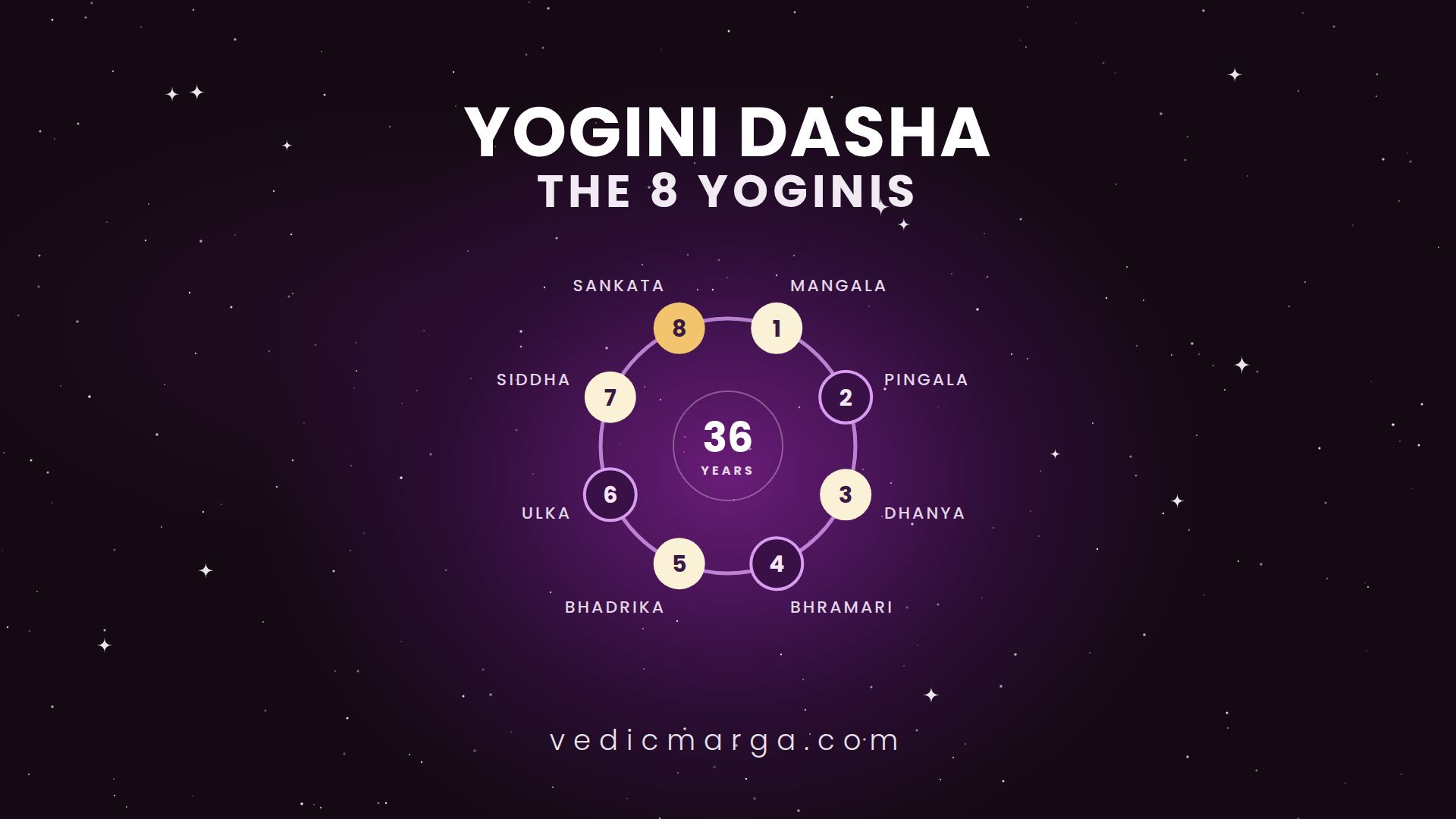
Yogini Dasha is a Vedic timing system of 36 years, divided among 8 Yoginis. Each Yogini is the feminine energy of a planet, and her period brings that planet's results forward in your life.
The system is short. A full round takes 36 years, so most people pass through it 2 or 3 times. Astrologers in North India and Nepal use it widely beside Vimshottari Dasha to confirm when an event is likely.
This guide explains each Yogini, what her period tends to bring and how to read it in your own chart. To find your current Yogini, use the Yogini Dasha calculator.
In this article
What the Yoginis Are
A Yogini is a form of the Goddess, the active power of the divine. In this dasha system, each of the 8 Yoginis carries the energy of one planet. The planet gives the subject of the period, and the Yogini gives its tone.
Brihat Parashara Hora Shastra describes Yogini Dasha among its dasha systems. The names of the Yoginis describe their nature in plain words: Mangala means auspicious, Ulka means meteor and Sankata means crisis.
The planets in your chart are energies you already hold. A Yogini period shows which of those energies comes forward, for how long and in what mood. Each period reflects a part of your own nature back to you. Seen this way, the dasha is a map for self-knowledge.
The 8 Yoginis at a Glance
| Yogini | Planet | Years | Nature |
|---|---|---|---|
| Mangala | Moon | 1 | Benefic |
| Pingala | Sun | 2 | Malefic |
| Dhanya | Jupiter | 3 | Benefic |
| Bhramari | Mars | 4 | Malefic |
| Bhadrika | Mercury | 5 | Benefic |
| Ulka | Saturn | 6 | Malefic |
| Siddha | Venus | 7 | Benefic |
| Sankata | Rahu and Ketu | 8 | Malefic |
The 4 benefic Yoginis alternate with the 4 malefic ones. Each period is 1 year longer than the one before it, and the 8 periods add up to 36 years.
How Your Yogini Dasha Begins
Your first Yogini comes from the nakshatra the Moon occupies at birth. Add 3 to the number of that nakshatra and divide by 8. The remainder gives the first Yogini, and a remainder of 0 gives Sankata.
The Moon's position inside the nakshatra decides how much of that first period is left at birth. From there the Yoginis follow the fixed order in the table above.
The 8 Yogini Periods and Their Results
A Yogini gives the results of her planet as it sits in your birth chart. The general results below shift with that planet's sign, house, lordship and aspects. Read each one against your own chart.
Mangala: The Moon's Yogini (1 Year)
The shortest period in the cycle belongs to the Moon. Mangala tends to bring comfort, a settled mind and pleasant events at home. Family ties grow warmer. Small wishes come true.
A strong Moon gives emotional steadiness and public goodwill. An afflicted Moon makes the year more changeable in mood. Use Mangala to rest. Reconnect with your mother, and build small daily habits that calm the mind before the heat of Pingala begins.
Pingala: The Sun's Yogini (2 Years)
Pingala means tawny, the colour of fire. These 2 years carry the Sun's heat, and they test your relationship with power, both your own and the power others hold. Matters of authority, the father, government and self-respect come forward, often with some friction.
When the Sun is strong, Pingala can bring recognition and a position of responsibility. When it is weak, pride and conflict with seniors tend to rise. The inner work here is to lead with humility and to keep ego out of hard decisions.
Dhanya: Jupiter's Yogini (3 Years)
Jupiter's 3 years carry the name Dhanya, wealthy and blessed, and they are counted among the best in the cycle. Income, learning, children, teachers and faith all tend to grow, often through the advice of someone older who sees your situation clearly.
A well-placed Jupiter makes good decisions easier and brings support when it is needed. Jupiter in a dusthana or in debilitation gives smaller gains that come more slowly. Study, generosity and respect for your teachers carry the period furthest.
Bhramari: Mars's Yogini (4 Years)
Bhramari is the wandering bee. Mars's 4 years bring movement: travel, a change of residence, new ventures and a restless mind. Energy runs high.
With a strong Mars, this drive builds property, courage and competitive success. With an afflicted Mars, it can turn into quarrels, haste and scattered effort. Give the energy a clear goal and a physical discipline, and Bhramari becomes productive.
Bhadrika: Mercury's Yogini (5 Years)
Good fortune through intelligence is the theme of Bhadrika, whose name means good and gentle, and whose planet is quick, curious Mercury. Mercury's 5 years favour study, trade, writing, friendships and skilled work.
A strong Mercury makes this one of the most productive periods for career and business. A weak Mercury brings scattered thinking and too many plans at once. Finish what you start.
Ulka: Saturn's Yogini (6 Years)
A meteor, a light falling to earth, gives Ulka its name. Saturn's 6 years tend to bring hard work, delays, responsibility and the weight of duty. Results come slowly, through effort, and they tend to stay once they arrive because they rest on work that was actually done.
For a Taurus or Libra ascendant, where Saturn is a yogakaraka, Ulka can build lasting success. An afflicted Saturn makes the period feel heavy, with losses that ask for patience. Steady routine, honest work and service to those who carry heavy loads settle Saturn in the mind.
Siddha: Venus's Yogini (7 Years)
Venus rules the 7 years of Siddha, the accomplished one. They are often the most rewarding of the cycle, with success in work, comfort, art, marriage and pleasant company.
A strong Venus fulfils long-held wishes and brings partnership and prosperity together. A weak or afflicted Venus can pull the period toward indulgence and overspending. Enjoy what arrives. Keep your values clear, so that comfort supports your purpose and success stays in your hands.
Sankata: The Yogini of Rahu and Ketu (8 Years)
Sankata means crisis, and at 8 years it is the longest period in the cycle, running from Rahu's ambition to Ketu's release. Rahu and Ketu were one body before they became 2 planets, so they share one Yogini. The first half of Sankata is Rahu's period, and the second half is Ketu's.
The first 4 years carry Rahu's results: ambition, sudden change, foreign links and unusual events. The last 4 years carry Ketu's results: detachment, loss of interest in old goals and a turn toward inner life.
Both halves shake what is loose. Both reveal what you have been holding on to, and seeing it clearly is the main work of these 8 years. Rahu's half asks for clarity about what you truly want. Ketu's half asks you to let go of what has already ended.
Reading Antardashas Inside a Yogini Period
Each Yogini Mahadasha divides into 8 Antardashas, starting with its own Yogini. An Antardasha lasts the Mahadasha years multiplied by the Antardasha years, divided by 36.
The Mahadasha sets the theme, and the Antardasha shows which part of it comes forward. A benefic Antardasha inside Dhanya or Siddha tends to give the clearest good results. A malefic Antardasha inside Ulka or Sankata concentrates the difficult ones.
Mixed combinations give mixed results. Bhadrika inside Ulka, for example, can bring a useful skill, a helpful friend or a good contract in the middle of slow, demanding years.
Using Yogini Dasha With Vimshottari Dasha
Vimshottari is the main timing system, and Yogini is the second lens. Start with the running Vimshottari Mahadasha and its Antardasha. Then check which Yogini is active in the same months, and see whether her planet repeats or supports the Vimshottari lord.
When both systems point to the same planet or theme, the timing is firm. A Venus Antardasha in Vimshottari that falls inside Siddha, for example, strongly supports marriage or success in that window.
When the 2 systems point to different planets, read the period as having 2 layers. Vimshottari gives the main direction, and Yogini shows the tone within it.
Timing Marriage and Career With Yogini Dasha
Astrologers often turn to Yogini Dasha for 2 questions: when marriage will happen and when career will rise. The method is simple and uses both systems together.
For marriage, look for Siddha or Mangala running together with a Vimshottari period of Venus, Jupiter or the 7th lord. For career, look for Dhanya, Bhadrika or Siddha during a Vimshottari period linked to the 10th house or its lord.
Ulka can also time career growth. Saturn rewards long effort, so a promotion can arrive late in Ulka after years of steady work. Sankata tends to bring a change of direction, such as a move abroad or a new field of work.
Always confirm the promise in the birth chart first, since marriage, children or high position must show there before a period brings them. Timing comes second.
What to Do in Each Yogini Period
A Yogini period brings forward an energy you already hold. The most useful response works on that energy within you. Mantra, service and steady conduct shape the mind, and the mind shapes how the period unfolds.
- Mangala and Siddha: use the easy periods to build. Start projects, strengthen relationships and practise gratitude.
- Dhanya and Bhadrika: study, teach and take on skilled work. These periods reward learning.
- Pingala: keep your ego in check with seniors. Offer water to the rising Sun or recite the Aditya Hridayam.
- Bhramari: give Mars a physical outlet and a single clear goal. Hanuman worship steadies the energy.
- Ulka: keep a firm routine and serve the elderly and the working poor. Saturn's mantra, chanted on Saturdays, supports patience.
- Sankata: slow down major decisions. Meditation and the worship of Durga or Ganesha steady the mind through change.
For a period that feels heavy, a reading of the full chart shows which planet needs attention. You can book a consultation with an astrologer for this.
Yogini Dasha in Brief
Yogini Dasha divides 36 years among 8 Yoginis, each the feminine energy of a planet. Mangala, Dhanya, Bhadrika and Siddha are the benefic periods, and Pingala, Bhramari, Ulka and Sankata are the testing ones. Each period gives its planet's results as placed in your chart. Read it beside Vimshottari, and use each period to work on the energy it brings forward.
Frequently asked questions
What are the 8 Yoginis in Yogini Dasha?
Mangala (Moon), Pingala (Sun), Dhanya (Jupiter), Bhramari (Mars), Bhadrika (Mercury), Ulka (Saturn), Siddha (Venus) and Sankata (Rahu and Ketu). Their periods run from 1 to 8 years in that order.
Which Yogini Dasha is the best?
Dhanya and Siddha are traditionally the most rewarding, followed by Bhadrika and Mangala. The final result depends on the strength of the planet in your birth chart.
What happens in Sankata Yogini Dasha?
Sankata is the 8-year period of Rahu and Ketu. Rahu's first half tends to bring ambition and sudden change. Ketu's second half tends to bring detachment and a turn inward.
What does Ulka Yogini Dasha bring?
Ulka is Saturn's 6-year period. It tends to bring hard work, delays and responsibility. A strong Saturn in the birth chart turns that effort into lasting results.
Is Yogini Dasha more accurate than Vimshottari?
Vimshottari is the main timing system, and Yogini works best as a second check. A result is most likely when both systems point to the same planet at the same time.


