


The Vasus are the deities of Dhanishta Nakshatra, which spans 23°20' Capricorn to 6°40' Aquarius and is ruled by Mars. They are a group of 8 Vedic gods tied to fire, earth, wind, sky and light. The Brihadaranyaka Upanishad says they are called Vasus because the whole world rests in them.
The word vasu means good, excellent and wealthy. Dhanishta carries the same idea in its own name, which comes from dhana, wealth.
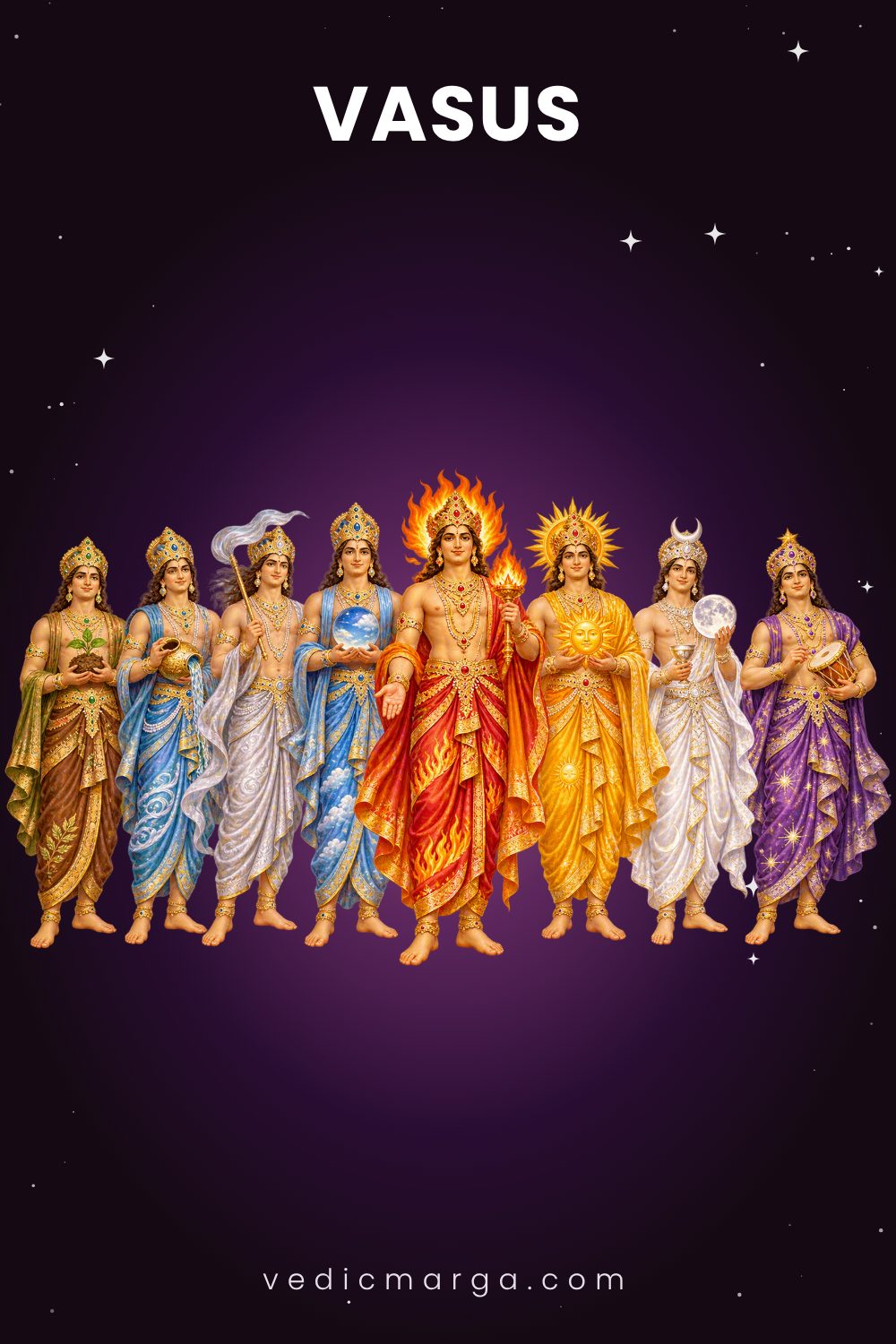
| The Vasus | Key facts |
|---|---|
| Number | 8, the Ashta Vasu |
| Nakshatra | Dhanishta (23°20' Capricorn to 6°40' Aquarius) |
| Nakshatra ruler | Mars |
| Vedic name of the nakshatra | Shravishtha |
| Upanishad list | Fire, earth, air, sky, sun, heaven, moon, stars |
| Mahabharata list | Dhara, Dhruva, Soma, Aha, Anila, Anala, Pratyusha, Prabhasa |
| Chief of the Vasus | Agni (Bhagavad Gita 10.23) |
In this article
Who Are the 8 Vasus?
The 8 Vasus are named in 2 main lists, one from the Upanishads and one from the Mahabharata. Both lists count 8, and they use different names.
In the older list, from the Brihadaranyaka Upanishad (3.9.3), the Vasus are fire, earth, air, the sky, the sun, heaven, the moon and the stars. One line explains the name: all this is placed in them, so they are called Vasus.
Personal names come from the Mahabharata (Adi Parva 66). The 8 Vasus are Dhara, Dhruva, Soma, Aha, Anila, Anala, Pratyusha and Prabhasa. The same chapter names their sons. Kala, or Time, is the son of Dhruva, and Vishvakarma is the son of Prabhasa.
Some Mahabharata names share their meaning with items in the older list. Anila is the wind, Anala is fire, and Soma is linked with the moon. Dhara means the one who holds, a name for the earth.
The Vasus Among the 33 Gods
The Vasus are one of the 3 great groups of Vedic gods. In the Brihadaranyaka Upanishad (3.9.2), the sage Yajnavalkya is asked how many gods there are. He brings the count down to 33.
Yajnavalkya's 33 are the 8 Vasus, the 11 Rudras and the 12 Adityas, with Indra and Prajapati making up the last 2. The 11 Rudras include Aja Ekapada and Ahirbudhnya, the deities of the 2 Bhadrapada nakshatras.
The Rig Veda often calls on these 3 groups together. Rig Veda 1.45 opens with a request to Agni:
त्वमग्ने वसूँरिह रुद्राँ आदित्याँ उत ।
O Agni, worship here the Vasus, the Rudras and the Adityas. (Rig Veda 1.45.1, first line)
Agni, Chief of the Vasus
Agni is the leader of the Vasus. In the Bhagavad Gita (10.23), Krishna names the best in each group and says, "Of the Vasus I am fire." The Sanskrit word is pavaka, the purifier, a name of Agni.
Fire also stands first in the Upanishad's list. In the Mahabharata list, Anala is fire. The same chapter calls Kumara, born in a forest of reeds, the son of Agni.
Bhishma and the Vasus
Bhishma of the Mahabharata was one of the Vasus born as a man. His story comes from the Adi Parva (sections 98 and 99 in the Ganguli translation).
Vasishtha, a sage also called Apava, kept a cow of plenty named Nandini at his hermitage on Mount Meru. The Vasus came there with their wives. One wife wanted the cow for a friend, a princess, so that she would never grow old or fall ill.
Her husband, the Vasu named Dyu, took the cow with the help of his brothers. Vasishtha saw what had happened through his ascetic power and cursed all 8 to be born on earth.
The Vasus begged for mercy. Vasishtha softened the curse: 7 of them would be freed within a year of birth. Dyu would stay on earth a long time, have no children and live as a virtuous man who knew the scriptures.
The Vasus asked the river goddess Ganga to be their mother. She married King Shantanu and drowned her first 7 sons at birth, which freed them. Shantanu stopped her at the 8th child. That child was Dyu, later called Devavrata and then Bhishma, the grandsire of the Kauravas and Pandavas.
The Vasus and the Morning of Life
The Chandogya Upanishad (3.16) links the Vasus with the first stage of life. It treats a person's life as a sacrifice with 3 pressings of Soma.
The first 24 years are the morning pressing, and the Vasus own it. The text says the pranas, the breaths of life, are the Vasus, because they make all this abide. A young person who falls ill prays to them to carry life on to the midday pressing.
The Vasus and Dhanishta Nakshatra
Dhanishta is the nakshatra of wealth, and its symbol is the drum. The Vedic text calls it Shravishtha. Its verse in the Nakshatra Suktam names 8 Vasus and 4 ageless goddesses, the Shravishtha stars.
Mars, the nakshatra ruler, gives courage and drive, and Mars is exalted at 28° Capricorn, inside the second pada. People with the Moon in Dhanishta are often generous, musical and good at gathering resources. You can find your own birth nakshatra with the nakshatra calculator.
Vasus Mantra
The Vedic verse for Dhanishta comes from the Nakshatra Suktam of the Taittiriya Brahmana (3.1). It is addressed to the Vasus:
अष्टौ देवा वसवः सोम्यासः ।
चतस्रो देवीरजराः श्रविष्ठाः ।
ते यज्ञं पान्तु रजसः पुरस्तात् ।
संवत्सरीणममृतग्ं स्वस्ति ।
यज्ञं नः पान्तु वसवः पुरस्तात् ।
दक्षिणतोऽभियन्तु श्रविष्ठाः ।
पुण्यं नक्षत्रमभि संविशाम ।
मा नो अरातिरघशग्ंसाऽगन्न् ॥Ashtau deva Vasavah somyasah |
chatasro devirajarah Shravishthah |
te yagyam pantu rajasah purastat |
samvatsarinamamritagum svasti |
yagyam nah pantu Vasavah purastat |
dakshinato'bhiyantu Shravishthah |
punyam nakshatramabhi samvishama |
ma no aratiraghashagumsa'gann ||
Meaning: There are 8 gods, the Vasus, who love Soma, and 4 ageless goddesses, the Shravishthas. May they guard the sacrifice from the front, from the mists, and give well-being and deathless life for the whole year.
May the Vasus guard our sacrifice in front, and may the Shravishthas come from the south. May we enter the holy nakshatra. May no enemy who wishes us harm come near.
The verses for all 27 nakshatras are on our page of nakshatra mantras. Learn the accents from a teacher or a recording before you recite a Vedic verse.
Name Mantra
We could not find a fixed name mantra for the Vasus in a classical text. A plain salutation is:
ॐ वसुभ्यो नमः
Om Vasubhyo Namah
It means "Om, salutation to the Vasus." Vasubhyo is the Sanskrit form for "to the Vasus."
How to Worship the Vasus
Recite the Nakshatra Suktam verse or the name salutation on the days the Moon passes through Dhanishta. This happens about once every 27 days. Agni leads the Vasus, so lighting a lamp or a small fire offering suits this worship.
The Upanishad's Vasus include earth, air and fire, the elements that support a body. Keeping the air fresh and the home clean and in order is a simple way to honour them.
All of this works on the mind. Steady gratitude for what supports life changes how a person meets a Mars period. For a reading of your own Moon nakshatra and running dasha, you can book a Vedic astrology consultation.
Frequently Asked Questions
Who is the deity of Dhanishta Nakshatra?
The 8 Vasus are the deities of Dhanishta. The Nakshatra Suktam verse for Dhanishta names them together with the 4 Shravishtha goddesses.
What are the names of the 8 Vasus?
The Mahabharata names them Dhara, Dhruva, Soma, Aha, Anila, Anala, Pratyusha and Prabhasa. The Brihadaranyaka Upanishad lists them as fire, earth, air, sky, sun, heaven, moon and stars.
Which Vasu was Bhishma?
Bhishma was the Vasu named Dyu in the Mahabharata. Dyu stole Vasishtha's cow Nandini, so he had to live a long life on earth as the son of Ganga and Shantanu.
Who is the leader of the Vasus?
Agni leads the Vasus. In the Bhagavad Gita (10.23), Krishna says, "Of the Vasus I am fire."
What does the word Vasu mean?
Vasu means good, excellent and wealthy. The Brihadaranyaka Upanishad says the Vasus are so called because all this is placed in them.
Summary
The Vasus are the 8 deities of Dhanishta Nakshatra. The Brihadaranyaka Upanishad lists them as fire, earth, air, sky, sun, heaven, moon and stars, and the Mahabharata gives them personal names. With the 11 Rudras and 12 Adityas, they make up most of the 33 Vedic gods.
Agni leads them, and Bhishma was one of them born as a man. To work with Dhanishta, recite the Vasus' verse on the Dhanishta day and care for the elements that support your life.


