


The Vishvedevas are the deities of Uttara Ashadha Nakshatra, which spans 26°40' Sagittarius to 10° Capricorn and is ruled by the Sun. Their name means "all the gods." In the Rig Veda they are the gods called on together as one group. Later texts make them the companions of the ancestors in the shraddha rite.
The name is also spelled Vishvadevas, the form used on our Uttara Ashadha page. Uttara Ashadha means "the later unconquered," and its Vedic verse asks all the gods to listen together.
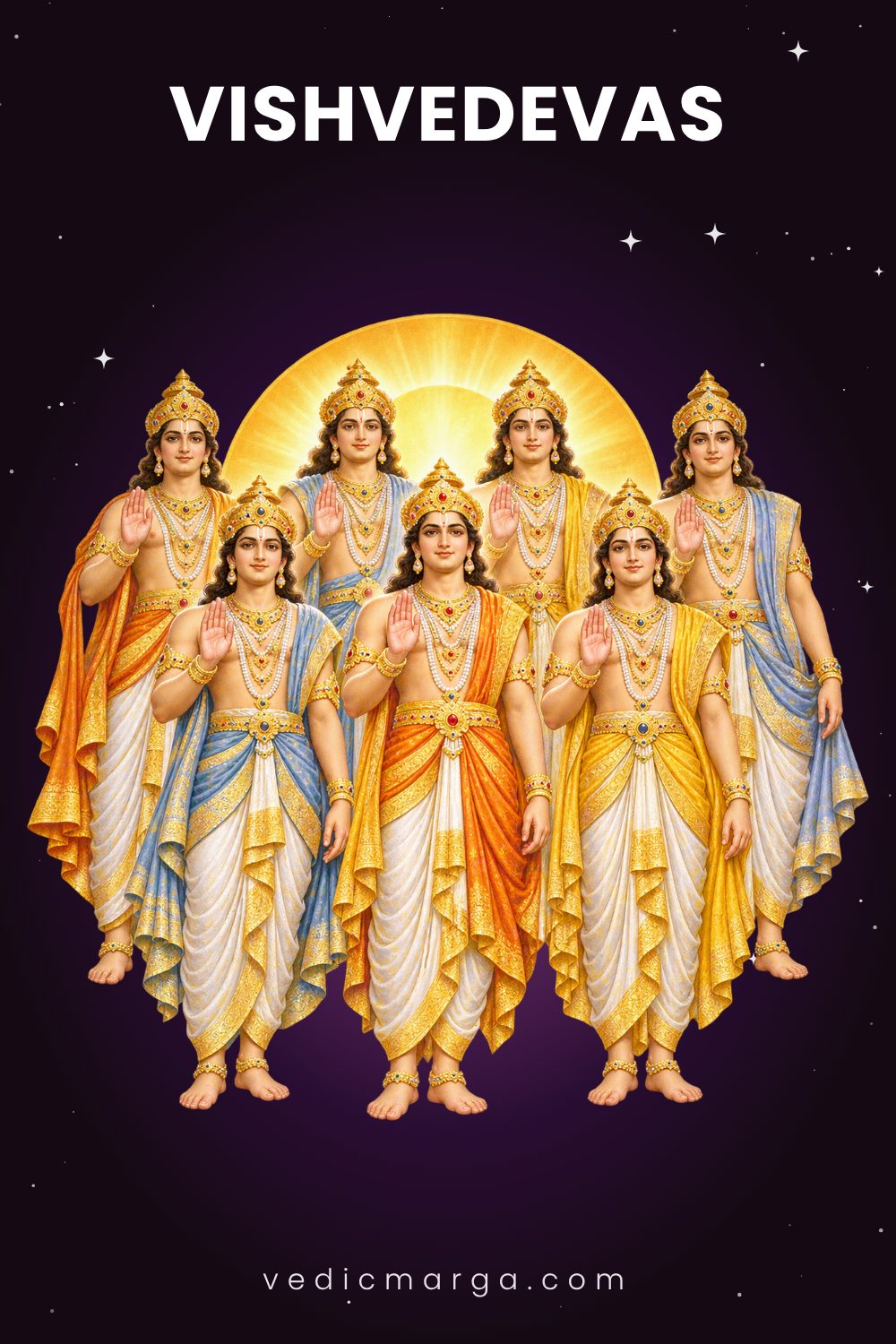
| Vishvedevas | Key facts |
|---|---|
| Meaning of the name | All the gods |
| Other spelling | Vishvadevas |
| Nakshatra | Uttara Ashadha (26°40' Sagittarius to 10° Capricorn) |
| Nakshatra ruler | Sun |
| Form | A group of gods called on together |
| Rig Veda example | Hymn 1.89, by the sage Gotama Rahugana |
| Puranic parents | Dharma and Vishva, a daughter of Daksha |
| Ritual role | Honoured with the Pitris in shraddha |
In this article
What Does Vishvedevas Mean?
The name joins vishva, "all," with deva, "god." Rig Veda 1.89.10 uses the same words, vishve devah, when it says that Aditi is all the gods and the 5 peoples.
In the Veda the Vishvedevas are the gods named together in one prayer. Rig Veda 1.89.3 calls on Bhaga, Mitra, Aditi, Daksha, Aryaman, Varuna, Soma and the Ashvins in a single verse.
The Vishvedevas in the Rig Veda
Rig Veda 1.89 is one of the hymns addressed to the Vishvedevas, and its seer is Gotama Rahugana. It opens with a prayer for good powers from every side:
आ नो भद्राः क्रतवो यन्तु विश्वतोऽदब्धासो अपरीतास उद्भिदः ।
May auspicious powers come to us from every side, never deceived, unhindered and victorious. (Rig Veda 1.89.1, first half)
The rest of the verse asks the gods to guard the singers day by day. Verse 3 names the gods who are called, and verse 10 ends the hymn with Aditi as all the gods.
Bhadram Karnebhih, the Peace Verse
Verse 8 of the same hymn is one of the best-known prayers of the Veda:
भद्रं कर्णेभिः शृणुयाम देवा भद्रं पश्येमाक्षभिर्यजत्राः ।
O gods, may we hear what is good with our ears. O holy ones, may we see what is good with our eyes. (Rig Veda 1.89.8, first half)
The second half asks for firm limbs and sound bodies. With them the singers hope to praise the gods for the full span of life the gods have set. This verse opens the Mundaka Upanishad as its peace invocation.
Who Are the Vishvedevas in the Puranas?
The Puranas give the Vishvedevas a family. The Bhagavata Purana (6.6.4) lists Vishva among the 10 daughters of Daksha who married Dharma. Verse 6.6.7 says that the sons of Vishva were the Vishvedevas, and that they had no children.
The Vishnu Purana (1.15) also says that the sons of Vishva were the Vishvadevas. In his notes to this verse, the translator H. H. Wilson adds that the Vayu Purana counts 10 Vishvedevas and the Matsya Purana counts 12.
The Brahmanda Purana (3.3.30-31) speaks of 10 Vishvedevas born of Vishva. Among the names it gives are Kratu, Daksha, Satya, Kala, Kama, Pururavas and Rochamana. The lists in different texts do not match exactly, which is common in Puranic genealogy.
Why Are the Vishvedevas Honoured in Shraddha?
The Vishvedevas have a fixed place in shraddha, the rite for the ancestors. In the Mahabharata (Anushasana Parva, section 91 in the Ganguli translation), King Nimi is the first to conceive the rite. The sage Atri tells him that Brahma himself had laid it down long before.
The same section calls the Vishvedevas "always the companions of the Pitris" and says that Brahma gave them a portion of the offerings. It then lists many of their names, among them Vala, Dhriti, Punyakrit, Pavana and Vivasvat.
In many shraddha rites, the Vishvedevas are invited and honoured first, before the ancestors. For ancestor-related doshas in a birth chart, see our article on Pitra Dosha.
The Daily Vaishvadeva Offering
Many households also make the vaishvadeva offering each day. A small part of the cooked food is set aside in the name of all the gods before the family eats. Some families give that portion to birds, cows or other animals.
The Vishvedevas and Uttara Ashadha Nakshatra
Uttara Ashadha follows Purva Ashadha, whose deity is Apah, the waters. Its symbols are the elephant tusk and the planks of a bed. Our Uttara Ashadha page gives its shakti as Apradhrishya shakti, the power to give a victory that cannot be challenged.
The Sun, the nakshatra ruler, adds authority and a sense of duty. Each year the Sun enters sidereal Capricorn while it passes through this nakshatra, on Makar Sankranti. You can find your own birth nakshatra with the nakshatra calculator.
People with the Moon in Uttara Ashadha are often principled, patient and trusted by others. Many look for what is fair to everyone in a group. Success often comes later in life and lasts.
Vishvedevas Mantra
The Vedic verse for Uttara Ashadha in the Nakshatra Suktam of the Taittiriya Brahmana (3.1) is addressed to all the gods:
तन्नो विश्वे उप शृण्वन्तु देवाः ।
तदषाढा अभिसंयन्तु यज्ञम् ।
तन्नक्षत्रं प्रथतां पशुभ्यः ।
कृषिर्वृष्टिर्यजमानाय कल्पताम् ।
शुभ्राः कन्या युवतयः सुपेशसः ।
कर्मकृतः सुकृतो वीर्यावतीः ।
विश्वान् देवान् हविषा वर्धयन्तीः ।
अषाढाः काममुपायन्तु यज्ञम् ॥Tanno Vishve upa shrinvantu devah |
tadashadha abhisamyantu yagyam |
tannakshatram prathatam pashubhyah |
krishirvrishtiryajamanaya kalpatam |
shubhrah kanya yuvatayah supeshasah |
karmakritah sukrito viryavatih |
vishvan devan havisha vardhayantih |
Ashadhah kamamupayantu yagyam ||
Meaning: May all the gods listen to this from us. May the Ashadha stars come together to the sacrifice. May that nakshatra spread wide for our animals. May farming and rain go well for the one who offers.
They are bright maidens, young and lovely, who do their work well and are full of strength. Making all the gods grow with the offering, may the Ashadhas come to the sacrifice as we wish.
The verses for all 27 nakshatras are on our page of nakshatra mantras. Learn the accents from a teacher or a recording before you recite a Vedic verse.
Name Mantra
We could not find a fixed name mantra for the Vishvedevas in a classical text. A plain salutation is:
ॐ विश्वेभ्यो देवेभ्यो नमः
Om Vishvebhyo Devebhyo Namah
It means "Om, salutation to all the gods." Vishvebhyo devebhyah is the Sanskrit form for "to all the gods."
How to Worship the Vishvedevas
Recite the Nakshatra Suktam verse or the name salutation on the days the Moon passes through Uttara Ashadha. This happens about once every 27 days. Rig Veda 1.89.8 also suits this worship, since it comes from a hymn to the Vishvedevas.
The daily vaishvadeva offering is the simplest home practice. Set aside a little cooked food before each meal and give it to birds or animals.
All of this works on the mind. Remembering all the gods before a meal, and asking what is fair for everyone, keeps this deity in mind. For a reading of your own Moon nakshatra and running dasha, you can book a Vedic astrology consultation.
Frequently Asked Questions
Who is the deity of Uttara Ashadha Nakshatra?
The Vishvedevas, "all the gods," are the deities of Uttara Ashadha. Its Nakshatra Suktam verse asks all the gods to listen and to bless farming and rain.
What does Vishvedevas mean?
Vishvedevas means "all the gods." The Rig Veda uses the phrase vishve devah for the gods called on together in one prayer.
Who are the parents of the Vishvedevas?
The Bhagavata Purana (6.6.4-7) makes them the sons of Dharma and Vishva, a daughter of Daksha. The Vishnu Purana (1.15) also calls them the sons of Vishva.
Why are the Vishvedevas worshipped in shraddha?
The Mahabharata (Anushasana Parva 91) calls them the companions of the Pitris. It says that Brahma gave them a share of the shraddha offerings.
What is Bhadram Karnebhih?
It is Rig Veda 1.89.8, from a hymn to the Vishvedevas. It asks the gods that we may hear and see what is good, and it opens the Mundaka Upanishad.
Which planet rules Uttara Ashadha Nakshatra?
The Sun rules Uttara Ashadha. Its first pada lies in Sagittarius and the other 3 in Capricorn, so Jupiter and Saturn also shape it through the signs.
Summary
The Vishvedevas are "all the gods" and the deities of Uttara Ashadha Nakshatra. Rig Veda 1.89 is addressed to them, and its 8th verse, Bhadram Karnebhih, opens the Mundaka Upanishad. The Puranas call them the sons of Dharma and Vishva.
The Mahabharata names them the companions of the Pitris, and families honour them in shraddha. To work with Uttara Ashadha, recite its Nakshatra Suktam verse on the star day. Set aside a little food for all the gods before each meal.


