


Agni, the god of fire, is the deity of Krittika Nakshatra, which spans 26°40' Aries to 10° Taurus under the Sun. He is the fire on the altar and the priest of the gods. The Rig Veda opens with his name. The Shatapatha Brahmana calls Krittika "Agni's asterism."
Krittika is the cluster of stars known as the Pleiades. Its Vedic verse asks Agni and the Krittikas to protect us, and calls the stars a source of strength.
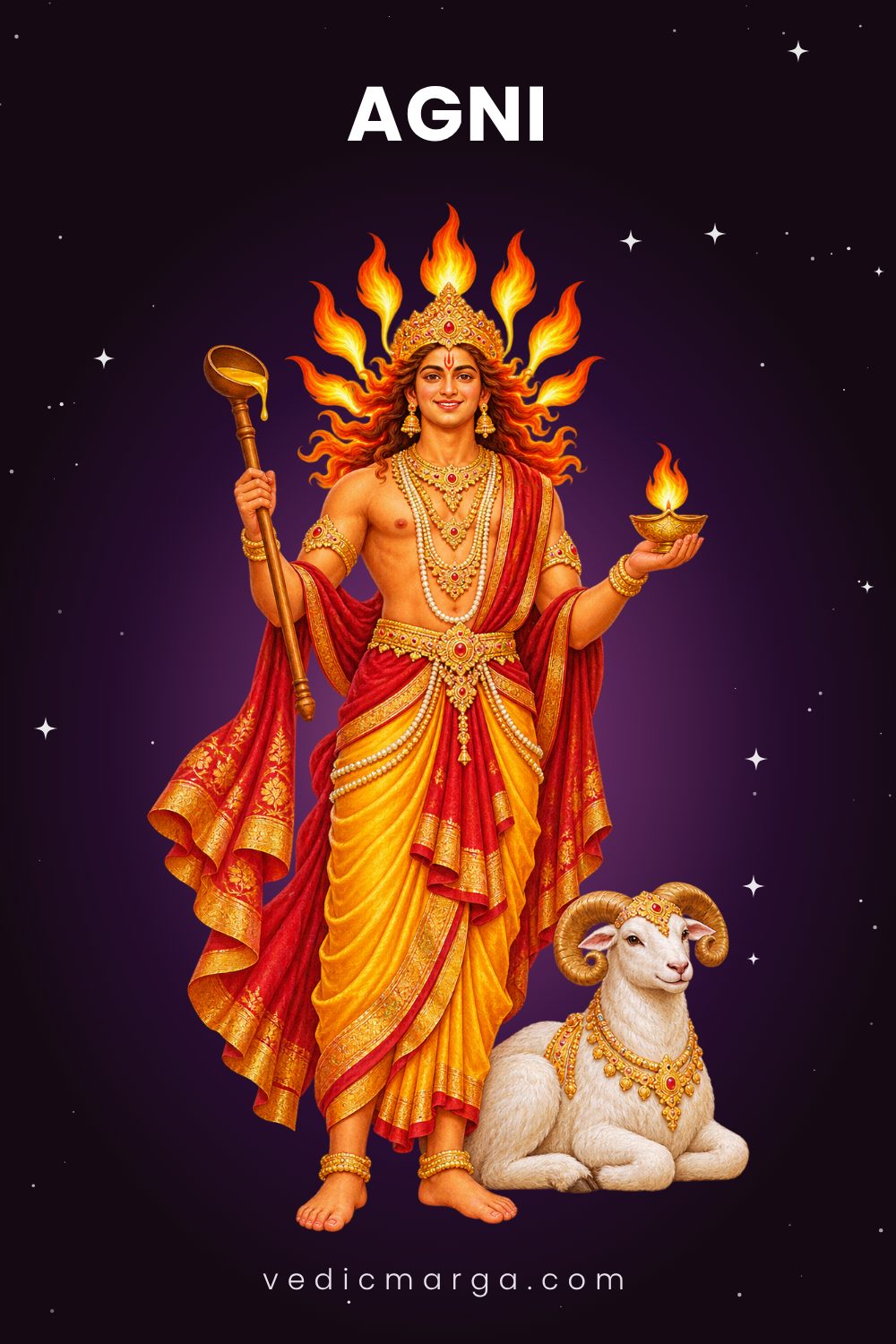
| Agni | Key facts |
|---|---|
| Meaning of the name | Fire |
| Nakshatra | Krittika (26°40' Aries to 10° Taurus) |
| Nakshatra ruler | Sun |
| Role | Priest of the gods, carrier of offerings |
| First hymn | Rig Veda 1.1, the opening hymn of the Rig Veda |
| The 7 tongues | Named in the Mundaka Upanishad (1.2.4) |
| Son in the Mahabharata | Skanda (Kartikeya) |
| Gita verse | "Of the Vasus I am Pavaka, fire" (10.23) |
In this article
Who Is Agni?
Agni means fire. In the Veda he is the fire lit on the altar at every sacrifice. The offerings go into him, and he takes them to the other gods. That makes him the link between people and the gods.
Agni is also the leader of the Vasus. In the Bhagavad Gita (10.23), Krishna says, "Of the Vasus I am Pavaka," using a name of Agni that means "the purifier."
Agni in the Rig Veda
The Rig Veda begins with the word agnim, and its first hymn is addressed to Agni:
अग्निमीळे पुरोहितं यज्ञस्य देवमृत्विजम् ।
होतारं रत्नधातमम् ॥I praise Agni, the priest set in front, the god of the sacrifice, the officiant, the caller of the gods, the best giver of treasure. (Rig Veda 1.1.1)
Verse 2 says that Agni is praised by the ancient seers and the new ones alike, and that he brings the gods to the rite. The hymn ends in verse 9 with a request: be easy to reach, like a father to his son.
Agni also works with Indra. The 2 gods are praised together as a pair in several hymns, and together they rule Vishakha as Indragni.
The 7 Tongues of Agni
The Mundaka Upanishad (1.2.4) names the 7 tongues of the fire, the flames that take the offerings. They are Kali, the black one, and Karali, the terrible one. Next come Manojava, swift as thought, Sulohita, deep red, and Sudhumravarna, smoke-coloured.
The last 2 are Sphulingini, the sparkling one, and Vishvaruchi, the one who shines in every form. The verse says these flames, flickering, are called the 7 tongues of fire.
Why Is Krittika Agni's Nakshatra?
The Shatapatha Brahmana (2.1.2) discusses which nakshatras suit the setting up of the sacred fires. It says a person may set up his fires under the Krittikas, since they are "Agni's asterism" (2.1.2.1).
It adds 2 more reasons. The Krittikas have the most stars, while other nakshatras have 1 to 4 (2.1.2.2). They also stay in the east, while the other nakshatras move away from it (2.1.2.3).
The text then raises an objection. The Krittikas were once the wives of the Bears, the 7 Rishis, who rise in the north (2.1.2.4). It answers that Agni is their mate, so the fires may still be set up under them (2.1.2.5).
Agni, the Krittikas and the Birth of Skanda
The Mahabharata tells of Skanda's birth in the Vana Parva (section 225 in the Ganguli translation). People of the forest said the child was born of Agni and the wives of the 7 Rishis. The goddess Svaha then told the Rishis that the child was hers.
The Rishis left their wives anyway, all except Arundhati, the wife of Vasishtha. The mothers took up the child and nursed him, and Agni cared for him.
Section 229 explains how Krittika got its place in the sky. When a star place fell vacant, Indra advised that Krittika should fill it. The text says that this nakshatra, "presided over by Agni, shines as if with seven heads."
Agni and the Blade of Grass
The Kena Upanishad (3.1-6) tells how the gods grew proud after a victory. Brahman appeared to them as a mysterious being, a Yaksha. The gods sent Agni first to find out who it was.
Agni boasted that he could burn anything on earth. The Yaksha placed a blade of grass before him, and Agni could not burn it. He went back to the gods without an answer. The story ends with Indra learning that the Yaksha was Brahman.
Agni and Krittika Nakshatra
Our Krittika page gives its symbols as a blade, a flame and a cutting tool. The name comes from the root krit, "to cut." The nakshatra spans 2 signs, with its 1st pada in Aries and the other 3 in Taurus.
The Sun, the nakshatra ruler, is exalted in the Aries pada. The Moon has its deepest exaltation at 3° Taurus, which also falls in Krittika.
People with the Moon in Krittika are often precise, direct and disciplined. Many speak bluntly and protect the people they love. You can find your own birth nakshatra with the nakshatra calculator.
Agni Mantra
The Vedic verse for Krittika in the Nakshatra Suktam of the Taittiriya Brahmana (3.1) is addressed to Agni:
अग्निर्नः पातु कृत्तिकाः ।
नक्षत्रं देवमिन्द्रियम् ।
इदमासां विचक्षणम् ।
हविरासं जुहोतन ।
यस्य भान्ति रश्मयो यस्य केतवः ।
यस्येमा विश्वा भुवनानि सर्वा ।
स कृत्तिकाभिरभिसंवसानः ।
अग्निर्नो देवः सुविते दधातु ॥Agnirnah patu Krittikah |
nakshatram devamindriyam |
idamasam vichakshanam |
havirasam juhotana |
yasya bhanti rashmayo yasya ketavah |
yasyema vishva bhuvanani sarva |
sa Krittikabhirabhisamvasanah |
Agnirno devah suvite dadhatu ||
Meaning: May Agni and the Krittikas protect us. This nakshatra is a god and a source of strength. This offering is for them, the far-seeing ones. Pour the oblation into their mouth, the fire.
His rays and banners shine, and all these worlds belong to him. He lives together with the Krittikas. May the god Agni place us in well-being.
The verses for all 27 nakshatras are on our page of nakshatra mantras. Learn the accents from a teacher or a recording before you recite a Vedic verse.
Name Mantra
We could not find a fixed name mantra for Agni in a classical text. A plain salutation to the god is:
ॐ अग्नये नमः
Om Agnaye Namah
It means "Om, salutation to Agni." Agnaye is the Sanskrit form for "to Agni."
How to Worship Agni
Recite the Nakshatra Suktam verse or the name salutation on the days the Moon passes through Krittika. This happens about once every 27 days. Rig Veda 1.1.1, the first verse of the Veda, can be recited with it.
Lighting a ghee lamp is the simplest offering to Agni at home. Families who keep the agnihotra make offerings into the sacred fire at sunrise and sunset.
All of this works on the mind. Keeping the home clean and the speech truthful suits a nakshatra of the purifying fire. For a reading of your own Moon nakshatra and running dasha, you can book a Vedic astrology consultation.
Frequently Asked Questions
Who is the deity of Krittika Nakshatra?
Agni, the god of fire, is the deity of Krittika. The Shatapatha Brahmana (2.1.2.1) calls Krittika "Agni's asterism."
Why does the Rig Veda begin with Agni?
The first hymn, Rig Veda 1.1, praises Agni as the priest of the sacrifice. He carries the offerings and brings the gods to the rite.
What are the 7 tongues of Agni?
The Mundaka Upanishad (1.2.4) names them Kali, Karali, Manojava, Sulohita, Sudhumravarna, Sphulingini and Vishvaruchi.
How is Agni linked to Kartikeya?
The Mahabharata (Vana Parva 225) tells of Skanda's birth from Agni, with Svaha claiming the child. Section 229 places Krittika in the sky under Agni.
Which planet rules Krittika Nakshatra?
The Sun rules Krittika. Its 1st pada lies in Aries and the other 3 in Taurus, so Mars and Venus also shape it through the signs.
Summary
Agni is the god of fire and the deity of Krittika Nakshatra. The Rig Veda opens with his praise as the priest of the sacrifice. The Shatapatha Brahmana calls Krittika his asterism, and the Mundaka Upanishad names his 7 tongues.
The Mahabharata ties him to the birth of Skanda and to Krittika's place in the sky. To work with Krittika, recite its verse on the Krittika day and light a ghee lamp.


