


Indra, the king of the gods, is the deity of Jyeshtha Nakshatra, which spans 16°40' to 30° Scorpio and is ruled by Mercury. In the Rig Veda he slays the serpent Vritra with his thunderbolt and sets the rivers free. The Nakshatra Suktam says he won that fight in Jyeshtha. The Upanishads also show him as a student of the Self.
Jyeshtha means "the eldest." Its symbols are an earring, an umbrella and a talisman, which point to rank and protection.
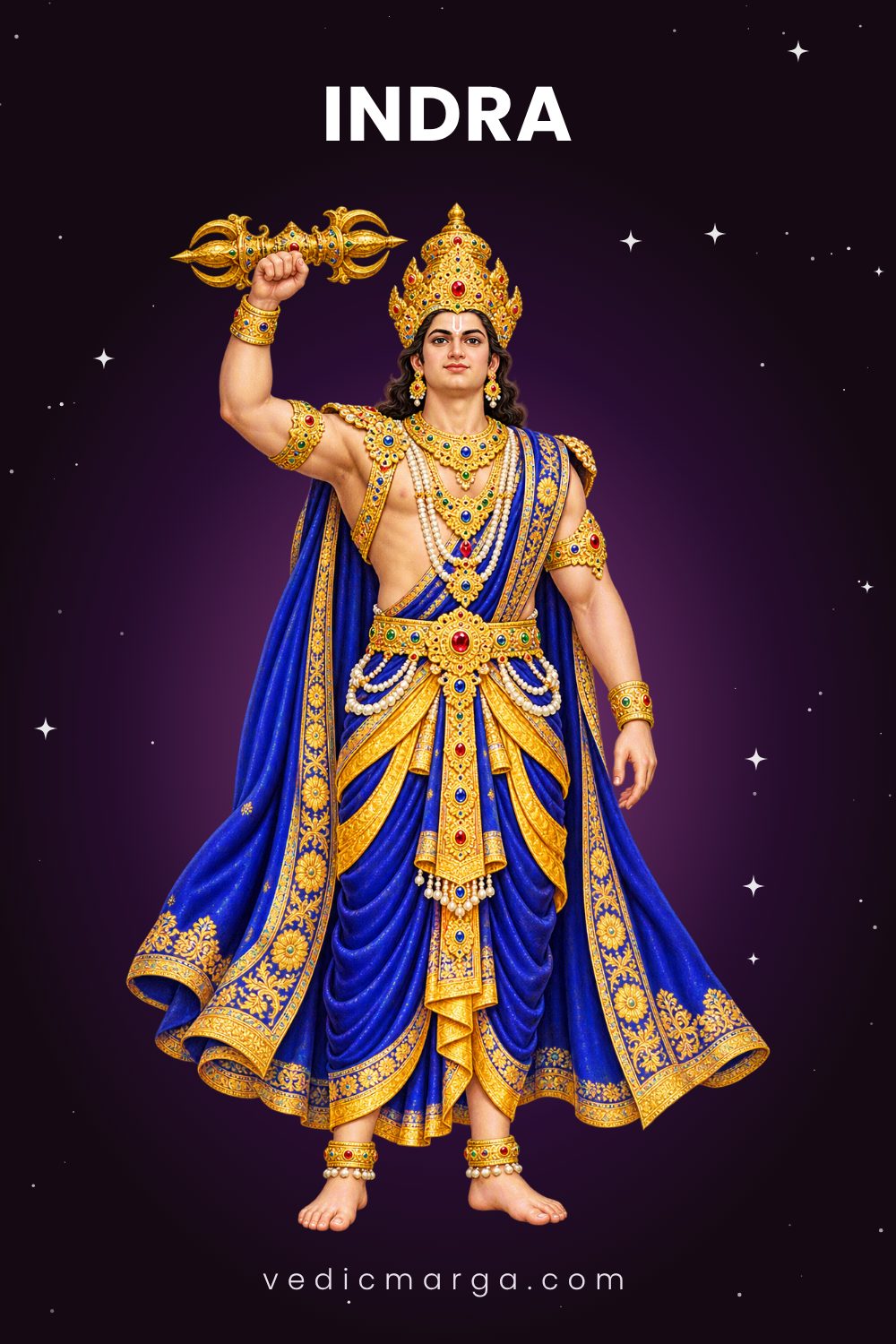
| Indra | Key facts |
|---|---|
| Role | King of the gods, lord of storms and rain |
| Other names | Shakra, Vasava, Purandara, Maghavan |
| Nakshatra | Jyeshtha (16°40' to 30° Scorpio) |
| Nakshatra ruler | Mercury |
| Weapon | Vajra, the thunderbolt, made by Tvashtar |
| Great deed | Slaying Vritra and freeing the waters |
| Shakti of the nakshatra | Arohana shakti, the power to rise |
| Gita verse | "Among the gods I am Vasava, Indra" (10.22) |
In this article
Who Is Indra?
Indra is the warrior king of the Vedic gods. He drinks the Soma, rides into battle and brings the rain. More hymns of the Rig Veda are addressed to him than to any other god.
He is also called Shakra, "the mighty," and Purandara, "the breaker of forts." In the Bhagavad Gita (10.22), Krishna says, "Among the gods I am Vasava," a name of Indra.
Indra and Vritra in the Rig Veda
Rig Veda 1.32 tells Indra's great victory. It opens like this:
इन्द्रस्य नु वीर्याणि प्र वोचं यानि चकार प्रथमानि वज्री ।
अहन्नहिमन्वपस्ततर्द प्र वक्षणा अभिनत्पर्वतानाम् ॥I will tell the heroic deeds of Indra, the first ones that the thunderbolt-bearer did. He slew the serpent and let the waters out. He split open the bellies of the mountains. (Rig Veda 1.32.1)
Verse 2 says that Tvashtar made the thunderbolt for him, and that the serpent lay on the mountain. In verse 12, Indra lets loose the 7 rivers to flow.
"He, O People, Is Indra"
Rig Veda 2.12 ends every verse with the same words: sa janasa indrah, "he, O people, is Indra." In verse 1, he surpasses the other gods as soon as he is born, and the 2 worlds tremble at his strength.
Verse 3 lists his deeds. He killed the serpent and freed the 7 rivers. He drove the cows out of Vala's cave and made fire between 2 stones.
Why Is Jyeshtha Indra's Nakshatra?
The Nakshatra Suktam gives the reason. Its verse says that Indra follows Jyeshtha, the nakshatra in which he overcame Vritra. It calls him Purandara, the bold bull, unconquered and victorious.
The same verse asks Jyeshtha to yield what is sweet for Indra and to make a wide world for the worshipper. Indra also shares the rule of Vishakha with Agni, as Indragni.
Indra and the Yaksha
The Kena Upanishad (chapters 3 and 4) shows Indra learning humility. The gods won a victory and grew proud of it. Brahman then appeared before them as a Yaksha, a mysterious being they did not know.
Agni could not burn a blade of grass in front of it, and Vayu could not blow it away. When Indra came near, the Yaksha vanished. In its place stood Uma Haimavati, the goddess, who told him that it was Brahman (4.1).
The Upanishad says that Agni, Vayu and Indra stand above the other gods, since they came near Brahman. Indra stands highest of all, as the first to know it as Brahman (4.3).
Indra's 101 Years with Prajapati
The Chandogya Upanishad (8.7-12) tells how Indra and Virochana, the king of the demons, went to Prajapati to learn about the Self. After 32 years of study, Prajapati showed them their reflections in water. Virochana left, content to think that the body is the Self.
Indra saw the flaw in that answer and came back. He studied for 32 more years, then another 32, and finally 5 more. In all he lived as a student for 101 years before Prajapati taught him the Self beyond the body (8.11.3).
Indra and Jyeshtha Nakshatra
Our Jyeshtha page calls Indra the king of the gods and gives the nakshatra the Arohana shakti, the power to rise. Its brightest star is Antares, the red heart of Scorpio.
Mercury, the nakshatra ruler, adds a sharp mind and skill with words. Scorpio is the Moon's sign of debilitation, so a Moon in Jyeshtha needs a check for Neecha Bhanga. The last pada touches the gandanta, where Scorpio meets Sagittarius.
People with the Moon in Jyeshtha are often dignified, loyal and protective. Many carry the role of the eldest in the family and rise to positions of authority. You can find your own birth nakshatra with the nakshatra calculator.
Indra Mantra
The Vedic verse for Jyeshtha in the Nakshatra Suktam of the Taittiriya Brahmana (3.1) is addressed to Indra:
इन्द्रो ज्येष्ठामनु नक्षत्रमेति ।
यस्मिन् वृत्रं वृत्रतूर्ये ततार ।
तस्मिन् वयममृतं दुहानाः ।
क्षुधं तरेम दुरितिं दुरिष्टिम् ।
पुरन्दराय वृषभाय धृष्णवे ।
अषाढाय सहमानाय मीढुषे ।
इन्द्राय ज्येष्ठा मधुमद्दुहाना ।
उरुं कृणोतु यजमानाय लोकम् ॥Indro Jyeshthamanu nakshatrameti |
yasmin Vritram Vritraturye tatara |
tasmin vayamamritam duhanah |
kshudham tarema duritim durishtim |
Purandaraya vrishabhaya dhrishnave |
ashadhaya sahamanaya midhushe |
Indraya Jyeshtha madhumadduhana |
urum krinotu yajamanaya lokam ||
Meaning: Indra follows the nakshatra Jyeshtha, in which he overcame Vritra in the battle with Vritra. In it may we, drawing out the deathless drink, cross over hunger, misfortune and failed rites.
Indra breaks forts; he is the bold bull, unconquered, victorious and generous. For him, may Jyeshtha yield what is sweet and make a wide world for the one who offers.
The verses for all 27 nakshatras are on our page of nakshatra mantras. Learn the accents from a teacher or a recording before you recite a Vedic verse.
Name Mantra
We could not find a fixed name mantra for Indra in a classical text. A plain salutation to the god is:
ॐ इन्द्राय नमः
Om Indraya Namah
It means "Om, salutation to Indra." Indraya is the Sanskrit form for "to Indra."
How to Worship Indra
Recite the Nakshatra Suktam verse or the name salutation on the days the Moon passes through Jyeshtha. This happens about once every 27 days. Rig Veda 1.32.1 can be recited with it.
Our Jyeshtha page suggests worship of Indra or Vishnu, and serving elders without seeking praise. Reading the story of the Yaksha in the Kena Upanishad also suits this deity.
All of this works on the mind. Using authority to protect others, and staying a student at any age, are the lessons of Indra's stories. For a reading of your own Moon nakshatra and running dasha, you can book a Vedic astrology consultation.
Frequently Asked Questions
Who is the deity of Jyeshtha Nakshatra?
Indra, the king of the gods, is the deity of Jyeshtha. Its Nakshatra Suktam verse says he overcame Vritra in this nakshatra.
Who made Indra's thunderbolt?
Rig Veda 1.32.2 says that Tvashtar, the craftsman of the gods, made the vajra for Indra.
Who was Vritra?
Vritra is the serpent who held back the waters. In Rig Veda 1.32, Indra slays him and sets the 7 rivers free.
What does Indra learn in the Kena Upanishad?
Uma Haimavati tells him that the Yaksha the gods could not recognise was Brahman. The text says he became the first of the gods to know it.
Which planet rules Jyeshtha Nakshatra?
Mercury rules Jyeshtha. The nakshatra lies fully in Scorpio, so Mars, the lord of Scorpio, also shapes it through the sign.
Summary
Indra is the king of the gods and the deity of Jyeshtha Nakshatra. Rig Veda 1.32 tells how he slew Vritra with the thunderbolt Tvashtar made and freed the 7 rivers. The Nakshatra Suktam says he won that battle in Jyeshtha.
In the Kena Upanishad he is the first god to know Brahman, and in the Chandogya he studies for 101 years. To work with Jyeshtha, recite its verse on the Jyeshtha day and use your position to protect others.


