


The Sarpas, the serpent gods, are the deities of Ashlesha Nakshatra, which spans 16°40' to 30° Cancer and is ruled by Mercury. Sarpa means "the one who creeps." The Yajur Veda honours the serpents of the earth, the mid-air and the sky. In the Mahabharata they are the 1,000 sons of Kadru and the sage Kashyapa.
Ashlesha means "the one who clings" or "the entwiner." Its symbol is a coiled serpent, and its Vedic verse offers a sweet oblation to the serpents.
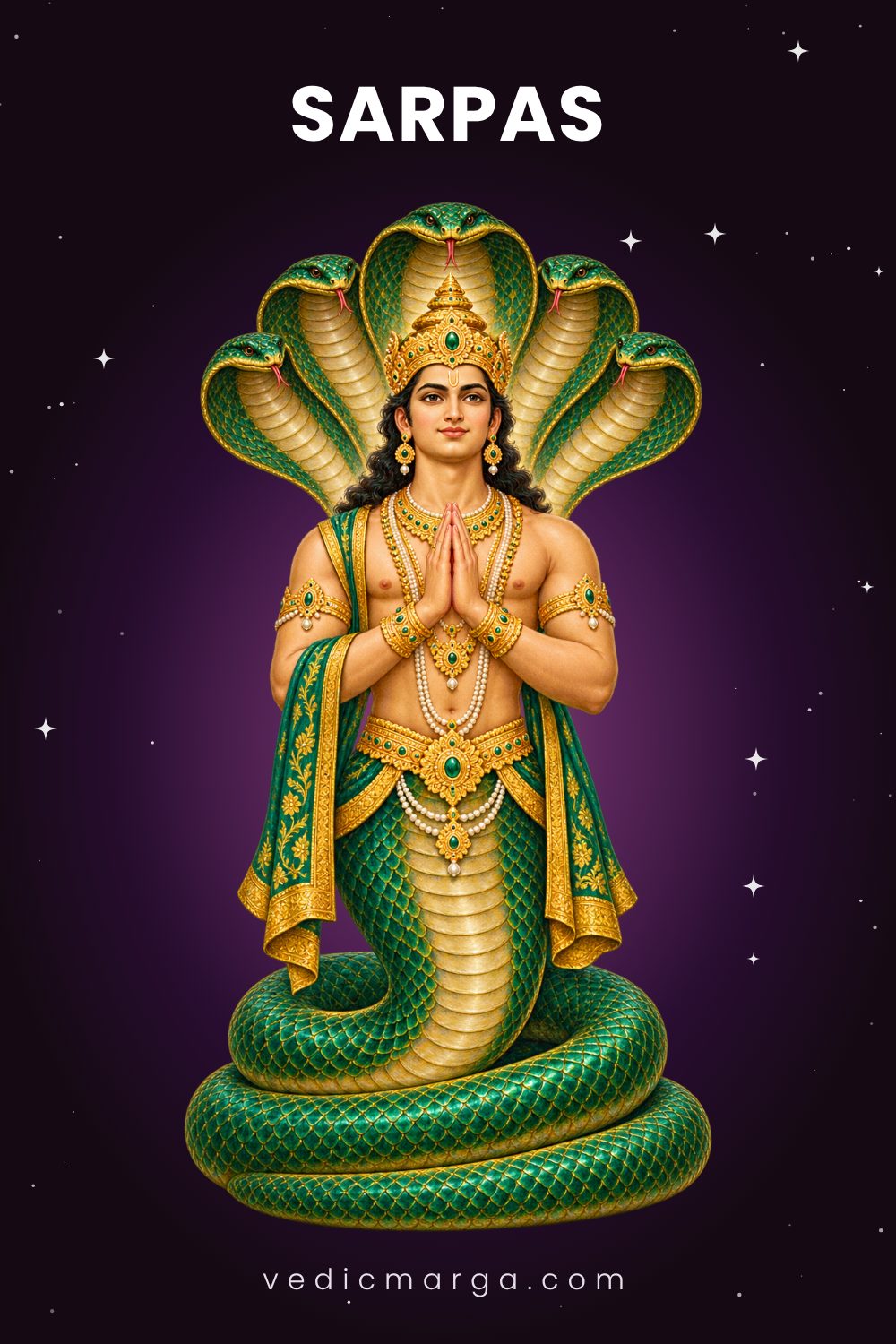
| Sarpas | Key facts |
|---|---|
| Meaning of the name | Serpents, the creeping ones |
| Other names | Nagas, Sarpa Devatas |
| Nakshatra | Ashlesha (16°40' to 30° Cancer) |
| Vedic name of the nakshatra | Ashresha |
| Nakshatra ruler | Mercury |
| Mother in the Mahabharata | Kadru, wife of Kashyapa |
| Great serpents | Shesha, Vasuki, Takshaka |
| Household rite | Sarpabali on the full moon of Shravana |
In this article
Who Are the Sarpas?
Sarpa is the common Sanskrit word for a snake, from a root meaning "to creep." Our Ashlesha page also calls these deities the Nagas and the Sarpa Devatas.
The deity of Ashlesha is the whole race of serpents, called on as one group. The Nakshatra Suktam verse speaks of them in the plural. It places them on the earth, in the mid-air and in the light of the sun.
The Serpents in the Veda
The Taittiriya Samhita (4.2.8) includes a homage to the serpents among the mantras for building the fire altar. It addresses the serpents in all 3 worlds:
नमो अस्तु सर्पेभ्यो ये के च पृथिवीमनु ।
ये अन्तरिक्षे ये दिवि तेभ्यः सर्पेभ्यो नमः ॥Homage to the serpents, whichever are on the earth. To the serpents in the mid-air and in the sky, to those serpents, homage. (Taittiriya Samhita 4.2.8)
The next lines honour the serpents whose seat is in the waters and those that live among the trees. The Ashlesha verse in the Nakshatra Suktam follows the same plan of earth, mid-air and sky.
Snake Knowledge as a Veda
During the horse sacrifice, a priest tells a cycle of stories that repeats every 10 days. On the 5th day he names King Arbuda Kadraveya, whose people are the snakes.
He then declares that the Sarpavidya, the knowledge of snakes, is the Veda for that day. He recites a section of it to the snakes and snake charmers who have gathered (Shatapatha Brahmana 13.4.3.9).
The Sarpabali Rite
Household ritual gives the serpents a yearly offering. The Ashvalayana Grihya Sutra (2.1.1) sets the Shravana rite on the full moon of Shravana.
The householder goes to the east of the house and pours water on a clean spot. He offers a bali with the words "To the divine hosts of the serpents, svaha!" (2.1.9). He repeats this offering every evening and morning until the Pratyavarohana rite (2.1.14).
Who Is the Mother of the Serpents?
The Mahabharata (Adi Parva, section 16 in the Ganguli translation) names Kadru as the mother of the serpents. Kadru and her sister Vinata were daughters of Prajapati and wives of Kashyapa.
Kashyapa offered each of them a boon. Kadru asked for 1,000 snakes of equal splendour as her sons. Vinata asked for 2 sons stronger than all of Kadru's, and Garuda was one of them. The Bhagavata Purana (6.6.21-22) also says that Kadru gave birth to the serpents.
Kadru's Curse
In section 20, Kadru and Vinata bet on the colour of the horse Uchchaihshravas. Vinata said it was all white, and Kadru said its tail was black. Kadru told her sons to cover the tail as black hairs, and they refused.
Kadru cursed them to burn in the snake sacrifice of King Janamejaya. Brahma heard the curse and approved it, since the serpents were venomous and harmful to other creatures.
Shesha, Vasuki and Takshaka
Shesha left his mother after the curse and practised hard penance (Adi Parva, section 36). Pleased, Brahma asked him to hold the unsteady earth. Shesha went below the earth and holds it up on his head, as Ananta.
Vasuki served the gods at the churning of the ocean. The Adi Parva (section 18) says the gods and the Asuras "made of Mandara a churning staff and Vasuki the cord."
Takshaka was saved at the end of Janamejaya's sacrifice. In section 58 of the Adi Parva, the young sage Astika calls out "Stay" 3 times. Takshaka stays hanging in mid-air above the fire. The king grants Astika a boon, and the sacrifice ends.
In return the serpents promise Astika that anyone who reads his story, morning or evening, will have no fear of them. The text adds that reciting this history removes all fear of snakes.
The Sarpas and Ashlesha Nakshatra
Ashlesha lies fully in Cancer, and its symbol is a coiled serpent. Mercury, the nakshatra ruler, adds a sharp mind and skill with words. Jupiter is exalted in Cancer and keeps that dignity through all of Ashlesha.
The 4th pada holds Mars's deepest debilitation at 28° Cancer. The end of this pada is a gandanta point, where the water sign Cancer meets the fire sign Leo. Ashlesha is also a Gand Mool nakshatra, for which tradition prescribes a shanti rite after birth.
People with the Moon in Ashlesha often have a sharp memory and a strategic mind. Many sense other people's motives and take an interest in psychology or healing. You can find your own birth nakshatra with the nakshatra calculator.
Ketu enters Cancer in Ashlesha on 5 December 2026 and stays in this nakshatra until 14 August 2027. Our article on the Ketu transit in Cancer 2026 gives the dates pada by pada.
Other Serpent Deities
The Veda has a second serpent deity among the nakshatras. Ahirbudhnya, the serpent of the deep, rules Uttara Bhadrapada.
In jyotish the serpent also names Kaal Sarp Dosh. In this chart pattern, the 7 planets lie on one side of Rahu and Ketu. The Kaal Sarp Dosh calculator checks a chart for it.
Sarpas Mantra
The Vedic verse for Ashlesha in the Nakshatra Suktam of the Taittiriya Brahmana (3.1) is addressed to the serpents:
इदग्ं सर्पेभ्यो हविरस्तु जुष्टम् ।
आश्रेषा येषामनुयन्ति चेतः ।
ये अन्तरिक्षं पृथिवीं क्षियन्ति ।
ते नः सर्पासो हवमागमिष्ठाः ।
ये रोचने सूर्यस्यापि सर्पाः ।
ये दिवं देवीमनु सञ्चरन्ति ।
येषामाश्रेषा अनुयन्ति कामम् ।
तेभ्यः सर्पेभ्यो मधुमज्जुहोमि ॥Idagum sarpebhyo havirastu jushtam |
Ashresha yeshamanuyanti chetah |
ye antariksham prithivim kshiyanti |
te nah sarpaso havamagamishthah |
ye rochane suryasyapi sarpah |
ye divam devimanu sancharanti |
yeshamashresha anuyanti kamam |
tebhyah sarpebhyo madhumajjuhomi ||
Meaning: May this offering please the serpents, whose will the Ashlesha stars follow. Some live in the sky and on the earth. May those serpents come quickly to our call.
Some serpents live in the light of the sun and move along the shining heaven. The Ashlesha stars follow their wish. To those serpents I offer this sweet oblation.
The verses for all 27 nakshatras are on our page of nakshatra mantras. Learn the accents from a teacher or a recording before you recite a Vedic verse.
Name Mantra
The Taittiriya Samhita homage ends with the words tebhyah sarpebhyo namah, "to those serpents, homage." A short salutation built on it is:
ॐ सर्पेभ्यो नमः
Om Sarpebhyo Namah
It means "Om, salutation to the serpents." Sarpebhyah is the Sanskrit plural form for "to the serpents."
How to Worship the Sarpas
Recite the Nakshatra Suktam verse or the name salutation on the days the Moon passes through Ashlesha. This happens about once every 27 days. The Taittiriya Samhita homage to the serpents can be recited with it.
Many families worship the serpents on Naga Panchami, the 5th tithi of the bright fortnight of Shravana. In 2027 it falls on 6 August, while Ketu is still in Ashlesha. Reading the story of Astika is a traditional way to remove the fear of snakes.
All of this works on the mind. Leaving snakes and their holes undisturbed is the simplest act of respect for this deity. For a reading of your own Moon nakshatra and running dasha, you can book a Vedic astrology consultation.
Frequently Asked Questions
Who is the deity of Ashlesha Nakshatra?
The Sarpas, the serpent gods, are the deities of Ashlesha. Its Nakshatra Suktam verse offers them a sweet oblation and asks them to come to the call.
Are the Sarpas and the Nagas the same?
In nakshatra lists, yes. Sarpa is the general word for a snake, and Naga is the name used for the serpent race in the epics and Puranas.
Who is the mother of the serpents?
Kadru, a wife of the sage Kashyapa, is the mother of the serpents. The Mahabharata (Adi Parva 16) says she asked for 1,000 snakes as her sons.
What is the mantra for the Sarpas?
The Vedic mantra is the Ashlesha verse of the Nakshatra Suktam, which begins "Idagum sarpebhyo havirastu jushtam." The short salutation is Om Sarpebhyo Namah.
Which planet rules Ashlesha Nakshatra?
Mercury rules Ashlesha. The nakshatra lies fully in Cancer, so the Moon, the lord of Cancer, also shapes it through the sign.
Summary
The Sarpas are the serpent gods and the deities of Ashlesha Nakshatra. In the Taittiriya Samhita they receive homage in earth, mid-air and sky. The Shatapatha Brahmana calls snake knowledge a Veda, and the Ashvalayana Grihya Sutra gives them an offering at the Shravana full moon.
The Mahabharata makes them the sons of Kadru and tells of Shesha, Vasuki and Takshaka. To work with Ashlesha, recite its verse on the Ashlesha day and leave snakes in peace.


